
Switching to solar energy is an excellent idea for reducing your bills and your ecological impact. But to truly benefit from your installation, you need to think about energy storage. This is where the solar panel battery comes in. Choosing the right capacity is a bit like choosing the right shoe size: not too small, not too big. We’ll guide you to find the one that suits you best.
Key Takeaways
- To choose the right solar panel battery, start by accurately assessing your daily electricity consumption in kWh and analysing your habits. This will help you determine the necessary capacity.
- Battery sizing is crucial. A capacity that’s too low will force you to buy electricity, while a capacity that’s too large represents an unnecessary extra cost. You need to find the right balance.
- Lithium batteries, and particularly LiFePO4, are the current benchmark for their lifespan, performance, and safety, surpassing older technologies like lead-acid.
- The lifespan of a solar battery is measured in charge/discharge cycles, not years. A well-sized and correctly used battery will last longer. Also, consider the warranty offered.
- It’s important to distinguish between a storage battery, which optimises self-consumption, and a backup battery, designed for power outages. Your choice will depend on the primary use you intend for it.
Understanding the Role of a Solar Panel Battery
Installing solar panels converts sunlight into electricity, but this production doesn’t always align with our needs. This is where a solar battery comes in, a key component for optimising your photovoltaic system.
Storing Solar Energy for Later Use
The solar energy captured by your panels is fluctuating. It depends on sunshine, which varies throughout the day and with the weather. A battery acts like a reservoir: it stores the surplus electricity produced when the sun shines brightly, and releases it when production is low, such as at night or during cloudy weather. This allows you to consume your own energy when you need it, rather than systematically feeding it back into the grid.
Reducing Dependence on the Electrical Grid
By storing solar energy, you decrease your reliance on electricity supplied by the public grid. This translates into greater energy independence for your home. You are less subject to electricity price fluctuations and potential outages. The goal is to maximise self-consumption, meaning the direct use of the electricity you produce. For a successful solar installation, it’s important to choose the right solar panels.
Optimising the Profitability of a Photovoltaic Installation
A well-sized battery significantly improves the return on investment of your solar installation. By using more of the energy you produce, you reduce your electricity bills. Furthermore, a suitable battery helps preserve its lifespan by avoiding overly extreme charge and discharge cycles, which is an important factor for long-term profitability.
Identifying Your Energy Needs to Choose the Right Capacity
Before you start choosing a battery for your solar installation, it is absolutely essential to clearly understand your energy needs. It’s a bit like wanting to buy a car: you wouldn’t buy an SUV if you only need a city car to get to work, would you? It’s the same for your solar system. A poorly sized battery means either money down the drain or intermittent power cuts. It’s best to avoid both.
Assessing Daily Consumption in kWh
The first, and arguably most important, step is to determine your average daily electricity consumption. Forget national averages; they won’t help you much. What matters is your consumption. The easiest way to find this is to look at your annual electricity bills. Take the total kilowatt-hours (kWh) consumed over a year and divide it by 365. For example, if your household consumed 4,000 kWh over the year, that’s about 11 kWh per day.
It’s always wiser to plan for a small buffer. If you work from home, have electric heating, or charge an electric car at home, your consumption may be higher than average. It’s better to have a little surplus than to run out of energy.
Analysing Household Consumption Habits
Once you have an idea of your daily consumption, you need to look at how that energy is used. Is everyone home all day? Is consumption concentrated in the evening? Do you have very energy-hungry appliances that run for hours? Understanding these habits will help you better anticipate when you’ll need the energy stored in your battery. For example, if you consume a lot in the evening, a battery capable of supplying this energy will be more relevant. The goal is to increase your self-consumption rate, i.e., the proportion of solar energy you consume directly. For a 3000 W installation, a 5 kWh battery is a good starting point for storing the energy produced.
Considering Household Composition and Appliances to Power
The size of your household and the appliances you use play a major role. A large family with several electronic devices, a refrigerator, a freezer, a washing machine, and perhaps even a heat pump will have very different needs from a single person in a small flat. Think about all the appliances that will potentially be powered by the battery, especially in the event of a grid outage. You also need to consider the type of appliances: some have power surges when starting up (like a refrigerator or a motor). Therefore, the battery must be able to supply the necessary power at these times. In summary, to choose the capacity of your battery, you need to:
- Calculate your average daily consumption in kWh.
- Analyse your consumption peaks and habits.
- List all the appliances you wish to power.
- Define the desired level of autonomy (how long the battery should last without sun).
By taking these elements into account, you will be able to determine the battery capacity that best suits your situation and your solar installation.
Sizing the Capacity of a Solar Panel Battery
Choosing the right capacity for your solar battery is a key step to making your photovoltaic installation truly effective. It’s a bit like choosing the right size fuel tank for a car: too small, and you’ll run out of fuel; too big, and you’ll carry unnecessary weight. You need to find the right balance for your system to work optimally.
Method for Calculating Ideal Capacity
To determine the ideal capacity, you first need a precise idea of your daily energy consumption. This is usually measured in kilowatt-hours (kWh). Once you know your average consumption, you can start calculating. A simple formula is to multiply your daily consumption by the number of days of autonomy you want. For example, if you consume 10 kWh per day and want to be able to last 2 days without sun, you’ll need a gross capacity of at least 20 kWh. Don’t forget to take into account the depth of discharge (DoD) of the battery, which indicates how much energy you can actually use without damaging the battery. If your battery has a DoD of 90%, you’ll need to divide the calculated gross capacity by 0.9. So, for our example, 20 kWh / 0.9 = 22.2 kWh. It’s also important to look at the power of your solar panels to ensure they can recharge the battery quickly enough. Good capacity management is essential.
Practical Sizing Examples for Different Types of Households
For a small flat or studio with moderate consumption (say, 5 kWh per day), a 3 to 5 kWh battery might suffice, especially if aiming for one day of autonomy. For a medium-sized house with a consumption of 10 kWh per day, an 8 to 12 kWh battery would be more appropriate, covering nighttime needs and less sunny days. For large houses or households with high energy needs (electric heating, electric car, etc.), consuming 20 kWh or more per day, you’ll need to consider batteries of 15 kWh or more to ensure good autonomy over several days. You also need to consider the required output power to run multiple appliances simultaneously. For example, two 250 Ah batteries can offer a good total capacity, but you need to check the simultaneous power available.
Importance of Desired Autonomy
Autonomy is the number of days your battery can power your home without solar input. This is a determining factor in sizing. If you live in a sunny region and don’t have critical needs in case of an outage, one day of autonomy may be sufficient. On the other hand, if you want maximum independence from the grid or are in an area with more variable sunshine, aiming for 2 to 3 days of autonomy is safer. This implies a larger battery capacity, but ensures greater peace of mind. You need to find a balance between the cost of a larger battery and the level of energy security you desire.
The sizing of your solar battery should not be taken lightly. A battery that is too small will force you to draw from the electrical grid, negating some of the benefits of your installation. Conversely, a battery that is too large represents a higher initial investment and may remain underutilised, which is also not optimal. The goal is to have a capacity that precisely matches your consumption habits and your environment.
Choosing the Type of Solar Panel Battery Technology
When we talk about batteries for solar panels, it’s important to know that there are different technologies. These technologies have a direct impact on the performance, lifespan, and cost of your energy storage system. There was a time when lead-acid batteries dominated the market, but things have changed a lot.
Advantages of Lithium Batteries (LiFePO4)
Currently, lithium batteries, and particularly those based on Lithium Iron Phosphate (LiFePO4) chemistry, have become the benchmark. Their popularity is due to a combination of significant advantages over older technologies. They offer higher energy density, meaning they can store more energy for a given weight and volume. Furthermore, they support a greater number of charge and discharge cycles without significant capacity loss. This translates into a longer lifespan, a crucial point when considering long-term investment. They are also known for their increased safety and lower environmental impact.
Comparison with Older Technologies (Lead-Acid, AGM, GEL)
Lead-acid batteries, although pioneers, have several drawbacks. They are heavier, less efficient, and have a much shorter lifespan, often limited to a few hundred cycles. AGM (Absorbent Glass Mat) and GEL technologies are improvements on lead-acid batteries, offering better electrolyte management and greater resistance to vibrations. They support slightly more cycles than pure lead-acid, but remain far behind the performance of lithium batteries.
Here is a simplified comparison table:
| Technology | Lifespan (cycles) | Energy Density | Initial Cost | Maintenance |
|---|---|---|---|---|
| Lead-acid | 300-500 | Low | Low | High |
| AGM | 600-900 | Medium | Medium | Low |
| GEL | 800-1200 | Medium | Medium | Low |
| Lithium (LiFePO4) | 3000-6000+ | High | High | Very low |
It is important to note that the higher initial cost of lithium batteries is often offset over their lifespan by their longevity and lower maintenance needs. Thinking about amortisation over 10 or 15 years is a good approach to evaluating the true cost. Installing an energy storage system can be complex, so it is advisable to thoroughly research the components and steps involved.
Impact of Technology on Lifespan and Efficiency
The chosen technology directly influences the longevity of your system. A LiFePO4 lithium battery can last 10 to 20 years, or even more, depending on its use and depth of discharge. In comparison, a lead-acid battery might need replacement every 3 to 5 years. Efficiency is also a key factor. Lithium batteries generally show higher charge and discharge efficiency, meaning less energy is lost during storage and retrieval cycles. This contributes to better overall efficiency of your photovoltaic installation and to optimising the profitability of your solar project.
Analysing the Technical Criteria of a Solar Battery
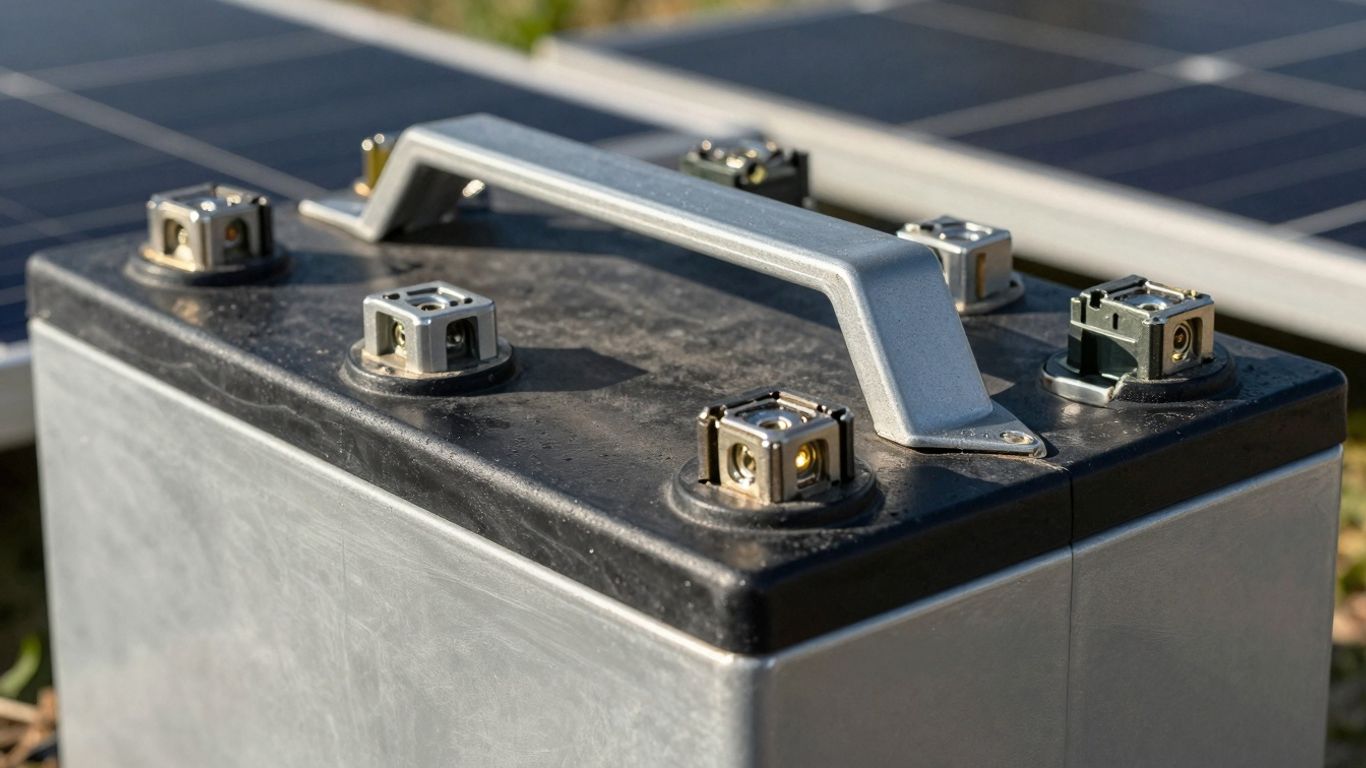
To choose the solar battery that best suits your installation, it’s important to look beyond its gross capacity. Several technical aspects play a decisive role in its performance and longevity. Ignoring these details could lead to a less efficient installation, or even one that is costly in the long run.
Understanding Battery Efficiency
The efficiency of a solar battery is a bit like the efficiency of an engine. It measures the amount of energy the battery manages to deliver compared to the amount it stored. In other words, it’s the ratio between incoming and outgoing energy. Even though technology has made enormous progress, a small amount of energy is always lost during storage and retrieval. High efficiency, close to 100%, means your battery wastes little energy. Modern batteries, especially lithium ones, generally show efficiencies above 90%. You also need to consider the daily energy loss, which is usually low, around 1% for storage.
Evaluating Charging Speed
Charging speed is the time it takes for your battery to be full and ready to supply electricity. This is an important figure, especially if you have significant electricity consumption or rely heavily on your solar production. A battery that charges quickly ensures you can replenish your energy reserves faster, even after intensive use. Some technologies, like X-Stream fast charging, can fully recharge a power station in just one hour, which is a significant advantage. Consider the power of your solar panels: the more they produce, the more beneficial fast charging will be to avoid creating a bottleneck.
Determining the Required Output Power
Output power, also known as instantaneous power, indicates the maximum amount of electricity your battery can supply at any given moment. It’s a bit like the flow rate of water from a tap: it needs to be sufficient for your needs. If you try to run too many energy-hungry appliances at the same time, and your battery’s output power is insufficient, you risk a circuit breaker tripping. To choose it correctly, you need to list the appliances you might want to use simultaneously and add up their electricity consumption. This will give you an idea of the output power you’ll need. For example, running a refrigerator, a computer, and a few lights at the same time requires less power than a swimming pool pump or an electric oven.
It is essential to understand that output power (in Watts) and storage capacity (in kWh or Ah) are two distinct but equally important criteria for the proper functioning of your solar system. A battery can have a large capacity but low output power, or vice versa.
Here is a simplified comparison table to illustrate:
| Technical Criterion | Description |
|---|---|
| Efficiency | Efficiency of energy storage and retrieval (in %). |
| Charging Speed | Time required to fully recharge the battery (in hours or minutes). |
| Output Power | Maximum amount of energy usable instantly (in Watts or kW). |
| Depth of Discharge | Maximum percentage of capacity that can be used before recharging (in %). |
| Number of Cycles | Estimated lifespan of the battery in full charge/discharge cycles. |
Choosing the right battery involves considering all these technical elements to ensure it integrates harmoniously into your photovoltaic project and meets your expectations in terms of performance and reliability. Good technical study helps avoid unpleasant surprises and maximise the return on investment of your [solar installation abb2].
Considering the Lifespan and Warranty of a Solar Battery
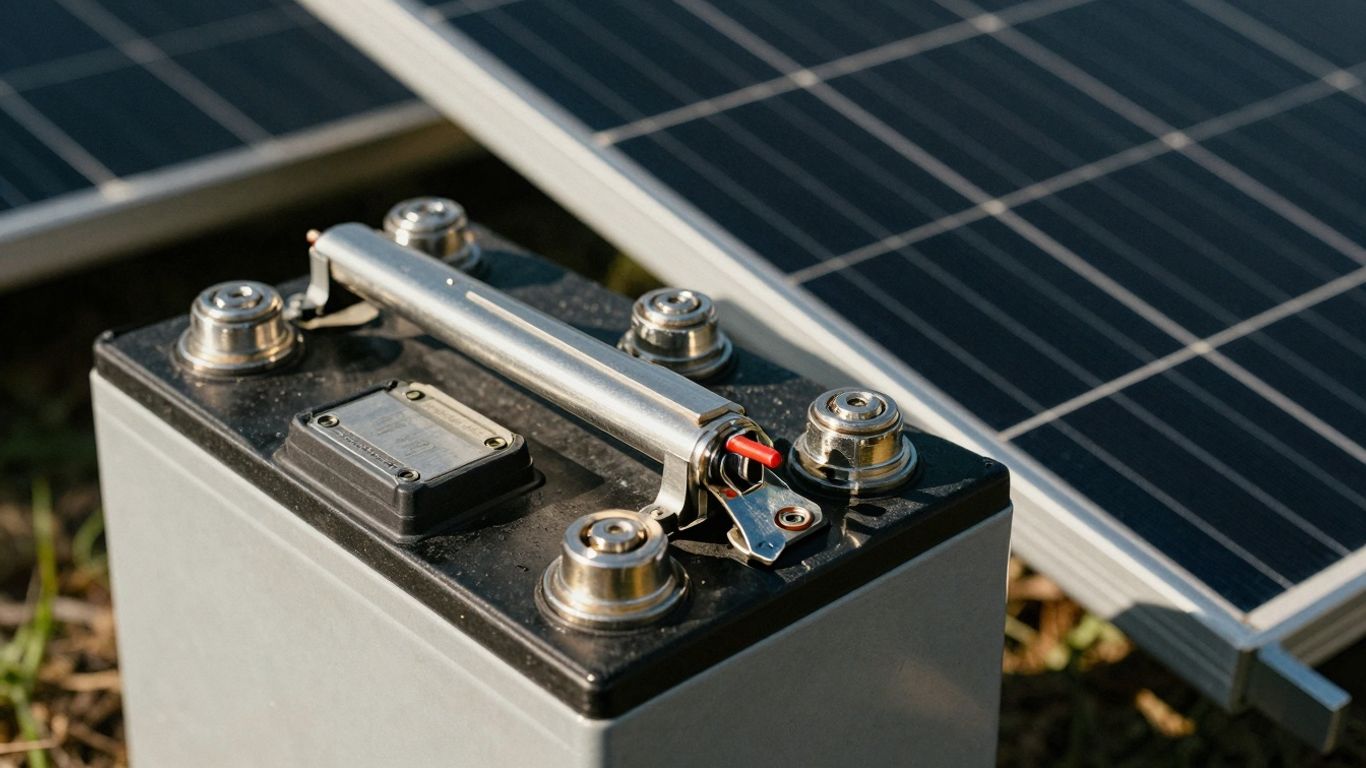
When investing in a battery for your solar installation, people often think about its immediate storage capacity. However, another equally important aspect is its longevity. After all, it’s not a purchase you make every year. So, you need to look closely at how long it’s supposed to last and what the manufacturer guarantees.
Calculating Lifespan in Charge/Discharge Cycles
The lifespan of a solar battery isn’t really measured in years, as one might initially think. It’s rather measured in charge and discharge cycles. Every time the battery charges (e.g., when your panels produce electricity) and discharges (when you consume that electricity), it counts as one cycle. Lithium batteries, especially those based on LiFePO4 technology, are known for offering a large number of cycles, often several thousand. Older technologies, like lead-acid, have a much shorter lifespan in terms of cycles.
Here’s an overview of average cycles for different battery types:
| Battery Type | Average Cycles |
|---|---|
| Lead-acid | 400 to 500 |
| AGM | 600 to 900 |
| GEL | 800 to 1,200 |
| Lithium Iron Phosphate (LiFePO4) | 3,000 to 6,000 |
It’s important to note that how you use your battery directly influences this number of cycles. Overly aggressive use, such as deep and frequent discharges, can reduce its effective lifespan.
Average Warranty for Solar Batteries
The warranty is a key indicator of a manufacturer’s confidence in its product. For solar batteries, the warranty is often expressed in years, but it can also be linked to a certain number of charge/discharge cycles. A standard warranty for a good quality lithium battery is usually around 10 years. Some brands may offer longer warranties, sometimes linked to a percentage of remaining capacity after a given period. It’s always wise to read the warranty conditions carefully, as they can vary considerably from one manufacturer to another. For example, some warranties may be degressive or exclude certain types of use. Solar panels, on the other hand, often benefit from a performance warranty of 20 to 25 years [0d71].
The warranty is a mark of quality, but it doesn’t replace proper use and maintenance of your battery. A well-maintained battery used within the manufacturer’s recommended limits will have a longer lifespan, even if it’s outside the warranty period.
Anticipating Battery Replacement
Even with a good warranty, it’s important to remember that a battery has a limited lifespan. Over time, its storage capacity gradually decreases. It’s a bit like your mobile phone battery: after a few years, it doesn’t hold a charge as well as it used to. So, it’s wise to anticipate its replacement. Generally, it’s recommended to start considering replacing a solar battery every 10 to 15 years, depending on its technology and usage. A personalised study of your installation can help determine the optimal time for this replacement, so you don’t find yourself without energy storage when you need it most. Thinking about this from the outset allows for better planning of future budgets related to your photovoltaic system.
Avoiding the Pitfalls of Oversizing and Undersizing
Choosing the right capacity for your solar battery is a bit like choosing the right shoe size: neither too small nor too big. A poorly sized battery can quickly turn a great idea of energy independence into a source of frustration and unnecessary expense.
Consequences of a Battery That’s Too Small
If you opt for a battery with insufficient capacity for your consumption, you risk finding yourself in a situation where your energy reserves are depleted too quickly. This means you’ll have to draw from the electrical grid more often than planned, thus negating some of the expected benefits of your solar installation. Essentially, you’re paying for a solution that doesn’t fully meet your needs. Furthermore, a battery constantly operating at its maximum can have its lifespan reduced, as it undergoes greater stress with each charge and discharge cycle. It is therefore crucial to accurately assess your actual consumption to avoid this scenario. A good analysis of your consumption habits, as described in assessing your energy needs, is the first step to avoiding this problem. Also, consider integrating the energy losses inherent in any system, which can make an apparently sufficient battery actually too small [4dbd].
Disadvantages of a Battery That’s Too Large
Conversely, an oversized battery also has its drawbacks. You invest in storage capacity that you don’t fully utilise. This represents a higher initial cost, without a proportional return on investment. A battery that never fully charges or is rarely deeply discharged may not reach its full profitability potential. Furthermore, some battery technologies may react poorly to chronic underutilisation. It is therefore important to find a balance. If you are hesitating between two sizes, it is often advisable to choose the larger one to have a safety margin, but this should remain a slight margin and not excessive oversizing. The goal is to optimise the use of the energy produced and stored.
Opting for a Slight Margin in Case of Hesitation
When faced with uncertainty, a small safety margin is preferable. If your calculations place you on the borderline between two battery capacities, opting for the higher capacity can be wise. This gives you increased flexibility to cope with unforeseen consumption variations or prolonged periods of low sunshine. A slightly oversized battery will be less stressed in terms of depth of discharge, which can help extend its lifespan. However, this margin should not be excessive, to avoid the disadvantages of oversizing. The idea is to have a resilient installation without unnecessarily burdening your budget. Good planning, including analysis of the depth of discharge (DoD) and the overall system efficiency, will help you make the most informed choice. The use of energy management systems can also help optimise the use of your battery [1001].
Understanding the Impact of Depth of Discharge
Definition of Depth of Discharge (DoD)
Depth of Discharge, often abbreviated as DoD, represents the amount of energy you can draw from a battery without damaging it. Imagine your battery as a water tank; the DoD tells you how far down you can empty this tank without risking breaking it. For example, a battery with a DoD of 80% means you can use 80% of its total capacity before needing to recharge it. It is essential to understand this concept well to optimise the lifespan of your storage system.
Influence of DoD on Usable Battery Capacity
DoD directly influences the usable capacity of your battery. A battery with a higher DoD allows you to utilise a larger portion of its stored energy. Let’s take a concrete example: if you have a 10 kWh battery and its DoD is 50%, you can only use 5 kWh. If the DoD increases to 90%, you can then use 9 kWh. This means that for the same energy requirement, a battery with a higher DoD will require a lower nominal capacity, which can translate into a lower purchase cost. It is therefore wise to choose a battery whose DoD matches your consumption habits and your desire for autonomy. For better longevity, it is often recommended not to exceed 80-90% discharge, even if the battery allows it, in order to preserve its life cycles. You can learn more about building a backup system with good depth of discharge management.
Choosing a Battery Suitable for the Desired Depth of Discharge
The choice of battery technology is closely linked to its maximum depth of discharge. Older technologies, such as lead-acid batteries, generally have a limited DoD of 50%. This means that to store a certain amount of usable energy, you will need to install a battery with twice the nominal capacity. Lithium batteries, particularly LiFePO4 models, offer much higher DoD, often between 80% and 100%. This makes them more efficient and longer-lasting, despite a potentially higher initial cost. Here is a simplified comparison table:
| Battery Type | Depth of Discharge (DoD) | Usable Capacity for 10 kWh Nominal |
|---|---|---|
| Lead-acid | 50 % | 5 kWh |
| Lithium (LiFePO4) | 80 % | 8 kWh |
| Lithium (LiFePO4) | 90 % | 9 kWh |
It is therefore important to consider the DoD when selecting your battery to ensure it meets your energy needs while guaranteeing good longevity. A well-chosen battery, which is not constantly pushed to its limits, will serve you longer and more reliably.
The Cost of a Solar Panel Battery
Addressing the cost of a solar panel battery means entering an area where figures can vary considerably. It’s difficult to give a single price, as many elements come into play. The price of a solar battery is directly linked to its storage capacity (in kWh), its technology, its lifespan, and the warranties offered by the manufacturer. For example, a lithium-ion battery, which is more efficient and durable, will be more expensive to purchase than an older lead-acid technology, but it will often prove more cost-effective in the long run. It should also be noted that the total cost of a photovoltaic installation with a battery can vary. In Canada, for example, a typical residential 10 kW installation can cost between $25,000 and $35,000 [ec64]. In Europe, a complete package, including panels and battery, can range from €4,309 to €7,135 [499c].
Factors Influencing Battery Price
Several factors determine the final price of a solar battery. Here are the main ones:
- Technology: LiFePO4 (lithium iron phosphate) batteries are generally more expensive to buy but offer better longevity and safety compared to lead-acid, AGM, or GEL batteries.
- Storage Capacity (kWh): The greater the capacity, the higher the price. Therefore, it’s important to size your needs correctly to avoid paying for unnecessary storage space.
- Depth of Discharge (DoD): A battery that can be discharged more deeply (higher DoD) offers greater usable capacity, which can influence its cost.
- Modularity: Some systems allow for the addition of modules to increase capacity, which can represent a lower initial investment but potentially be more costly in the long run if the system needs to be expanded.
- Brand and Warranty: Reputable brands offering longer warranties (often 10 years) may offer more expensive products.
Relationship Between Price, Quality, and Capacity
There is a fairly direct correlation between the price, quality, and capacity of a solar battery. A large-capacity battery, using cutting-edge technology and benefiting from a long warranty, will represent a more significant investment. However, it’s important not to focus solely on the purchase price. Instead, you should evaluate the total cost of ownership over the battery’s lifespan. A cheaper but lower-quality battery might require earlier replacement, negating initial savings. The goal is to find the right balance to optimise the profitability of your photovoltaic installation [5b10].
Market Trend Outlook
The solar battery market is constantly evolving. Technological innovations and increased production are leading to a gradual decrease in prices. It is possible that in the coming years, batteries will become even more accessible. Some initiatives, such as the reuse of old electric car batteries for solar energy storage, already show ways to reduce costs and environmental impact. It is therefore wise to stay informed about the latest advancements to make the best choice at the time of investment.
Differentiating Storage Battery and Backup Battery
Main Functionality of Each Battery Type
It is important to distinguish between two types of batteries in the context of solar installations: the storage battery and the backup battery. Although they both store energy, their roles and applications differ significantly. The storage battery, often called a domestic or residential battery, is designed to accumulate surplus electricity produced by your solar panels during the day. This stored energy is then used to power your home in the evening, at night, or during periods when solar production is insufficient. Its main objective is to increase your self-consumption and reduce your dependence on the public electricity grid. It allows for deferred use of solar energy, thus optimising the profitability of your photovoltaic installation. For a comprehensive evaluation of a photovoltaic project, it is advisable to consider all technical and financial aspects, including battery sizing [14fc].
In contrast, the backup battery, also known as a backup inverter or uninterruptible power supply (UPS) system, is primarily intended to provide immediate power in the event of a grid outage. Its primary function is to ensure continuity of service for critical appliances, such as security systems, medical equipment, or computers, to prevent data loss or operational interruptions. It is generally not sized to cover all the energy needs of a household over a long period, but rather to provide temporary autonomy until the grid is restored or a backup generator is activated. The objective is resilience against power failures.
Considerations of Price and Installation Complexity
The functional differences between these two types of batteries translate into significant implications in terms of cost and installation complexity. Solar storage batteries, while representing a substantial initial investment, are designed for frequent and deep charge and discharge cycles. Their technology, often based on lithium (such as LiFePO4), aims to maximise long-term lifespan and efficiency, which justifies their price. The installation of a storage battery is generally integrated into the existing photovoltaic system, requiring a connection to the inverter and the electrical panel to manage energy flows. Analysing household consumption habits is a key step in determining the appropriate capacity [a982].
Backup batteries, on the other hand, can vary considerably in price depending on their capacity and technology. The simplest models, designed to power a few devices for a few hours, can be relatively affordable. However, more robust backup systems, capable of handling a larger load for an extended period, can be expensive. The complexity of their installation depends on their type: a small portable UPS can be plug-and-play, while a more integrated backup system will require more advanced electrical installation, potentially by a professional. It is essential to accurately assess daily consumption in kWh to choose the correct battery capacity.
Adapting Your Choice to the Intended Use
The choice between a storage battery and a backup battery must be guided by the intended use. If your main goal is to maximise the use of your solar production, reduce your electricity bills, and move towards greater energy independence, a storage battery is the appropriate solution. It is part of a total self-consumption approach, where the aim is to consume the maximum amount of locally produced energy. The sizing of this battery will depend on your daily consumption, your habits, and the desired autonomy.
If, on the other hand, your primary concern is to protect yourself against the inconvenience of power outages and ensure the continuous operation of your essential equipment, a backup battery is more suitable. It acts as an electrical safety net. In some cases, it is possible to combine both functions by opting for a hybrid system, but this represents a more complex and costly solution. Understanding the depth of discharge (DoD) is also important, as it influences the usable capacity of the battery, whether it is for storage or backup [14fc].
Are you wondering about the difference between a battery that stores energy and one that takes over when needed? This is an important question to understand how energy works in your home. We’ll explain everything in a simple way so you can make the best choice. To learn more about the energy solutions available to you, visit our website!
In Summary: The Right Choice for Your Solar Battery
Choosing the right capacity for your solar battery is a bit like choosing the right shoe size: it needs to be just right. Too small, and you risk running out of energy when you need it most. Too large, and you’re paying for capacity you don’t really use. So, you need to carefully consider your consumption, the number of people in the household, and the appliances you use. Also, don’t forget the battery’s lifespan, as it’s a long-term investment. If you’re unsure, seeking advice from a professional is always a good idea. They can help you make the precise calculations to ensure your solar installation is truly effective and allows you to save money.
Frequently Asked Questions
What is the ideal size of a battery for my solar panels?
The battery size depends on how much electricity you consume each day. For a house with a 6 kWp solar installation, a battery of around 6.5 kWh is often recommended. However, it’s best to seek advice from a professional to accurately assess your specific needs.
Why is it important to choose the capacity of my battery carefully?
Choosing the right capacity is crucial. If it’s too small, you won’t have enough stored energy when you need it, especially at night. If it’s too large, you’ll have paid more for capacity you won’t fully use, which is a waste of money.
What type of battery is most recommended for solar panels?
Today, lithium batteries, and particularly lithium-iron-phosphate (LiFePO4) ones, are the most recommended. They are more durable, perform better, and are less polluting than older technologies like lead-acid.
What is depth of discharge (DoD) and why is it important?
Depth of discharge, or DoD, indicates what portion of the battery’s total capacity can be used without damaging it. A battery with a higher DoD can provide more usable energy, which is important for maximising your autonomy.
How long does a solar panel battery last?
The lifespan of a solar battery is mainly measured in charge and discharge cycles. On average, a good battery can last between 10 and 15 years, but this depends heavily on the technology and how it’s used. Lithium batteries generally have a longer lifespan.
What is the difference between a storage battery and a backup battery?
A storage battery is used to keep the energy produced by your solar panels to use it later, for example in the evening. A backup battery is designed to provide electricity in case of a power outage. They have different uses and sometimes different prices.
What is the efficiency of a solar battery?
Battery efficiency is the amount of energy it manages to deliver compared to the amount of energy it stored. A battery with high efficiency loses less energy during storage and retrieval, making it more efficient.
Can I use an electric car battery to store solar energy?
Some cities have experimented with using old electric car batteries for solar energy storage. While this can be an economical and ecological solution, it requires specific technical adaptations and is not always as efficient or simple as a battery designed for this purpose.
