Connecting a solar panel is an important topic for anyone wanting to produce their own electricity. It might seem complicated at first, but with the right information, it’s entirely achievable. This guide is here to help you understand the key steps, from planning to commissioning, including the different types of connection. The aim is to give you all the keys to successfully complete your solar panel connection project in 2025.
Key Points
- Before connecting a solar panel, you need to understand how it works and plan properly.
- Connecting a solar panel involves linking the panels together, then connecting them to a control box and the meter.
- There are several ways to connect the panels (series, parallel, mixed) and the choice depends on your installation.
- Safety is very important. You must follow the rules and be careful to avoid accidents when connecting the solar panel.
- For your installation to work well, you need to orient the panels correctly and maintain them regularly.
Understanding photovoltaic solar panels
Before embarking on the connection of solar panels, it is essential to understand how they work and the different elements that make up a photovoltaic system. It’s a bit like learning the basics of a language before you can write a novel. We will explore together the different types of panels, the role of the inverter and the importance of energy storage. Believe me, it’s worth dwelling on it a little.
The different types of solar panels
There are mainly three types of photovoltaic solar panels: monocrystalline, polycrystalline and thin film. Each has its advantages and disadvantages, and the choice will depend on your needs and your budget.
- Monocrystalline panels are made from a single silicon crystal. They are recognisable by their uniform black colour and offer a higher efficiency, which means they produce more electricity per unit area. However, they are more expensive.
- Polycrystalline panels are made up of several silicon crystals melted together. They have a bluish appearance and a slightly lower efficiency than monocrystalline panels, but they are also more affordable. It’s often a good compromise.
- Thin-film panels use a different technology, where a thin layer of semiconductor material is deposited on a support. They are more flexible and cheaper to produce, but their efficiency is generally lower. They are well suited for specific applications, such as photovoltaic installations on curved surfaces.
The role of the inverter in a photovoltaic system
The inverter is an essential element of a solar installation. It converts the direct current (DC) produced by the solar panels into alternating current (AC), which is the type of current used by most electrical appliances and fed into the public electricity grid. Without an inverter, you cannot use the electricity produced by your solar panels.
The inverter optimises energy production by tracking the maximum power point (MPPT) of the solar panels. It also ensures the safety of the system by monitoring the voltage and frequency of the current, and by shutting down in the event of a problem.
The importance of energy storage with batteries
Energy storage with batteries allows you to store the electricity produced by the solar panels for later use. This is particularly useful if you want to be energy independent or if you live in an area where the electricity grid is unstable. Batteries allow you to consume solar energy even when the sun is not shining, for example at night or on cloudy days. This can be a major asset for the future of photovoltaics.
Here are some advantages of energy storage:
- Increased energy autonomy
- Reduced dependence on the electricity grid
- Emergency power supply in the event of a power cut
- Optimisation of self-consumption
Considering energy storage is an important step to maximise the benefits of your solar installation, especially if you are aiming for an ecological agricultural operation.
The preliminary steps to connecting a photovoltaic solar panel
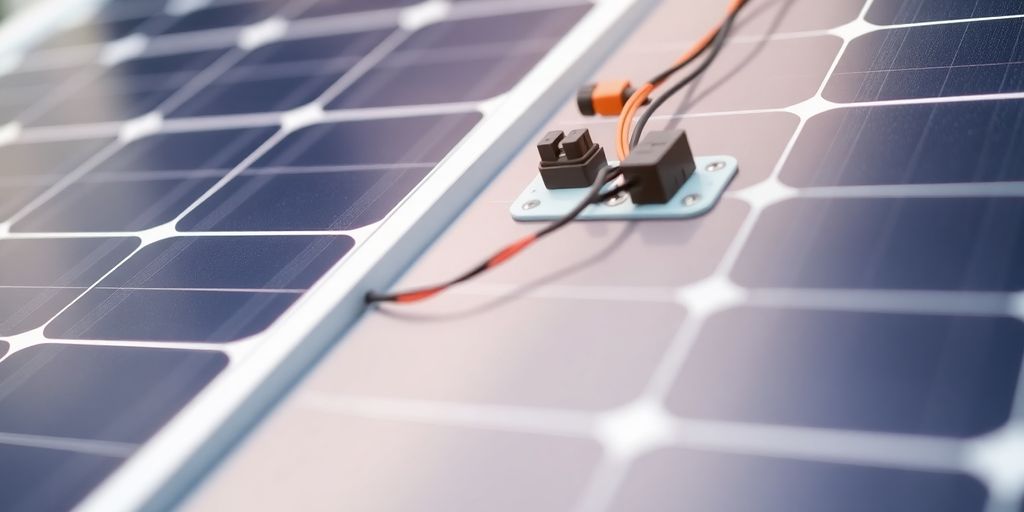
Before you start connecting your solar panels, some preparatory steps are essential. They ensure the safety of the installation, its efficiency and its compliance with current standards. These steps are a bit like the foundations of a house: if they are solid, the rest will follow without any problems.
Carrying out an accurate solar assessment
The first step is to carry out an accurate solar assessment. This assessment evaluates the solar potential of your site, taking into account the sunshine, orientation and inclination of your roof. A well-done solar assessment will help you determine the amount of energy you can expect to produce with your installation. You need to take into account potential shading (trees, neighbouring buildings) that could reduce production. To do this, you can use online tools or call in a professional. It’s a bit like doing a diagnosis before starting work. An accurate solar assessment is essential to correctly size your installation and optimise its performance. It will allow you to determine the profitability of your solar project.
Sizing your installation correctly
Once the solar assessment has been carried out, it is time to size your installation. This means determining the number of solar panels required, the power of the inverter and the capacity of the batteries (if you opt for energy storage). The sizing must be adapted to your energy needs and your budget. Correct sizing is essential to avoid wasting energy and optimise your investment. You need to assess your annual electricity consumption, taking into account your habits and your equipment. Don’t hesitate to ask a professional for advice to help you with this delicate step. Good sizing will allow you to maximise your self-consumption and reduce your electricity bill.
Checking compliance with current regulations
Before connecting your solar panels, it is imperative to check that your installation complies with current regulations. This includes electrical standards, planning rules and grid connection obligations. A non-compliant installation may result in financial penalties and safety problems.
Here are some points to check:
- The prior declaration of works to your local council.
- Compliance with electrical standards (NF C 15-100).
- Obtaining the Consuel (certificate of electrical conformity).
It is strongly recommended to use a QualiPV certified installer to ensure that your installation complies with the regulations. This professional will be able to assist you with the administrative procedures and guarantee an installation that complies with safety standards. It is important to choose the type of installation carefully, considering their placement on the roof.
How is a solar panel connected?
Connecting a solar panel is a crucial step in transforming sunlight into usable electricity. There are several steps to follow to ensure a correct and safe installation. It is important to understand these steps before starting the installation.
Choosing the right type of connection
The first step is to choose the type of connection that is best suited to your installation. There are mainly three types of connection: series, parallel and mixed. The choice will depend on the characteristics of your solar panels and your energy needs. Each type of connection has its advantages and disadvantages, and it is important to understand them before making a decision. For example, a series connection will increase the voltage, while a parallel connection will increase the current.
Connecting the panels together
Once the type of connection has been chosen, the solar panels must be connected together. This step involves connecting the positive and negative terminals of the panels according to the chosen configuration. It is essential to respect the polarity of the panels to avoid damaging the system. A bad connection can lead to a loss of power or even a short circuit. Make sure to tighten the connectors properly to ensure optimal electrical contact. For a photovoltaic installation in La Rochelle, it is important to consider the exposure to wind and humidity solar panel La Rochelle.
Connecting the system to the control box and the solar meter
The last step is to connect the entire photovoltaic system to the control box and the solar meter. The control box monitors energy production and protects the system from overvoltages. The solar meter records the amount of electricity produced by the solar panels. This step is essential to be able to use the electricity produced by your solar panels and possibly resell it to the electricity grid. It is strongly recommended to use a professional for this step, as it requires electrical skills and compliance with safety standards. Don’t forget to check the compliance of the installation with current standards.
The different types of connection for solar panels
It is essential to understand the different methods of connecting solar panels to optimise the energy production of your photovoltaic installation. The choice of the type of connection will depend on the characteristics of your panels, your inverter and your energy needs. There are mainly three types of connection: series, parallel and mixed. Each has advantages and disadvantages that should be carefully evaluated.
Series connection: advantages and disadvantages
Series connection consists of connecting the solar panels one after the other, connecting the positive terminal of one panel to the negative terminal of the next panel. This type of connection increases the total voltage of the system, while the current remains constant. Imagine a string of fairy lights: it’s the same principle.
- Advantages:
- Allows the input voltage required by the inverter to be reached more quickly, especially with low voltage panels.
- Reduces current losses in the cables, as the voltage is higher.
- Disadvantages:
- The performance of the entire string is affected if a single panel is shaded or defective. It’s a bit like a single blown bulb turning off the whole string.
- Requires an inverter compatible with the high voltage generated.
It is important to note that series connection is more sensitive to partial shading problems. If part of a panel is in the shade, this can significantly reduce the energy production of the entire string. This is why it is crucial to avoid shaded areas when designing your installation.
This type of connection is common in large-scale photovoltaic installations, such as ground-mounted solar power plants.
Parallel connection: optimising production
Parallel connection consists of connecting all the positive terminals of the panels together, and all the negative terminals together. This type of connection increases the total current of the system, while the voltage remains constant. It’s like having several taps feeding the same tank: the total flow increases, but the pressure remains the same.
- Advantages:
- Less sensitive to partial shading problems. If one panel is shaded, the others continue to produce energy normally.
- Allows the use of lower voltage inverters.
- Disadvantages:
- Requires larger cables to support the high current, which can increase the cost of the installation.
- Can lead to greater current losses in the cables if the voltage is too low.
Parallel connection is often used in small residential installations where shading is a potential problem. It is also used to optimise production in variable conditions.
Mixed connection: combining the benefits
Mixed connection combines series and parallel connections to optimise energy production according to the specific conditions of the installation. This is a more complex solution, but it can offer the best results in some cases.
- Advantages:
- Allows the voltage and current to be adapted to the requirements of the inverter.
- Offers better tolerance to partial shading compared to series connection.
- Allows energy production to be optimised according to sunlight conditions.
- Disadvantages:
- More complex to implement and wire.
- Requires careful planning to balance the series and parallel strings.
Mixed connection is often used in medium to large installations, where it is important to optimise energy production while minimising losses. It is crucial to understand the characteristics of each type of connection to choose the ideal configuration for your solar installation.
Step-by-step solar panel installation process
Once you have carefully planned your solar installation, the next step is to implement that plan. Whether you choose to do the installation yourself or hire professionals, it is crucial to follow a methodical approach to ensure a safe and efficient installation. Here are the key steps to follow for a successful installation.
Gather the necessary materials and tools
Before starting the installation, make sure you have all the necessary materials and tools. This includes solar panels, mounting brackets, the inverter, appropriate wiring, as well as essential tools such as a drill, level, wrench set, multimeter and appropriate safety equipment (insulating gloves, safety glasses, helmet). Check that all components are compatible and comply with current safety standards. Remember to carefully consult the manufacturer’s instructions for each component, as they may contain important specific information. It is also important to choose your solar kit carefully.
Install the mounting system on the roof
The mounting system is the basis of your solar installation. It is essential to install it correctly to ensure the stability and durability of your panels. Start by identifying the optimal location for the mounting brackets, taking into account the ideal orientation and inclination to maximise sun exposure. Securely attach the brackets to the roof structure, using appropriate fixings for the type of roof (tiles, slate, sheet metal, etc.). Make sure the brackets are perfectly aligned and level to avoid any later installation problems. Correct installation of the mounting system is essential for the safety and performance of your solar installation.
Securely attach the solar panels
Once the mounting system is in place, you can proceed to attach the solar panels. Gently lift each panel and position it on the mounting brackets. Secure the panels using the bolts and nuts provided, being careful not to overtighten to avoid damaging the panels. Check that each panel is securely attached and that there is no play. It is recommended to work with two people for this step, to facilitate the handling of the panels and ensure a safer installation. Adequate fixing is essential to withstand the weather and guarantee the longevity of your installation.
Wiring the solar panels to the inverter
Wiring the solar panels to the inverter is a crucial step that requires special attention. Use solar cables of the appropriate section and connect them to the terminals of the panels, respecting the polarity (positive and negative). Run the cables through the conduits or cable trays provided for this purpose, ensuring that they are well protected from the weather and UV rays. Then connect the cables to the inverter, scrupulously following the manufacturer’s instructions. Incorrect wiring can lead to energy losses, system malfunctions, or even fire hazards. If you are unsure of your electrical wiring skills, it is strongly recommended to use a qualified professional. It is important to understand the role of silicon in electricity production.
Installing solar panels is a project that requires rigour and precision. Each step is important and must be carried out with care to ensure the safety, performance and durability of your installation. Don’t hesitate to seek assistance from professionals if you have any doubts or lack experience.
Here is a list of steps to follow for wiring:
- Check the open circuit voltage (Voc) of each solar panel with a multimeter.
- Connect the solar panels in series or parallel, depending on the configuration of your system.
- Use MC4 connectors to ensure watertight and secure connections.
- Clearly label all cables for easy future maintenance.
Inverter and battery installation
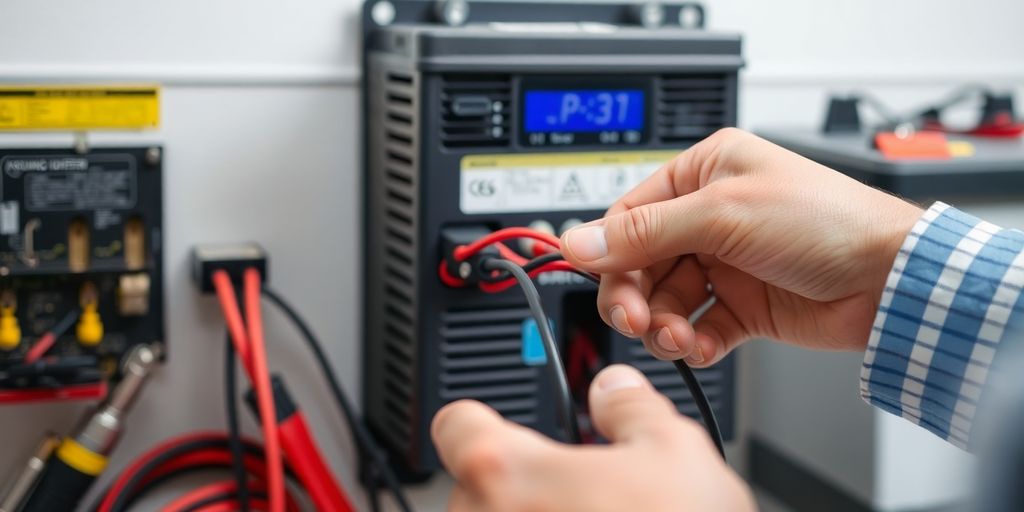
The installation of the inverter and the battery is a decisive step in setting up your solar system. It allows you to convert and store the energy produced by your panels. A correct installation guarantees the performance and durability of your investment.
The crucial role of the inverter in energy conversion
The inverter is the brain of your solar installation. It transforms the direct current (DC) produced by the solar panels into alternating current (AC), which can be used by your electrical appliances and fed into the grid if you opt for self-consumption with resale of the surplus. Choosing an inverter that is adapted to the power of your installation is essential. There are different types of inverters, including string inverters, micro-inverters and hybrid inverters. Each has its advantages and disadvantages in terms of cost, efficiency and flexibility. The inverter must be installed in a dry, ventilated place, protected from the weather, in accordance with the manufacturer’s recommendations. It is also important to choose the location of the inverter carefully to facilitate maintenance.
Integrating batteries for energy storage
Batteries allow you to store the energy produced by your solar panels that is not consumed immediately. This is particularly useful for night-time use or on days with little sunshine. Integrating batteries increases your energy autonomy and reduces your dependence on the electricity grid. There are different types of solar batteries, including lead-acid batteries, lithium-ion batteries and flow batteries. Lithium-ion batteries are generally more efficient and have a longer lifespan, but they are also more expensive. It is important to size your battery bank correctly according to your energy needs and your consumption. Connecting a battery to your solar panels allows you to store the surplus energy.
Optimal positioning of the inverter
The positioning of the inverter is an important factor for its proper functioning and lifespan. It is recommended to install it in a cool, dry and well-ventilated place. Avoid places exposed to excessive heat, humidity or dust. A garage, a cellar or a technical room are suitable locations. Make sure the inverter is easily accessible for maintenance and possible repairs. It is also important to respect the safety distances from other electrical equipment and flammable materials. When installing stand-alone panels, it is important to connect the charge controller first.
Connection to the electricity grid or off-grid installation
The choice between a connection to the electricity grid and an off-grid installation is an important decision that depends on your energy needs, your location and your autonomy objectives. Let’s examine the two options in more detail.
The steps for connecting to the public grid
Connecting to the public grid involves several administrative and technical steps. It is mandatory to apply for a connection, whether for total self-consumption or for self-consumption with resale of the surplus.
Here are the main steps:
- Connection request: Contact Enedis, the electricity distribution network operator, to submit a connection request. Your photovoltaic installer can often take care of these administrative procedures.
- Connection Proposal (PDR): Enedis will send you a PDR, which takes the form of a quote indicating the timeframe and the work you will be responsible for. Even if Enedis takes care of most of the work, some may be your responsibility (digging trenches, preparing the metering panel, etc.).
- Consuel Certificate: You must obtain a Consuel certificate of conformity, which certifies that your installation complies with electrical safety standards.
- Connection work: Once the quote has been accepted and the Consuel certificate obtained, the connection work can begin. Enedis will carry out the work necessary to connect your installation to the public grid.
It is important to note that connecting to the grid may involve initial costs, but it allows you to benefit from a reliable energy source and to resell your surplus production.
The specificities of an autonomous off-grid installation
An autonomous installation, or off-grid solar installations, is not connected to the public electricity grid. This type of system allows complete self-consumption of the energy produced, offering independence from the traditional grid. This is an interesting solution if you are located in an isolated area or if you want total energy autonomy.
The key elements of an off-grid installation include:
- Solar panels to produce electricity.
- A charge controller to optimise battery charging.
- Batteries to store the energy produced.
- An inverter to convert the direct current (DC) from the batteries into alternating current (AC) that can be used by your appliances.
Although off-grid installation offers autonomy, it requires careful planning to size the system correctly and ensure a reliable power supply in all circumstances. You need to carefully assess your consumption and the production of the solar panels.
The intervention of a certified professional for the final connection
Whether you opt for a grid connection or an off-grid installation, it is strongly recommended to use a certified professional. A qualified professional will be able to advise you on the solution that is best suited to your needs, carry out an installation that complies with safety standards and assist you with the administrative procedures. In addition, a certified professional will be able to help you assess the profitability of grid-tied versus off-grid solar systems.
Using a professional is a guarantee of safety and performance for your solar installation.
Safety and compliance during connection
Safety and compliance are paramount when connecting solar panels. A non-compliant installation can lead to electrical hazards, property damage, and void warranties. It is therefore essential to scrupulously respect the standards in force and to take all necessary precautions.
Essential precautions before any intervention
Before starting any work on your solar installation, it is imperative to take certain precautions. These measures are designed to ensure your safety and prevent any electrical accidents.
Here are some steps to follow:
- Cut off the power supply: Before handling cables or electrical components, cut off the main power supply to the solar installation. Use a circuit breaker or appropriate switch to isolate the circuit.
- Check for absence of voltage: Use a multimeter to make sure there is no more voltage in the cables and components you are going to work on. Even after cutting off the power, there may be a residual voltage.
- Wear personal protective equipment (PPE): Wear insulating gloves, safety glasses and appropriate work clothes to protect yourself against electrical and mechanical hazards.
It is strongly recommended to use a qualified professional to carry out the connection and connection work on your solar installation. A certified electrician has the skills and experience necessary to carry out the work safely and in accordance with current standards.
The importance of earthing the installation
Earthing is a crucial element of the safety of a solar installation. It allows fault currents to be discharged to earth, protecting people and equipment from the risk of electric shock and fire. Correct earthing ensures effective protection in the event of an electrical problem.
Here are the important points regarding earthing:
- Connect all metal parts: All metal parts of the solar installation, including panels, supports, inverters and junction boxes, must be connected to earth.
- Use an appropriate earth conductor: The earth conductor must be of sufficient cross-section to withstand fault currents. Electrical standards define the minimum cross-sections to be used depending on the size of the installation.
- Check the resistance of the earth connection: The resistance of the earth connection must be low enough to ensure effective discharge of fault currents. It is recommended to have the resistance of the earth connection measured by a professional.
Respecting current electrical standards
Compliance with electrical standards is imperative to ensure the safety and compliance of your solar installation. These standards define the rules to be followed for the design, installation and maintenance of electrical installations. For a roof installation, it is important to know the installation steps.
Here are some important standards to know:
- NF C 15-100: This standard defines the general rules for low voltage electrical installations in France. It covers all aspects of the installation, including protection against overcurrents, overvoltages and indirect contacts.
- UTE C 15-712-1: This standard specific to grid-connected photovoltaic installations defines the specific requirements for these installations, particularly with regard to protection against earth faults, cable cross-section and disconnection devices.
- Consuel: The Consuel certificate of conformity is mandatory for any electrical installation connected to the public grid. It certifies that the installation has been carried out in accordance with current standards and that it is safe for users. To obtain the Consuel certificate, a specific procedure must be followed.
It is important to note that these standards are regularly updated to take into account technological developments and feedback. It is therefore essential to keep informed of the latest versions in force. For a profitable photovoltaic project, it is important to respect the regulations in force.
Optimising the performance of your solar installation
It is essential to optimise the performance of your solar installation to maximise your return on investment and contribute to a more sustainable future. Several factors influence the efficiency of your installation, and paying particular attention to these aspects can make a significant difference.
The orientation and inclination of the panels
The orientation and inclination of the solar panels are crucial elements for capturing the maximum amount of solar radiation. In the northern hemisphere, a south-facing orientation is generally optimal. The ideal inclination varies depending on your latitude and the season.
- For maximum production throughout the year, the inclination should be close to your latitude.
- To favour summer production, reduce the inclination by 10 to 15 degrees.
- To favour winter production, increase the inclination by 10 to 15 degrees.
A precise study of the sunshine on your site is essential to determine the optimal orientation and inclination. Solar simulation tools can help you assess the impact of different parameters on energy production. It is important to note that the shade cast by trees or neighbouring buildings can significantly reduce the efficiency of your panels. So make sure you choose a clear location.
Regular maintenance for maximum efficiency
Regular maintenance is essential to maintain the maximum efficiency of your solar installation. Dust, leaves, bird droppings and other dirt can accumulate on the surface of the panels and reduce their ability to capture sunlight. Regular cleaning helps prevent this loss of efficiency.
Here are some tips for maintaining your solar panels:
- Clean the panels at least twice a year, ideally in spring and autumn.
- Use fresh water and a soft brush to avoid scratching the surface of the panels.
- Avoid using harsh chemicals or high-pressure cleaners.
- Regularly check the condition of the cables and connections to detect any problems.
It is also important to monitor the energy production of your installation and compare the data with the forecasts. An unexpected drop in efficiency may indicate a problem requiring intervention.
Monitoring and maintenance of the photovoltaic system
Regular monitoring and maintenance of your photovoltaic system is essential to ensure its long-term performance. Inverters, batteries and other system components may require periodic maintenance to ensure they are functioning properly.
A monitoring system can help you quickly detect problems and optimise energy production. These systems provide real-time data on the performance of your panels, voltage, current and power produced. By analysing this data, you can identify anomalies and take the necessary corrective action. For example, using monitoring software such as SUN2000 from FusionSolar can help you ensure the safety, efficiency and durability of your system.
It is recommended to have your installation inspected by a qualified professional every two to three years. This inspection will detect potential problems and carry out the necessary maintenance operations. A professional can also check that your installation complies with current safety standards. Don’t forget that the profitability of your solar panels also depends on good maintenance.
Here are some points to monitor:
- Checking the condition of the panels (cracks, peeling, etc.).
- Checking electrical connections (oxidation, loosening, etc.).
- Testing inverters and batteries.
- Cleaning the panels.
By following these tips, you can optimise the performance of your solar installation and fully enjoy the benefits of solar energy for many years to come. Optimising your HVAC system is also important for overall energy efficiency.
Grants and subsidies for the installation of solar panels
Investing in solar panels represents a significant opportunity to reduce your carbon footprint and your energy bills. Fortunately, various financial schemes are available to reduce the initial cost of installation. Let’s explore together the national, regional and procedures to benefit from them.
National support schemes for solar energy
At national level, several financial aids are available to encourage the installation of solar panels. These schemes aim to make solar energy more accessible and accelerate the energy transition. Among the most common are:
- MaPrimeRénov’: A financial aid paid by the State for energy renovation work, including the installation of thermal or hybrid solar panels. Its amount varies according to your income and the type of work carried out.
- The self-consumption bonus: It is paid to individuals who consume their own solar electricity production. The amount of this bonus depends on the power of the installation and is paid in several instalments over the first five years.
- Energy Saving Certificates (CEE): Energy suppliers offer CEE bonuses to encourage energy saving work, including the installation of thermal solar panels. These bonuses can take the form of cheques, discounts or services.
It is important to note that most of these aids cannot be combined. It is therefore essential to find out about the eligibility conditions and choose the most advantageous aid for your situation.
Local and regional aid available
In addition to national aid, local and regional aid may also be available. This aid is often specific to each region and may concern different types of work related to solar energy. For example, some regions offer aid for the installation of combined solar systems for heating and hot water production.
- Check with your regional council or town hall to find out about the aid available in your region.
- Consult the website of the National Housing Agency (ANAH) to find out about the schemes specific to your department.
- Don’t hesitate to contact a Solencia advisor for personalised information on the aid available and the procedures to follow. installation of solar panels
How to benefit from financial incentives
To benefit from financial incentives, it is essential to follow certain steps and respect certain conditions. Here are some tips to maximise your chances of success:
- Carry out an energy assessment of your home to assess your needs and determine the type of solar installation that is most suitable.
- Use an RGE (Recognised Guarantor of the Environment) certified installer to carry out the work. This certification is often a condition of eligibility for financial aid.
- Prepare a complete and accurate aid application file, providing all the supporting documents requested.
- Respect the deadlines for submitting aid applications, which may vary depending on the schemes.
By following these tips and informing yourself with the competent organisations, you will be able to benefit from the financial aid available and significantly reduce the cost of your solar installation. Remember that investing in solar energy is a sustainable and profitable choice in the long term. Also consider the installation of