
Considering installing a heat pump (HP) and pairing it with solar photovoltaic panels? This is an excellent step towards reducing your energy expenses and doing your bit for the environment. The HP and solar duo is increasingly popular, as it allows you to use free solar energy to heat your home. But what is the price of a heat pump with solar panels in 2025? We have gathered the essential information for you to estimate the total cost of your project, taking into account available financial aid and expected profitability.
Key Takeaways
- The overall cost of an installation combining a heat pump and solar panels in 2025 generally ranges between €14,000 and €33,000 before aid deductions, depending on the chosen power outputs.
- The price varies according to the type of heat pump (air-to-water is more expensive but more efficient for central heating and domestic hot water, air-to-air is cheaper but often limited to heating only) and the size of the photovoltaic installation.
- Financial aid such as MaPrimeRénov’, Energy Saving Certificates (CEE), and self-consumption bonuses can significantly reduce the initial investment.
- Optimal sizing of the HP and solar panels is crucial to maximise self-consumption and improve the return on investment (ROI), which is often between 7 and 12 years.
- It is recommended to carry out an energy audit and compare several quotes from RGE-certified installers to secure the price and performance of your installation.
Estimating the Price of a Heat Pump with Solar Panels in 2025
The combination of a heat pump (HP) and solar photovoltaic panels represents a significant investment, but it promises to reduce your long-term energy expenses. In 2025, the overall cost of this synergy will depend on several key factors, ranging from the power of the equipment to the complexity of the installation.
Price Ranges for HP and Photovoltaic Coupling
The price of an installation combining a heat pump and solar photovoltaic panels can vary considerably. For a general estimate, budget between €14,000 and €33,000 before financial aid deductions. This range takes into account different types of heat pumps (air-to-water or air-to-air) and solar panel power outputs from 3 kWp to 9 kWp. Air-to-water heat pumps, which are more efficient for central heating and domestic hot water, generally cost between €8,000 and €19,000 installed, while air-to-air systems are more affordable, ranging from €4,000 to €9,000.
Solar photovoltaic panels, on the other hand, cost between €5,500 and €17,500 depending on their power output (3 kWp to 9 kWp). It is important to note that these prices include materials and installation by qualified RGE (Reconnu Garant de l’Environnement – Environmentally Responsible Installer) professionals.
Factors Influencing the Total Installation Cost
Several elements will affect the final price of your HP and solar panel installation:
- Type of heat pump: An air-to-water HP will be more expensive than an air-to-air HP, but offers greater versatility.
- Power of the equipment: The power of the HP (expressed in kW) and the production capacity of the solar panels (expressed in kWp) must be adapted to your energy needs.
- Complexity of the installation: Site accessibility, your roof configuration, or the need for specific connection work can influence labour costs.
- Brand and quality of materials: Equipment performance and durability vary by manufacturer.
- Need for ancillary work: Sometimes, insulation work or electrical network upgrades may be necessary.
The combination of a heat pump and solar panels is a project that requires a personalised study. It is therefore essential to request several detailed quotes to compare offers and ensure that the installation perfectly meets your needs.
Cost Comparison by House Size
The sizing of the installation is directly linked to the surface area of your home and your consumption habits. Here are estimates for different house sizes:
| House Size | Type of HP (indicative power) | Solar Panels (indicative power) | VAT Price Range (before aid) |
|---|---|---|---|
| 80 m² | Air-to-water (6-7 kW) | 3 kWp | €14,000 – €20,000 |
| 120 m² | Air-to-water (8-10 kW) | 6 kWp | €20,000 – €27,500 |
| 150 m² | Air-to-water (10-12 kW) | 9 kWp | €26,000 – €36,500 |
These figures are approximate. For a precise estimate, it is recommended to consult a professional who will carry out an energy audit of your home.
Optimal Sizing for a Heat Pump Coupled with Solar
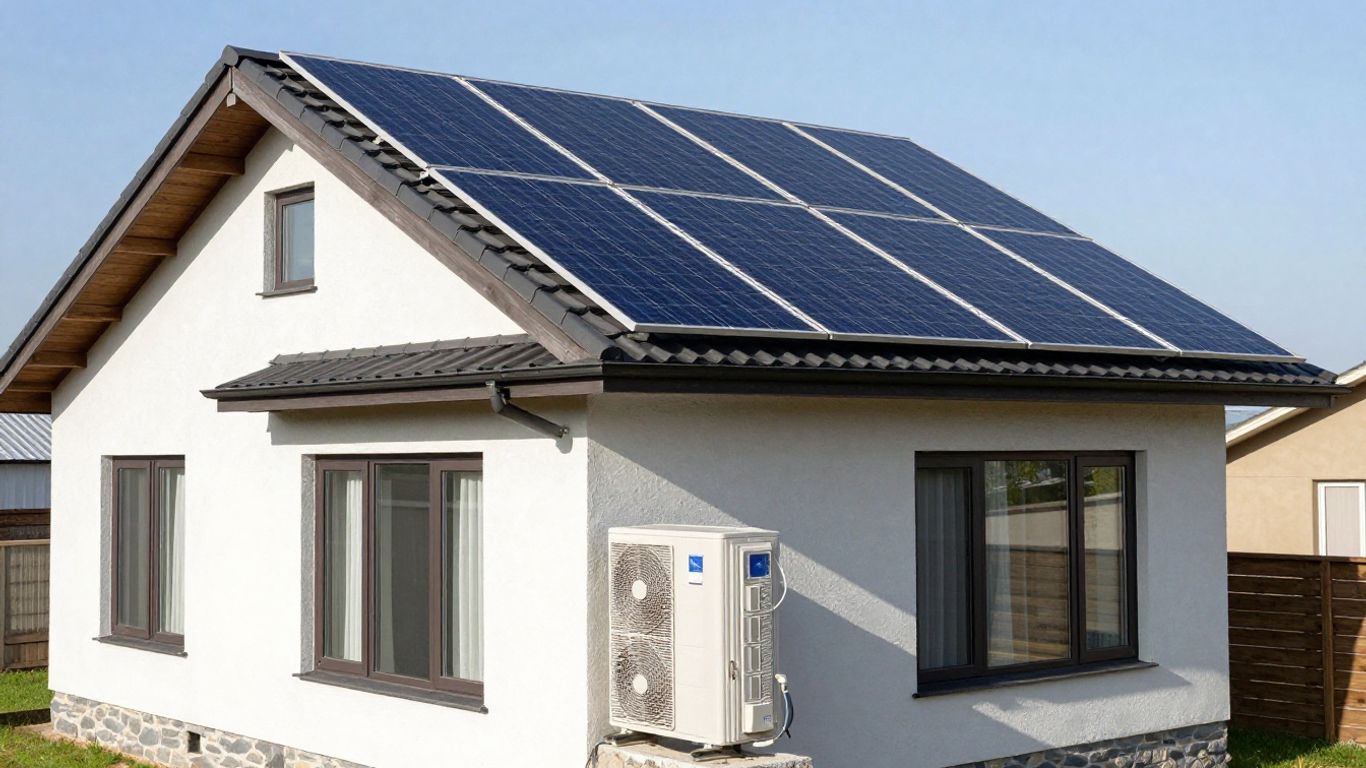
For your combined heat pump (HP) and solar photovoltaic (PV) installation to be truly effective and profitable, the needs of each must be carefully calculated. It’s not just a matter of power, but also of how the two systems will work together daily. Proper sizing is key to ensuring that the price of your ‘heat pump solar panel’ system is justified by the savings achieved.
Calculating Annual Energy Needs for the Heat Pump
Before considering solar panels, you need to know how much energy your home consumes for heating and domestic hot water. The easiest way is to look at your past energy bills. If you don’t have this data, a professional can estimate your needs based on your home’s size, insulation, and the type of heat emitters (radiators, underfloor heating).
Once you have an idea of your annual kWh needs (e.g., 12,000 kWh for heating), you need to look at the efficiency of the HP you are considering. This efficiency is called the SCOP (Seasonal Coefficient of Performance). A SCOP of 3.5 means that for every 1 kWh of electricity consumed, the HP produces 3.5 kWh of heat. The annual electricity consumption of the HP will therefore be: Heat needs / SCOP. In our example: 12,000 kWh / 3.5 = approximately 3,430 kWh per year.
Determining the Necessary Photovoltaic Power
Now that you know how much electricity your HP will consume, you can determine the size of your solar installation. The goal is for your panels to produce a good portion of this electricity. We generally aim to cover between 50% and 70% of the HP’s consumption with local production.
To give you an idea, 1 kWp (kilowatt-peak) of solar panels produces an average of 1,050 to 1,300 kWh per year, depending on your region and roof orientation. If your HP consumes 3,430 kWh per year, to cover 60% of its needs, you would need approximately 2 to 3 kWp of PV installation. You also need to consider your usual electricity consumption (lighting, appliances) to adjust the size of the PV system.
Precise sizing takes into account not only the HP’s consumption but also your daily and annual electricity consumption habits. The objective is to maximise self-consumption, i.e., to directly use the electricity produced by your panels, rather than feeding it back into the grid.
Concrete Sizing Examples for Different Types of Homes
Here are some examples to help you visualise:
- Well-insulated house: For a 6 kW HP with a SCOP of 4, the annual electricity consumption will be around 2,000 to 2,400 kWh. A PV installation of 2.5 to 3 kWp would be recommended to cover 50% to 70% of this consumption.
- Standard-sized house: With an 8 kW HP and a SCOP of 3.6, consumption will be around 2,800 to 3,300 kWh per year. 3 to 4 kWp of solar panels will be needed.
- Large house: For a 12 kW HP and a SCOP of 3.2, consumption can reach 4,000 to 4,800 kWh per year. A PV installation of 4.5 to 6 kWp would then be more appropriate.
These figures are estimates. Your roof’s orientation, potential shading, and the type of HP (air-to-water, air-to-air) can influence the final choice. It is always best to have a personalised study carried out by a qualified professional.
Impact of Financial Aid on the Price of a Heat Pump with Solar Panels
The combination of a heat pump (HP) and solar photovoltaic panels represents a significant investment. Fortunately, several financial aid schemes are available in 2025 to reduce this cost. These subsidies can transform an ambitious project into a more accessible reality, making the HP + PV duo even more attractive.
Overview of Aid Schemes Available in 2025
In 2025, the landscape of energy renovation and solar self-consumption aid is designed to encourage the adoption of these technologies. The main financial levers are:
- MaPrimeRénov’: Aimed at energy renovation work, it directly concerns the installation of the heat pump. Its amount varies according to your income and the expected energy savings from the work.
- Energy Saving Certificates (CEE): These aids, offered by energy suppliers, reward the energy savings achieved. They can be combined with MaPrimeRénov’ under certain conditions.
- Self-consumption bonus (PAC): For the photovoltaic component, this bonus is paid directly upon installation of solar panels intended for self-consumption. It depends on the installation’s power output.
- Feed-in tariff for surplus photovoltaic electricity: The electricity you do not consume immediately can be sold at a guaranteed rate by EDF OA (Obligation d’Achat – Purchase Obligation), providing additional income.
- Reduced VAT: A reduced VAT rate (5.5% or 10%) may apply to the purchase and installation of equipment, depending on their nature and eligibility criteria.
Eligibility for most of these aids is conditional on the work being carried out by an RGE-certified professional (Reconnu Garant de l’Environnement) for the heat pump installation, and often for the photovoltaic installation as well. This certification attests to the quality of the installations and their compliance with environmental standards.
Eligibility Criteria for MaPrimeRénov’ and Energy Saving Certificates
To benefit from MaPrimeRénov’, several criteria must be met. You must be the owner-occupier or landlord of a property built at least 15 years ago. The work must be carried out by an RGE company. Income ceilings are decisive for the amount of aid. CEE are awarded based on the energy savings generated by the HP installation. The amounts vary depending on the type of work and the climate zone. It is essential to submit an application before the work begins.
Consideration of Self-Consumption Bonuses and Feed-in Tariffs for Surplus Photovoltaic Electricity
The self-consumption bonus is paid in one go, usually within months of the installation being commissioned. Its amount is degressive according to the peak power (kWp) of your photovoltaic installation. Regarding the feed-in tariff, it is set by the Energy Regulation Commission (CRE) and revised quarterly. This tariff is guaranteed for 20 years. It is important to note that the income generated by selling surplus electricity can significantly improve the overall profitability of your project, in addition to the direct savings made through self-consumption of your solar production to power your HP.
Profitability and Return on Investment of the HP + Photovoltaic System
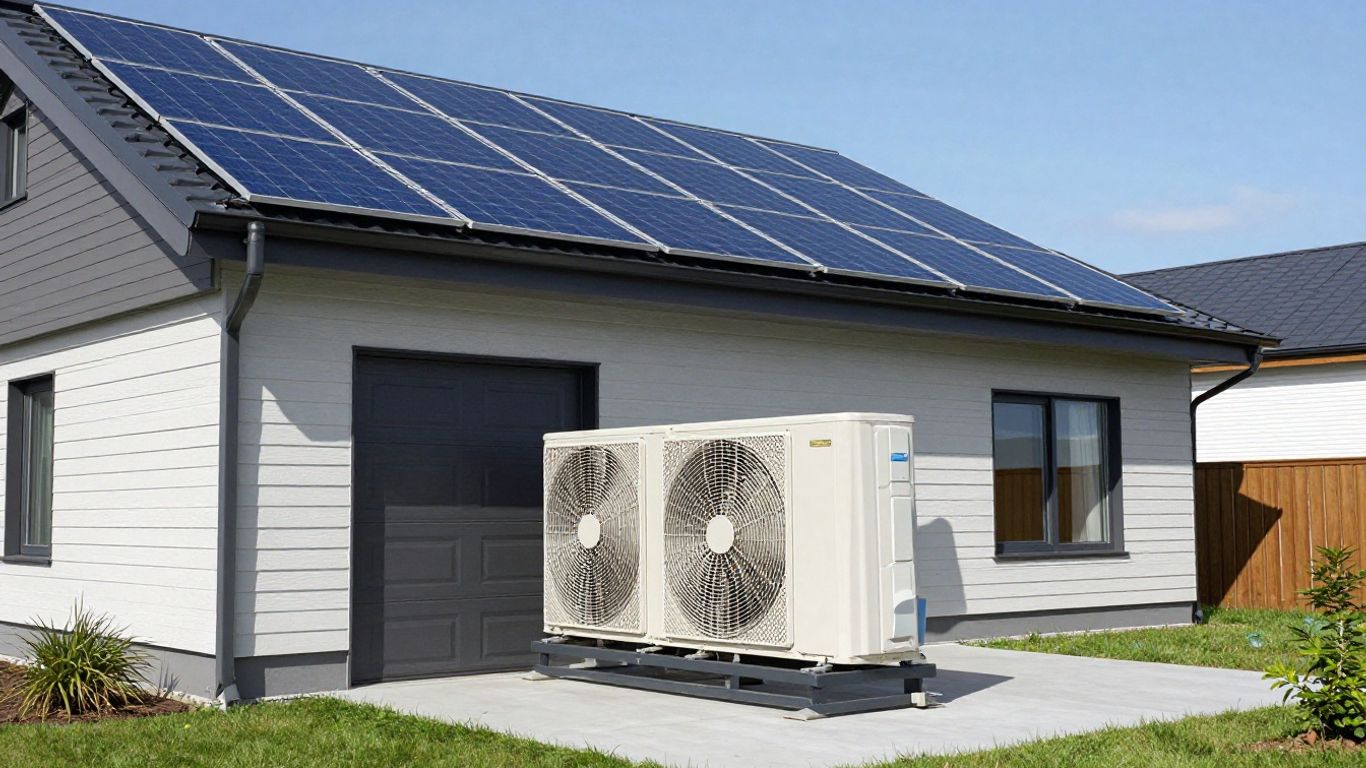
Once your heat pump coupled with solar panels is installed, the question of its profitability becomes central. It’s about understanding how long it will take for the initial investment to be recovered through savings and potential income.
Methodology for Calculating Return on Investment (ROI)
The calculation of the return on investment (ROI) for a combined heat pump (HP) and photovoltaic (PV) system is based on a simple formula, but it requires a good understanding of the variables:
ROI = (Initial investment net of aid) / (Annual savings + Surplus sale income)
The initial investment, after deducting various financial aids such as MaPrimeRénov’ or Energy Saving Certificates (CEE), represents the actual cost borne by the household. Annual savings come mainly from the reduction in your electricity or gas bill, replaced by the energy produced by your solar panels and consumed by your HP. Added to this are the revenues generated by selling the surplus electricity not consumed, the rate of which is set by a contract with EDF OA (Obligation d’Achat).
Factors Influencing Profitability: Self-Consumption, Electricity Price, Sunshine
Several key factors will directly impact how quickly your system becomes profitable:
- Self-consumption rate: The more you manage to consume the electricity produced by your solar panels at the time it is generated, the greater your savings will be. This implies good synchronisation between HP production and solar production, for example, by scheduling domestic hot water heating during the day.
- Electricity price: An increase in the price of electricity on the grid will make your savings even more significant, as each kWh self-consumed represents a greater saving compared to purchasing it.
- Sunshine in your region: A region with high sunshine will produce more electricity, thus increasing the potential for self-consumption and surplus sale income.
- HP efficiency (SCOP): A high Seasonal Coefficient of Performance (SCOP) means your HP consumes less electricity to produce the same amount of heat, thus reducing its own electricity consumption.
The insulation of your home plays a decisive role. A well-insulated house requires a less powerful HP, which reduces the initial purchase cost and the HP’s electricity consumption, thereby improving the overall ROI of the system.
Estimating the Payback Period for Different Configurations
The payback period can vary considerably. For a well-sized system and considering the available aid, periods of 7 to 12 years are generally observed. The most efficient configurations, particularly in very sunny regions and with optimised self-consumption rates, can shorten this period. For example, a 3 kWp installation coupled with a 6 kW HP could see its ROI around 8 to 11 years, while a larger configuration (6 kWp + 8 kW HP) could achieve an ROI of 7 to 10 years. It is important to note that these estimates are based on assumptions of stable electricity prices and feed-in tariffs, which are not guaranteed in the long term. For a precise estimate, it is advisable to carry out a personalised simulation taking into account your actual consumption and the specificities of your home. The installation of a 3 kWp photovoltaic system, for example, is estimated between €6,000 and €9,000 in 2026, before aid.
| Configuration | Estimated Cost (before aid) | Estimated Aid | Annual Savings | Surplus Income | Estimated ROI |
|---|---|---|---|---|---|
| 3 kWp + 6 kW HP | €14,000 – €18,000 | €1,500 – €3,500 | €600 – €800 | €80 – €150 | 8 – 11 years |
| 6 kWp + 8 kW HP | €20,000 – €26,000 | €2,500 – €4,500 | €900 – €1,200 | €150 – €300 | 7 – 10 years |
| 9 kWp + 12 kW HP | €27,000 – €33,000 | €3,000 – €5,000 | €1,200 – €1,600 | €250 – €450 | 8 – 12 years |
Detailed Costs of Components for an HP and Solar Installation
To fully understand the overall budget for an installation combining a heat pump (HP) and solar photovoltaic (PV) panels, it is useful to break down the cost of each component. This helps to better understand price variations and identify the most significant cost items.
Purchase and Installation Price of a Heat Pump (Air-to-Water, Air-to-Air)
The cost of a heat pump varies significantly depending on its technology and power output. Air-to-water models, which are more efficient for central heating and domestic hot water (DHW) production, are generally more expensive than air-to-air systems, which primarily distribute warm air.
- Air-to-water HP: Expect between €8,000 and €19,000 for a 6 to 12 kW unit, including installation. This price often includes the outdoor unit, the indoor unit (or hydraulic module), and sometimes a storage tank for hot water.
- Air-to-air HP: These systems are more affordable, ranging from €4,000 to €9,000 depending on the configuration (mono-split, multi-split).
Choosing a reputable brand and a high Seasonal Coefficient of Performance (SCOP) can influence the initial price, but translates into greater energy savings in the long run.
Acquisition and Installation Cost of Solar Photovoltaic Panels
The price of solar panels depends mainly on the total installed power, expressed in kilowatt-peak (kWp). The cost per kWp tends to decrease as the total power increases.
Here are approximate figures for the purchase and installation of PV panels:
- 3 kWp: €5,500 to €7,500
- 6 kWp: €9,500 to €12,500
- 9 kWp: €13,500 to €17,500
These prices generally include the panels, inverters or micro-inverters, mounting systems, cabling, and labour. It is important to note that VAT may vary (5.5% or 10% depending on the case, particularly for eligible air-to-water HPs, and 10% or 20% for PV).
Ancillary Costs: Inverter, Cabling, Connection
Beyond the main equipment, some ancillary costs should be anticipated:
- Inverter(s): Essential for converting the DC current from the panels into AC current usable by the home. The cost varies depending on whether it is a central inverter or micro-inverters (more expensive but more efficient in case of shading).
- Cabling and electrical protection: Includes solar cables, circuit breakers, surge protectors, and possibly roof reinforcement if necessary.
- Grid connection: Administrative and technical procedures are required for connection, the cost of which can vary.
- Studies and diagnostics: A preliminary energy audit and a technical visit to confirm the feasibility of the installation may incur costs, often included in quotes from RGE professionals.
All these elements, although sometimes less visible, contribute to the total installation cost. Good planning and comparing multiple quotes help optimise the overall budget for your heat pump and solar panel project.
It is recommended to request detailed quotes that specify each cost item to avoid unpleasant surprises.
Comparison of HP and Solar Panel Configurations
Choosing the right combination of a heat pump (HP) and a photovoltaic (PV) installation is a key step to optimising your investment. There is no one-size-fits-all approach; the ideal configuration will depend on your specific needs, the size of your home, and your budget. We will examine different options to help you see more clearly.
Analysis of Costs and Savings for Systems of Different Power Outputs
The price of a combined HP and solar panel installation varies considerably depending on the power outputs chosen for each component. A smaller installation, for example, 3 kWp of solar panels associated with a 6 kW HP, will represent a lower initial investment than a more robust configuration of 9 kWp of panels and a 12 kW HP. However, the annual savings achieved and the potential for selling surplus electricity will not be the same. It is therefore essential to find a balance.
Here is an overview of approximate figures, including installation, excluding specific site technicalities:
- 3 kWp + 6 kW HP Configuration: Estimated cost between €14,000 and €18,000. Financial aid could reduce this amount by €1,500 to €3,500. Annual savings are between €600 and €800, with surplus sold generating €80 to €150 per year. The return on investment is generally 8 to 11 years.
- 6 kWp + 8 kW HP Configuration: The cost is between €20,000 and €26,000. Aid can range from €2,500 to €4,500. Annual savings vary from €900 to €1,200, and selling surplus can bring in €150 to €300 per year. The return on investment is often faster, between 7 and 10 years.
- 9 kWp + 12 kW HP Configuration: The investment is more substantial, between €27,000 and €33,000. Aid can reach €3,000 to €5,000. Annual savings are estimated between €1,200 and €1,600, with surplus sold generating €250 to €450 per year. The return on investment is generally between 8 and 12 years.
Comparative Table of Configurations and Their Profitability
To visualise the differences more clearly, a comparative table can be very useful. It allows you to cross-reference data on cost, potential aid, annual savings, and payback period for each configuration.
| Configuration (PV + HP) | Estimated Cost (before aid) | Estimated Aid | Annual Savings | Surplus Sold (annual) | Estimated ROI Period |
|---|---|---|---|---|---|
| 3 kWp + 6 kW HP | €14,000 – €18,000 | €1,500 – €3,500 | €600 – €800 | €80 – €150 | 8 – 11 years |
| 6 kWp + 8 kW HP | €20,000 – €26,000 | €2,500 – €4,500 | €900 – €1,200 | €150 – €300 | 7 – 10 years |
| 9 kWp + 12 kW HP | €27,000 – €33,000 | €3,000 – €5,000 | €1,200 – €1,600 | €250 – €450 | 8 – 12 years |
It is important to note that these figures are estimates. The return on investment can be shorter in regions with high sunshine or if the price of electricity increases significantly.
Impact of Heat Pump Type (Air-to-Water vs. Air-to-Air) on Overall Cost
The choice between an air-to-water heat pump and an air-to-air heat pump has a direct impact on the total installation cost. Air-to-water HPs are generally more expensive to purchase and install. They heat the water circulating in your central heating system (radiators, underfloor heating) and can also produce domestic hot water (DHW). Their cost can range from €8,000 to €19,000 depending on the power output.
Air-to-air HPs, on the other hand, distribute warm air directly into rooms. They are more affordable, with prices ranging from €4,000 to €9,000 depending on the configuration. However, they do not produce domestic hot water, which may require a supplementary heating solution for this purpose. Air-to-water, although more expensive initially, offers a more complete heating solution and can generate greater long-term savings, especially when considering DHW production.
The insulation of your home is a prerequisite step that can significantly reduce the power required for the heat pump, positively impacting the purchase cost and the payback period of the entire system.
Key Steps for Installing a Heat Pump with Solar Panels
Setting up a system combining a heat pump (HP) and solar photovoltaic (PV) panels requires a methodical approach to ensure its efficiency and longevity. This process, although complex, is structured into several distinct phases.
Energy Audit and Personalised Sizing
The first step is to carry out a thorough energy audit of your home. This allows for a precise assessment of your heating and domestic hot water needs, as well as your home’s thermal losses. Based on this, an *optimal* sizing of the heat pump and photovoltaic installation is carried out. This involves determining the appropriate power for the HP, taking into account its seasonal performance coefficient (SCOP), and the power required for the solar panels to cover a significant portion of the HP’s electricity consumption and your other appliances. A good needs assessment is crucial for determining the right system size and configuration to effectively meet your energy demands. Assessing your needs is the cornerstone of this project.
Administrative Procedures and Obtaining Authorisations
Once the sizing is validated, you need to handle the administrative procedures. These may include a prior declaration of works at the town hall if the installation modifies the external appearance of your building, as well as connection requests to the electricity distributor (Enedis). It is also necessary to comply with current standards, particularly through the Consuel certificate which attests to the compliance of the electrical installation. Setting up a contract for the sale of surplus electricity, if you opt for this option, is also part of these procedures.
Physical Installation of Equipment and Commissioning
This phase involves the actual installation of the various components. For solar panels, this includes fixing the supports to the roof, cabling, installing the inverter (or micro-inverters), and connecting to the electrical panel. For the heat pump, installation includes fitting the outdoor unit, hydraulic connection, installation of a buffer or domestic hot water tank if necessary, and connection to the control system. Commissioning, carried out by qualified RGE (Reconnu Garant de l’Environnement) professionals, includes functional tests, setting parameters (heating curve, hot water production), and verifying the correct synchronisation between solar production and HP consumption. All these works generally take a few days, depending on the complexity of the site and the availability of the teams.
Here is an overview of the timelines and associated costs:
| Stage | Estimated Duration | Average Cost (excluding materials) |
|---|---|---|
| Energy audit and sizing | 1-2 days | €300 – €800 |
| Administrative procedures | Variable | €0 – €200 |
| Solar panel (PV) installation | 2-4 days | €1,500 – €3,000 |
| Heat pump (HP) installation | 1-3 days | €1,000 – €2,500 |
| Commissioning and acceptance of works | 1 day | Included in installation |
It is important to note that these costs are indicative and can vary significantly depending on the complexity of the site, the chosen equipment, and the installers’ rates. Coordination between the different trades is also a key factor for the smooth running of the project.
Maintenance, Warranty, and Recurring Costs of a Solar and HP Installation
Once your heat pump (HP) system coupled with solar photovoltaic panels is installed, it is important to consider its upkeep to ensure its longevity and performance. This includes regular maintenance, understanding the warranties offered, and anticipating potential future costs.
Maintenance Obligations and Associated Costs
Maintaining your installation is a key step to ensuring its proper functioning. For the heat pump, an annual maintenance contract is often recommended, or even mandatory depending on the warranty terms. This contract, which generally costs between €150 and €250, covers basic checks, filter cleaning, and refrigerant control. For solar panels, maintenance is less demanding. Cleaning the panels may be necessary once or twice a year, especially if you notice a drop in production or if your environment is prone to dust or bird droppings. You can do this cleaning yourself or hire professionals. Some systems allow remote monitoring via an app, which helps to quickly detect any problems.
Duration of Warranties on HP and Photovoltaic Equipment
Warranties are a reassuring aspect when purchasing a solar and HP installation. Heat pump manufacturers generally offer warranties ranging from 5 to 10 years on main components. For solar photovoltaic panels, warranties are often longer, extending from 10 to 25 years on the modules themselves, and covering production performance over a similar period. It is also important to check the installer’s ten-year warranty, which covers significant damage related to the installation for ten years.
Estimating Long-Term Maintenance Costs
Beyond annual maintenance, you need to anticipate certain replacement costs in the longer term. The most likely component to be replaced is the inverter (or micro-inverters for newer systems), with a lifespan estimated between 10 and 12 years. The budget to allocate for this replacement generally ranges between €800 and €1,800, depending on the chosen technology and the power of your installation. It is also possible that cabling or connection work may require an update over time. Considering these recurring costs provides a clearer picture of the total cost of ownership of your system over its lifespan. For example, cleaning solar panels can cost between €100 and €300 if carried out by a professional for a residential home solar panel cleaning.
It is wise to set aside a small amount each year to cover these unforeseen or planned expenses, so as not to be caught out when it’s time to replace a component.
Optimising Self-Consumption to Maximise Gains
To get the most out of your combined heat pump (HP) and solar photovoltaic (PV) installation, it is essential to manage your electricity consumption effectively. The goal is simple: use as much of the electricity you produce yourself as possible, thereby reducing your reliance on the grid and your bills. Without optimisation, the average self-consumption rate in France is generally between 35% and 45%, as solar production does not always coincide with your actual needs. A good self-consumption strategy can significantly increase this rate.
Strategies for Synchronising HP Consumption with Solar Production
The key lies in planning and adapting your consumption habits. The heat pump, especially for domestic hot water (DHW) production or heating, can be controlled. It is advisable to schedule high-demand periods for the HP, such as water heating, during the hours when your solar panels produce the most electricity, generally around midday. Adjusting your system’s heating curve can also help to better align it with available solar production.
Role of an Energy Management System
An energy management system, sometimes called an ‘energy manager’ or ‘smart box’, plays a central role in this optimisation. These devices analyse your solar production and electricity consumption in real time. They can then automatically trigger certain appliances, such as your water heater or even the HP itself, when the surplus solar production is at its highest. This maximises the use of your own green energy and reduces purchases from the grid. The installation of such systems is often included in offers from recognised installers, thus facilitating the control of your solar installation.
Impact of Self-Consumption on Overall Price and ROI
Increasing your self-consumption rate has a direct and positive impact on the profitability of your investment. By consuming more of the electricity you produce, you reduce your electricity bills accordingly. This means that the payback period (ROI) for your HP + solar panel installation will be shorter. For example, a well-sized and optimised installation for self-consumption can see its ROI between 7 and 12 years, or even less in very sunny regions. The overall price of the installation, although significant initially, is amortised more quickly thanks to the daily savings generated.
Practical Cases and Financial Profitability Studies
To truly understand the financial benefits of combining a heat pump (HP) with a photovoltaic installation, it’s best to look at concrete examples. We will break down two scenarios for different-sized houses, taking into account costs, aid, and expected gains.
Analysis of an Installation Scenario for a Medium-Sized House
Let’s consider a 80 m² house, well-insulated, heated electrically. The goal is to replace this energy-intensive heating with an air-to-water heat pump and pair it with solar panels to reduce the overall bill.
- Typical configuration:
- 6 kW air-to-water heat pump.
- 3 kWp photovoltaic installation.
- Estimated cost before aid: Between €14,000 and €20,000.
- Financial aid: In 2025, schemes like MaPrimeRénov’ and Energy Saving Certificates (CEE) can significantly reduce this cost. We can estimate net aid of approximately €1,500 to €3,500 for this type of installation, depending on the household’s income and the targeted energy performance.
- Annual savings:
- Savings on electricity bill thanks to the HP (replacement of electric heating): €600 to €800 per year.
- Income from selling surplus photovoltaic electricity: approximately €80 to €150 per year.
- Return on investment (ROI): With a net investment after aid of approximately €10,500 to €16,500, and total annual savings of €680 to €950, the payback period is generally between 8 and 11 years. This is a reasonable timeframe for such a project.
The combination of an HP and solar allows for maximised self-consumption, thus reducing dependence on electricity price fluctuations.
Figured Example for a Large House with a Larger HP and PV Configuration
Let’s now move on to a larger house, say 120 m², with more significant heating needs. Here, we opt for a more powerful HP and a larger solar installation to cover a greater portion of the consumption.
- Typical configuration:
- 8 kW air-to-water heat pump.
- 6 kWp photovoltaic installation.
- Estimated cost before aid: Between €20,000 and €26,000.
- Financial aid: Aid can be greater for an installation of this size. We can expect net aid of €2,500 to €4,500.
- Annual savings:
- Savings on heating bill: €900 to €1,200 per year.
- Income from selling surplus PV: approximately €150 to €300 per year.
- Return on investment (ROI): The net investment is between €15,500 and €21,500. With total annual savings of €1,050 to €1,500, the ROI is generally shorter, ranging between 7 and 10 years. This is a strong argument for this type of project, which can be further improved by good *energy management*.
These examples clearly show that coupling an HP with solar panels is an effective solution for reducing energy bills. The average payback period is a key figure to consider, but one must also think about the ecological benefits and the comfort provided by these systems.
Discover concrete examples and calculations that show how solar can be profitable. These practical cases will help you see more clearly. To learn more and see how we can help you, visit our website!
In Summary: Your HP + Solar Panels Project in 2025
In conclusion, combining a heat pump with solar panels is a smart move to control your energy expenses and act for the environment. The initial cost may seem high, but when considering the available financial aid in 2025 and the potential for long-term savings, the investment quickly becomes profitable. It is essential to size your installation correctly, adapting the HP’s power and the size of your photovoltaic array to your actual needs. Don’t forget that your home’s insulation plays a key role in the overall efficiency of the system. To bring your project to fruition, we recommend requesting several quotes from RGE-certified installers. This will allow you to compare offers and choose the solution best suited to your budget and your home.
Frequently Asked Questions
What is the average price to install a heat pump with solar panels in 2025?
In 2025, the total cost to install a heat pump (HP) with solar panels, including installation, generally ranges between €14,000 and €33,000. This price can vary greatly depending on the chosen HP power (between 6 and 12 kW) and the size of the solar installation (from 3 to 9 kWp). It is important to note that this amount does not include financial aid which can reduce the final cost.
How many solar panels are needed to run an 8 kW heat pump?
To power an 8 kW heat pump, you need approximately 3 to 4 kWp of solar panels. This allows you to cover between 50% and 70% of the HP’s electricity consumption. The exact amount will depend on the region you live in, your roof’s orientation, and how you use your heating.
What financial aid is available in 2025 for a combined HP and solar panel installation?
For the heat pump, you can benefit from MaPrimeRénov’ and Energy Saving Certificates (CEE), subject to certain conditions and your income. For solar panels, there is a self-consumption bonus and a fixed tariff to buy back surplus electricity that you do not consume. VAT can also be reduced to 5.5% for air-to-water HPs and 10% for solar panel installation.
Is it mandatory to have a battery for the heat pump to work with solar panels?
No, a battery is not essential for a heat pump to work with solar panels. The electricity produced by the panels directly powers the HP and your appliances. A battery can help consume more solar electricity, but you can start without one and see if it is really useful after a year of use.
What is the payback period for an investment in a heat pump and solar panels?
Generally, the time to recoup the money invested in a combined HP and solar panel installation is 7 to 12 years. This period can be shorter if your installation is well calculated, if you take full advantage of financial aid, and if your region benefits from good sunshine. The price of electricity also plays an important role.
What is the cost and benefit difference between an air-to-water HP and an air-to-air HP when using solar panels?
An air-to-water heat pump generally costs more to purchase and install than an air-to-air HP. However, the air-to-water HP can heat your entire home and produce your domestic hot water, leading to greater savings. The air-to-air HP is cheaper but only heats the ambient air and does not produce hot water.
Is it better to insulate my house before installing a heat pump and solar panels?
Yes, it is strongly recommended. Good insulation reduces the amount of heat your house needs. This means you can install a less powerful heat pump, which costs less to purchase. Furthermore, a well-insulated house makes the heat pump more efficient, thus improving the return on investment time.
How can I ensure my heat pump uses the maximum electricity produced by my solar panels?
To maximise the use of solar electricity by your heat pump, you can try to synchronise its operating times with daylight hours. For example, schedule domestic hot water production during the day. An energy management system can also help to automatically optimise this synchronisation and increase your savings.
