
Storing solar energy is a bit like putting rays in a can. We capture it during the day to use it in the evening, at night, or when the electricity grid shows signs of weakness. By 2025, solar batteries have become indispensable allies for self-consumption. They allow us to extend the use of green electricity and strengthen our energy independence, even with simple solar installations. Faced with a variety of models and brands, choosing the right battery can seem complicated. Should we prioritise performance, lifespan, or cost per kilowatt-hour? We have examined the main options to offer you a clear comparison.
Key Takeaways
- In 2025, lithium batteries, particularly LiFePO₄ technology, remain the benchmark for individual homes thanks to their durability and performance. The average installed price is between €700 and €1,100/kWh.
- The best solar battery for your home depends on your specific needs: desired autonomy, budget, available space, and intended uses (electric car charging, heating, etc.).
- Brands like BYD, Pylontech, LG Chem, and Sungrow are recognised for the reliability of their residential storage solutions.
- For a small installation (up to 3 kWp) or a limited budget, entry-level Gel batteries are an option, while modular systems like the BYD HVS or Huawei LUNA2000 offer better scalability.
- The choice of a battery should consider its storage capacity (in kWh) to cover your daily needs, its lifespan (number of charge cycles), and its technical compatibility with your photovoltaic installation.
1. BYD HVS Battery
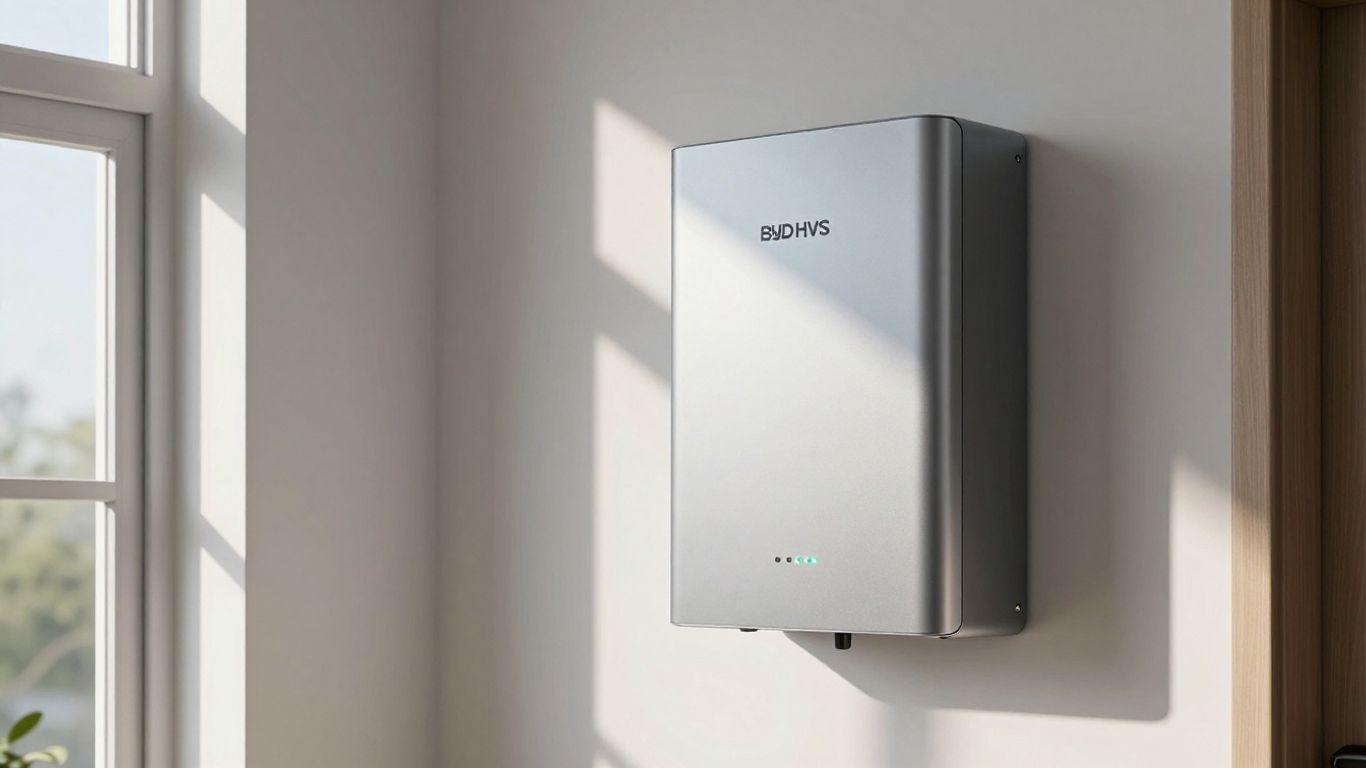
The BYD HVS is an energy storage solution designed for residential and commercial installations. It uses lithium-iron-phosphate (LiFePO4) technology, known for its safety and longevity. This modular battery allows for great flexibility, as you can stack multiple modules to reach the desired storage capacity, ranging from 5.1 kWh to 25.5 kWh for the HVS range. This is a definite advantage if your needs evolve.
Modularity is the strong point of the BYD HVS.
Here are some notable features:
- LiFePO4 Technology: Offers increased safety and extended lifespan, with up to 6,000 charge/discharge cycles.
- Modularity: 5.1 kWh modules can be combined to create a custom system, up to 25.5 kWh for the HVS.
- High Voltage: Compatible with high-voltage hybrid inverters, optimising energy efficiency.
- Performance: High efficiency, over 95%, maximises the use of stored solar energy.
It is important to note that the BYD HVS requires a compatible high-voltage inverter. Its cost per kilowatt-hour may be slightly higher than other solutions, but its reliability and durability justify this investment for many families. The BYD brand is a recognised global player in energy storage, inspiring confidence in the quality and technical support of their products, as confirmed by their presence in the energy storage sector.
The installation of the BYD HVS requires particular attention to available space, as the modules are generally stacked and require a wall mount or suitable rack. Planning the location is therefore a key step before purchase.
2. Pylontech US5000
The Pylontech US5000 is an energy storage solution that has carved out a significant niche in the domestic battery market. Founded in 2009, Pylontech is a Chinese company that has rapidly established itself thanks to its lithium-ion batteries, recognised for their good value for money and reliability. The US series, which includes the US5000, is particularly appreciated by installers in Europe.
What sets the US5000 apart is its 4.8 kWh capacity, offering comfortable autonomy for many households. It uses lithium-iron-phosphate (LiFePO4) technology, renowned for its safety and long lifespan. With a depth of discharge (DoD) of 95% and the ability to support up to 6,000 charge/discharge cycles, this battery is built to last. The 10-year warranty is an additional sign of confidence.
Here are some key points regarding the Pylontech US5000:
- Usable Capacity: 4.8 kWh
- Technology: Lithium-iron-phosphate (LiFePO4)
- Depth of Discharge (DoD): 95%
- Lifespan: 6000 cycles at 95% DoD
- Warranty: 10 years
- Compatibility: Works with many hybrid inverters on the market.
Modularity is also an asset. Although the US5000 offers a capacity of 4.8 kWh, it is possible to connect multiple modules in parallel to increase the total storage capacity, thus adapting to the evolving needs of your solar installation. This flexibility makes it an attractive option for those considering expanding their photovoltaic system in the future. The ease of installation and compact design also contribute to its success. It is a solid option for those seeking a high-performance and economical energy storage solution.
The Pylontech US5000 represents an excellent balance between performance, cost, and durability, making it a wise choice for many residential solar installations. Its adoption by professionals testifies to its long-term reliability.
For a 3 kWp installation, for example, a battery like the Pylontech US5000 is often recommended. It allows you to store excess energy produced during the day for later use, thus optimising self-consumption. You can find more information on available storage solutions.
3. LG Chem RESU 10
The LG Chem RESU 10 is a residential energy storage solution offered by LG Energy Solution, a subsidiary of the South Korean giant LG. This battery stands out with its 10 kWh capacity, making it particularly suitable for households with higher electricity consumption or those wishing to maximise their energy autonomy. It uses lithium-ion technology, known for its energy density and lifespan.
It is designed to integrate easily with a wide range of hybrid inverters on the market. Its modular design allows for relatively simple installation, although it requires the intervention of a qualified professional. The RESU 10 offers a good balance between storage capacity, performance, and reliability, which are important assets for daily use.
Here are some key points regarding the LG Chem RESU 10:
- Usable Capacity: Approximately 10 kWh, offering a substantial energy reserve.
- Technology: Lithium-ion, ensuring good efficiency and a long lifespan.
- Compatibility: Designed to work with many hybrid inverters, facilitating its integration into existing or new systems.
- Performance: It boasts a high depth of discharge (DoD) rate, allowing a large portion of its capacity to be used.
- Lifespan: Generally guaranteed for a certain number of charge/discharge cycles, ensuring use over several years.
The LG Chem RESU 10 represents a solid choice for homeowners looking to increase their solar self-consumption and benefit from a reliable backup power source. Its generous capacity positions it as a prime option for homes requiring significant energy storage, while benefiting from LG’s reputation for quality and reliability.
Although its initial cost may be higher than some smaller capacity alternatives, its capacity/price ratio and overall performance make it an interesting investment for optimised energy management in the long term.
4. Huawei LUNA2000
The Huawei LUNA2000 battery is presented as a modular and scalable energy storage solution, designed to integrate seamlessly into Huawei’s solar ecosystem. It uses Lithium-iron-phosphate (LiFePO4) technology, known for its safety and longevity. This battery is particularly appreciated for its flexibility, allowing the storage capacity to be adapted to the specific needs of each household.
Available in several 5 kWh, 10 kWh, and 15 kWh modules, the LUNA2000 can be configured to meet a wide range of energy demands. Each module is managed independently thanks to an integrated optimiser, allowing for fine-grained energy management and better overall system performance. Safety is a strong point of this model, with four levels of protection: cell level, electrical, structural, and an emergency function. A fire extinguisher is even integrated for increased safety.
Here is an overview of its main features:
- Modularity: Stack up to three modules for a maximum capacity of 15 kWh.
- LiFePO4 Technology: Ensures superior safety and lifespan.
- Per-Module Optimisation: Each unit operates autonomously for increased efficiency.
- Compatibility: Works with Huawei’s single-phase and three-phase inverters.
- Smart Management: Controllable via the Huawei AI Life mobile app for real-time monitoring.
The LUNA2000 is designed for simplified installation, often with quick commissioning. Its compact and modern design allows it to integrate discreetly into the home environment. Scalability is a major asset, as you can add modules over time if your storage needs increase, without having to replace the entire system.
The design of the Huawei LUNA2000 emphasises safety and flexibility. The use of LiFePO4 chemistry, combined with multiple protections, offers users peace of mind. Its ability to adapt to changing needs makes it a wise investment for the home’s energy future.
5. Sungrow Battery
Sungrow, a well-known player in energy solutions, also offers its range of batteries for domestic solar storage. These systems are part of a commitment to performance and reliability, aiming to optimise self-consumption and strengthen households’ energy independence.
The Sungrow SBR series, for example, uses Lithium Iron Phosphate (LiFePO₄) technology, known for its safety and long lifespan. These batteries are designed to be modular, allowing for an extension of storage capacity according to the evolving needs of the installation. It is thus possible to go from more modest configurations to systems capable of storing over 25 kWh, which is ideal for energy-intensive homes or for those wishing to maximise their autonomy.
Their high-voltage (HV) design allows for better overall energy efficiency of the solar system. The modules stack easily, simplifying installation and maintenance. Sungrow focuses on durability, with high charge and discharge cycles, often guaranteed for 10 years. This translates into a more advantageous cost per kWh stored in the long term.
Here are some key points to consider for Sungrow batteries:
- Extended Modularity: Possibility of assembling multiple modules to achieve significant storage capacities, suitable for large homes or specific needs.
- LiFePO₄ Technology: A battery chemistry renowned for its stability, safety, and longevity, minimising risks and maximising lifespan.
- Optimised Efficiency: High-voltage systems help reduce energy losses during charge and discharge cycles, thereby improving overall efficiency.
- Solid Warranty: A 10-year warranty period is commonly offered, demonstrating the manufacturer’s confidence in the reliability of its products.
While the initial investment may be higher for large-capacity configurations, the performance and durability of Sungrow batteries make them a serious option for homeowners seeking a reliable and scalable energy storage solution. It is always wise to compare these features with other solutions, such as DMEGC Solar panel panels, to build a coherent system.
6. Biwatt Battery
Biwatt is positioning itself in the energy storage solutions market with an interesting approach, notably by exploring alternative technologies such as sodium-ion. This direction shows a desire to innovate and offer alternatives to traditional lithium-ion batteries.
Sodium-ion technology, while less common currently, has significant potential advantages in terms of cost and material availability. It could offer a more affordable solution for residential storage in the future. Biwatt appears to be capitalising on this technology to develop products that meet the growing needs for energy autonomy.
While specific information on Biwatt’s exact models is still being clarified for 2025, their commitment to sodium-ion suggests a strategy focused on sustainability and accessibility. Their future offerings are likely to focus on capacities suitable for households, with particular attention to safety and performance.
Points to consider when evaluating a Biwatt battery might include:
- The proposed storage capacity (in kWh).
- The charge and discharge power (in kW).
- The estimated lifespan and the warranty offered.
- Compatibility with existing photovoltaic systems.
- Real-world performance.
It is always recommended to consult detailed technical data sheets and compare the precise specifications of the models available at the time of purchase to ensure they perfectly match your energy needs.
7. Freen Battery
The Estonian brand Freen is positioning itself on the market with an innovative offering: a 10 kWh residential battery using sodium-ion chemistry. This technology, less common than lithium-ion, offers notable advantages in terms of cost and safety, while being more environmentally friendly as it does not use cobalt. Freen thus aims to democratise solar energy storage for households.
The Freen battery stands out with its 10 kWh capacity, a size suitable for most domestic needs. It is designed to integrate easily with existing solar installations, allowing homeowners to maximise their self-consumption and reduce their reliance on the electricity grid. Its modular architecture would allow, according to available information, some flexibility for future needs.
Here are some key points regarding the Freen battery:
- Sodium-ion Technology: A promising alternative to lithium-ion, offering a better environmental profile and potentially lower cost.
- 10 kWh Capacity: Ideal for standard residential use, covering a good portion of daily energy needs.
- Easy Integration: Designed to be compatible with various solar installations, simplifying the installation process.
- Safety: Sodium-ion chemistry is known for its thermal stability, reducing the risk of thermal runaway.
While sodium-ion technology is still developing compared to lithium-ion, Freen is making a bold bet by adopting it for the residential market. This could be an interesting option for those seeking a more sustainable and economical storage solution. However, it is important to check local availability and technical support, as customer feedback has sometimes reported difficulties with less established products, such as a faulty solar battery that left a customer without power for eight months [d09b].
Energy management is an important aspect, and the Freen battery, like other modern solutions, should offer monitoring and control features via a dedicated app. This would allow users to monitor their production, consumption, and battery charge level in real-time, thus optimising their energy usage.
8. Zendure SolarFlow
Zendure is positioning itself as a notable player in residential solar solutions, particularly with its SolarFlow range. This brand, known for its innovative approach, offers systems designed to simplify access to solar energy for individuals. The Zendure SolarFlow system aims to make self-consumption more accessible and flexible.
The philosophy behind SolarFlow is to offer an energy storage solution that easily integrates with existing or new solar installations. This approach seeks to maximise the use of energy produced by your panels, thereby reducing your reliance on the traditional electricity grid. The brand emphasises ease of installation and use, which is an important point for many households who do not wish to undertake complex work.
Zendure batteries, often based on LiFePO4 technology, are designed to offer a good lifespan and increased safety. They are designed to be modular, allowing users to adapt the storage capacity to their specific needs. This means you can start with a smaller configuration and expand it later if your energy consumption evolves.
Here are some key features often found in Zendure SolarFlow solutions:
- Modularity: Possibility of adding battery modules to increase total capacity.
- LiFePO4 Technology: A battery chemistry recognised for its stability and longevity.
- Smart Management: Often accompanied by an app to monitor energy production, consumption, and storage.
- Compatibility: Designed to integrate with a wide range of solar panels and inverters.
Zendure’s goal is to democratise solar energy storage by offering products that are not only high-performing but also easy for the general public to understand. This contributes to a smoother energy transition for households.
While the exact specifications may vary depending on the specific models in the SolarFlow range, Zendure’s commitment to innovation in the domestic solar sector is clear. They aim to offer solutions that combine performance, safety, and practicality, making their products a serious option to consider for those planning the installation of a solar battery.
9. EcoFlow STREAM Ultra X
The EcoFlow STREAM Ultra X is positioned as a particularly high-performance domestic energy storage solution, designed for households with significant electricity consumption. Its base capacity of 3.84 kWh is expandable up to an impressive total of 23.04 kWh, thus offering great flexibility to adapt to the evolving needs of each household. This modularity allows you to start with a more modest configuration and add modules over time without having to replace the entire system.
This system stands out with its continuous output power of 2,300 W, capable of powering most household appliances, including more energy-intensive ones like a heat pump or a water heater. Solar efficiency is also a strong point, with an integrated micro-inverter that starts capturing energy from as little as 3 W of solar input, thus optimising production even in cloudy weather. Installation is designed to be simple, often described as plug-and-play, reducing costs and complexity compared to traditional solar systems. The EcoFlow OASIS app completes the package by offering real-time monitoring of production, consumption, and battery charge level, allowing for fine-grained self-consumption management.
Here is an overview of its capabilities:
- Modular Storage Capacity: From 3.84 kWh to 23.04 kWh.
- Output Power: Up to 2,300 W continuous.
- Solar Efficiency: Optimisation of energy capture even in low light conditions.
- Simplified Installation: Plug-and-play design, often without the need for a qualified electrician.
- Smart Management: Mobile app for monitoring and control.
While the price may be a factor to consider, the potential for annual savings of up to €2,000 and an estimated battery lifespan of over 15 years make this a strategic investment for many households. It is advisable to check for available local grants that could further improve the profitability of your solar project.
In terms of comparison with the standard model, the Ultra X offers double the base capacity (3.84 kWh vs 1.92 kWh), a higher maximum capacity (23.04 kWh vs 11.52 kWh), greater output power (2,300 W vs 1,000 W), and increased maximum solar production (2,000 W vs 1,200 W), clearly positioning it for primary residences and high consumption.
10. LG RESU
The LG RESU range, an acronym for Residential Energy Storage Unit, represents a proven solution for domestic energy storage. From LG Chem, a major player in chemistry and energy, these batteries are known for their reliability and design tailored for households.
LG RESU batteries are distinguished by their modularity and their ability to integrate easily into various solar installations. They are available in several capacities, allowing homeowners to choose the size best suited to their energy needs. Their lithium-ion technology, specifically lithium-iron-phosphate (LiFePO4) for some models, ensures a good lifespan and increased safety.
Here are some key points regarding the LG RESU series:
- High Energy Density: Allows for significant storage in a relatively compact format.
- Extended Compatibility: Designed to work with a wide range of hybrid inverters on the market.
- Simplified Installation: Their design aims to facilitate setup by professionals.
- Consistent Performance: Offer notable energy efficiency to maximise the use of your solar production.
For installations requiring greater capacity, the LG RESU 16H Prime model is an option to consider, offering 16 kWh of storage and 94.5% efficiency for maximum solar optimisation. This type of system is particularly suitable for homes with high energy consumption or those seeking increased autonomy. The brand places a strong emphasis on research and development to continuously improve its products, whether in terms of performance, longevity, or safety. Integrating these batteries into a home energy management system allows for better control of consumption and reduced reliance on the traditional electricity grid. It is a solution that has proven itself and continues to evolve to meet the growing demands of the residential solar market. Choosing an LG RESU battery is a step towards greater energy independence. The brand offers solutions for different installation sizes, from small homes to larger properties, with upgrade options to adapt to future needs. It is always advisable to consult a professional to correctly size the system and ensure compatibility with your existing installation. Investing in an LG solar battery is a step towards greater energy independence.
Discover the LG RESU solution, a high-performance energy storage system for your home. It allows you to store electricity produced by your solar panels and use it when you need it, even when the sun isn’t shining. It’s a great way to reduce your electricity bills and do your bit for the planet. To learn more about this technology and how it can fit your situation, visit our website today!
Conclusion: Which Solar Battery to Choose in 2025?
Ultimately, finding the right battery for your home in 2025 is a bit like choosing a pair of shoes. There isn’t a single model that fits everyone. What matters is finding one that fits your foot, your lifestyle, and your budget. Lithium batteries, especially LiFePO4, remain the current champions for their longevity and performance, even though new technologies like sodium-ion are emerging. Think carefully about your consumption, the space you have available, and most importantly, what you expect from your installation: just a little boost or true independence? By weighing these factors, you’ll find the storage solution that allows you to make the most of your solar energy without breaking the bank or complicating your life.
Frequently Asked Questions
Why install a solar battery at home in 2025?
Installing a solar battery is a bit like having your own energy reserve. You capture the sun during the day and use it in the evening or at night, when there’s no more sun. This makes you less dependent on grid electricity, which can lower your bills and help you in case of power outages. It’s also good for the planet because you use more of the green energy you produce.
What is the difference between lead-acid batteries and lithium batteries?
Lead-acid batteries, like gel batteries, are cheaper initially but last less long and are less efficient. Lithium batteries, especially lithium-iron-phosphate (LiFePO4), are more expensive at first, but they last much longer, store more energy, and are more performant. For most homes, lithium is the best choice today.
How do I know what battery capacity I need?
To choose the right battery size, you need to look at how much electricity you consume each day. Imagine you want to power your home all night or when there’s little sun. If you have a large family or many high-consumption appliances (like an electric car or heating), you’ll need a larger battery. It’s a bit like choosing the size of a water tank to ensure it’s sufficient.
Are all solar batteries compatible with my installation?
Not always. You need to check that the battery you choose works well with your solar panel system and your inverter. Some batteries are called ‘low voltage’ (LV) and others ‘high voltage’ (HV). It’s important to ensure everything is properly connected for it to work correctly and safely.
How long does a solar battery last?
The lifespan of a battery depends heavily on its technology and how it’s used. Lead-acid batteries can last between 5 and 10 years. Lithium batteries, however, are designed to last much longer, often between 10 and 15 years, or even more. They also support many more charge and discharge cycles before losing capacity.
What is battery efficiency and why is it important?
Efficiency is like the battery’s effectiveness. It indicates what proportion of the stored energy can actually be used. For example, a battery with 95% efficiency means that if you store 100 units of energy, you can use 95. Good efficiency means not losing too much energy, which is essential for making savings and maximising the use of your solar production.
Can I add modules to my battery later if I need more storage?
Yes, this is called scalability. Many modern batteries, especially those in ‘rack’ or modular format, allow for the addition of extra storage blocks. This is practical if your electricity needs increase over time, for example, if you buy an electric car or if your family grows. You don’t need to replace everything.
What is the average cost to install a solar battery in 2025?
The cost can vary quite a bit depending on the brand, capacity, and type of battery. Generally, for an installed lithium battery, you should expect to pay between €700 and €1,100 per kilowatt-hour (kWh) of usable capacity. For a typical home, a 5 to 10 kWh battery can cost between €3,800 and €10,000, including installation. It’s an investment, but one that can be recouped in the long term through the savings made.
