Photovoltaic canopies, these structures that combine shade and energy production, are becoming essential. The Climate and Resilience Law mandates their installation in many car parks, transforming these spaces into solar power plants. But beyond the obligation, what is the real benefit of these installations? Let’s take stock of what you need to know to get your bearings, covering regulations, costs, and benefits.
Key Takeaways
- Photovoltaic canopies must cover at least 50% of the surface area of outdoor car parks larger than 1500 m², with specific deadlines depending on the size.
- The installation offers a dual function: protecting vehicles and producing green electricity, thereby reducing bills or generating income.
- The cost of a photovoltaic canopy varies, but the investment is generally amortised in 7 to 10 years, supported by incentive schemes.
- Exemptions exist under certain conditions (technical or economic constraints, natural shading), and alternatives such as equivalent solarisation are possible.
- Regular maintenance is important to ensure the longevity and efficiency of solar panels, which can operate for 30 to 40 years.
Understanding Photovoltaic Canopies
Definition and Operating Principle
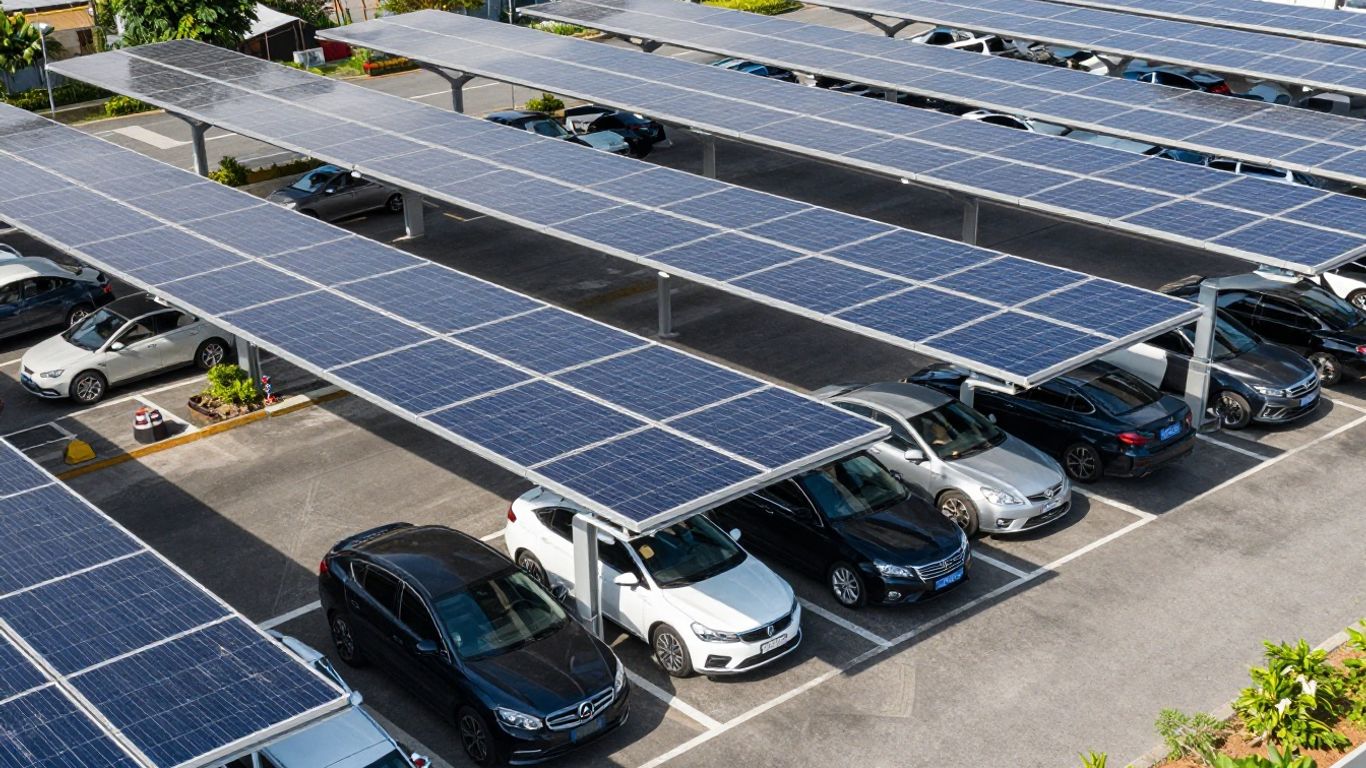
A photovoltaic canopy is essentially a shelter for vehicles that produces electricity. Imagine a structure, often made of metal or wood, designed to cover parking spaces. Solar panels are installed on its roof. The main purpose is twofold: firstly, to protect cars from bad weather and the sun, and secondly, to capture solar energy and convert it into electricity. The operation is quite simple: the photovoltaic modules on the roof capture sunlight and, through a phenomenon called the photoelectric effect, convert it into direct current. This current is not directly usable, so it passes through an inverter that transforms it into alternating current, the type used in our homes and businesses. This electricity can then be consumed on-site (self-consumption) or sold to the grid. It’s a smart way to make the most of an often under-utilised space.
Different Types of Canopies Available
There are several canopy configurations to suit different needs and locations. Linear structures are found, perfect for large car parks, forming continuous rows. There are also more compact models, such as individual or double carports, ideal for private individuals or small businesses. Some canopies have a double slope, in a V-shape, which helps with water drainage and can optimise production by orienting the panels towards the east and west. Others are simpler, with a single slope (monopitch), which often makes them more economical. Finally, for those seeking a particular aesthetic integration, there are so-called architectural canopies with more personalised designs.
Here is an overview of common types:
- Linear Canopies: Ideal for large areas, they cover multiple parking spaces in alignment.
- Individual/Double Carports: Compact solutions for 1 to 2 vehicles.
- Double-Sloped Canopies: V-shaped configuration for better water management and optimised production.
- Monopitch Canopies: Structure inclined in one direction, simpler and more economical.
- Architectural Canopies: Custom designs for advanced aesthetic integration.
Multiple Advantages of Solar Structures
The advantages of photovoltaic canopies are numerous and relate to economics, ecology, and comfort. For vehicles, they offer valuable protection against the scorching sun that can make the interior unbearable in summer, as well as against hail or snow. In terms of energy, they allow for the production of green electricity, thus contributing to the ecological transition and the reduction of the carbon footprint. This production can be used to reduce electricity bills for businesses or individuals, or even generate additional income by selling surplus energy. Furthermore, they enhance the value of parking spaces, improve a company’s image in terms of Corporate Social Responsibility (CSR), and can even be coupled with charging stations for electric vehicles, creating synergy with sustainable mobility. Finally, by covering asphalt, they help to limit the urban heat island effect. The installation of these structures is an opportunity that many professionals should seriously consider [0db5].
The Regulatory Framework for Photovoltaic Canopies
The installation of photovoltaic canopies in car parks is no longer just an option, but a legal obligation for many sites. This regulatory evolution, primarily stemming from the Climate and Resilience Law, aims to accelerate the deployment of renewable energies by utilising already built-upon surfaces. It is therefore essential to fully understand the legislation governing these installations to anticipate the necessary steps.
Obligations Arising from the Climate and Resilience Law
Article 101 of the Climate and Resilience Law, incorporated into the Urban Planning Code, now mandates the installation of photovoltaic canopies on outdoor car parks of a certain size. The objective is clear: to transform these parking areas into green energy production sites. This obligation applies to car parks larger than 1,500 m², whether existing or newly constructed.
The main requirements are as follows:
- Minimum Coverage: At least 50% of the total car park surface area must be covered by a structure incorporating a renewable energy production system.
- Integration: Solar panels must be integrated into the canopy structure.
- Scope: The obligation applies to car parks open to the public.
This measure is part of a broader effort to combat climate change and reduce the carbon footprint.
Implementing Decree and Technical Modalities
To clarify the scope of this law, an implementing decree has been published, providing clarifications on technical modalities and deadlines. This decree defines, in particular, how to calculate the area to be covered and the expected characteristics for the installations. It is important to note that canopies on parking areas are generally not subject to a systematic environmental assessment, even for significant power outputs, which simplifies certain procedures compared to other types of installations [e695].
The regulatory framework distinguishes several urban planning procedures based on the peak power of the installation and its location:
- Less than 3 kWp: No formalities or prior declaration, depending on height and location.
- Between 3 kWp and 3 MWp: Generally a prior declaration, unless in a protected area where a building permit may be required.
- More than 3 MWp: A building permit is required.
It is also specified that the canopy must cover at least 50% of the total car park area, not just 20% of the canopy’s built surface area [a5fc].
Deadlines and Compliance Schedule
The implementation schedule for this obligation is progressive and depends on the size of the car parks:
- Car parks larger than 10,000 m²: The deadline is 1st July 2026.
- Car parks between 1,500 m² and 10,000 m²: The deadline is 1st July 2028.
- New constructions larger than 1,500 m²: The obligation applies from the opening of the car park.
Given the time required for feasibility studies, obtaining administrative authorisations, and carrying out the works, which can take 12 to 18 months, it is imperative to anticipate these deadlines. Failure to meet these deadlines may result in penalties.
There are cases of exemptions, particularly for insurmountable technical constraints or specific easements, but these are strictly regulated and require solid justification.
Exemptions and Alternatives to the Obligation
Cases of Exemptions and Justifications Required
The obligation to install photovoltaic canopies in car parks is not absolute. Specific situations may allow for exemption. However, it is imperative to be able to justify these exemptions to the competent authorities. The main reasons include major technical constraints that would make installation impossible or dangerous, or implementation costs deemed excessive. This excessiveness is generally assessed in relation to the cost of creating or renovating the car park, or its market value if the car park is existing and the works are solely to meet this obligation. The ratio between the cost of the works and these reference values must not exceed a certain threshold, set at 10% to establish the excessive nature of the expenditure. It should also be considered that potential income from electricity sales over 20 years can reduce the cost of works to be taken into account in this calculation. The idea is not to impose a burden that would compromise the economic viability of the car park owner. Car parks integrated into buildings (underground or covered) are, by nature, excluded from this obligation.
The justifications required for these exemptions must be presented in the form of a certificate, including a non-technical summary. For cases of economic overcost, a techno-economic study carried out by a qualified company is often requested. This study must demonstrate that the investment is not profitable, for example, if the return on investment period exceeds 20 years. It is important to note that temporary car parks, planned for less than 5 years, are not subject to this obligation. Similarly, if more than half of the car park is already naturally shaded by trees, the installation of canopies may be dispensed with. The law simplifying urban planning and housing law of 26 November 2025 introduced provisions to facilitate the integration of these installations, while providing safeguards for specific situations.
The Alternative of Equivalent Solarisation
Another way to comply with the spirit of the law, without necessarily resorting to traditional canopies, is to implement equivalent solarisation. This approach, introduced by legislation, allows for meeting the renewable energy production obligation through means other than structures above parking spaces. This could involve, for example, installing photovoltaic panels on the roofs of adjacent buildings, or other types of solar installations on available spaces. The essential point is that the renewable energy production generated is comparable to what would have been obtained with canopies. The precise calculation methods to establish this equivalence are yet to be defined by decree, but the objective is clear: to encourage green energy production in all its relevant forms. The minimum coverage rate for shading structures incorporating renewable energy production has been adjusted to 17.5%, thus offering more flexibility.
Pooling Installations Across Multiple Car Parks
For companies or entities owning multiple car parks, a strategic solution is to pool efforts. It is possible to distribute photovoltaic installations across different car parks located on the same site. The solarisation obligation must then be met globally for the entire site. This means that the area covered by canopies or other renewable energy production devices must reach the required threshold, taking into account all affected car parks. This approach allows for cost optimisation and better integration of installations, potentially concentrating efforts on the most suitable areas. A combination of photovoltaic canopies and greening solutions can also be considered to meet regulatory requirements while providing additional ecological benefits.
Design and Sizing of Installations
The Importance of a Prior Feasibility Study
Before embarking on the construction of photovoltaic canopies, a preliminary step is essential: the feasibility study. It’s a bit like preparing the ground before building a house. Several factors need to be examined to ensure the project is viable. The nature of the soil is assessed to determine the type of foundations required, as unstable soil demands more work. Local planning regulations, such as the Local Urban Plan (PLU), must also be checked to ensure your project is permitted and that there are no easements that could cause problems. Site sunlight is, of course, crucial for calculating the expected electricity production. Finally, the feasibility of electrical connection to the grid must be studied, as this can impact cost and deadlines. A good feasibility study helps avoid many unpleasant surprises later on.
Structural Sizing Constraints
Once feasibility is confirmed, the structure itself needs to be considered. Canopies must be robust to withstand adverse weather conditions, particularly wind and snow. European standards, known as Eurocodes, provide the rules to follow to ensure structural safety. Wind is often the most determining factor, especially in exposed areas. The height under the canopy must also be sufficient for vehicles to pass without issue, generally at least 2.50 metres, or even 3 metres for larger vehicles. The spacing between posts is also an important point, as it influences the total cost of the structure. Larger spans can reduce the number of posts but require more robust structures. Galvanised steel is often used because it is strong and long-lasting, but aluminium or glued laminated timber are also options, each with its own advantages and disadvantages in terms of cost and aesthetics. It is important to choose the material that best suits your project and budget. For foundations, it is recommended to consult specialists to ensure their stability, as suggested by the recommendations for foundations for photovoltaic structures.
Optimising Photovoltaic Sizing
For each parking space covered, it is generally possible to install between 1.5 and 2 kWp (kilowatt-peak) of solar panels. This means that for a standard installation, approximately 3 to 4 panels are used per space. The orientation and tilt of the panels are important for maximising energy production. A slight tilt, between 5° and 15°, is often ideal. It aids architectural integration and reduces wind resistance, even if it slightly decreases production compared to a steeper tilt. A south-facing orientation remains the best, but south-east or south-west orientations also yield good results, with a production loss of less than 10%. Consideration must also be given to the integration of modules onto the structure. Rail-mounted systems are flexible and easy to maintain. Integrated systems, which also provide waterproofing, are more expensive. Waterproofing is a critical point; a gutter system must be provided to drain rainwater. The choice of inverters, which convert the direct current from the panels into usable alternating current, is also important. For medium-sized installations, central inverters are often preferred. Connection to the electricity grid can take several months, so this process must be anticipated. Good planning of these elements allows for optimisation of your installation’s energy production. To assist you in this process, there are photovoltaic design software that can facilitate the process.
The sizing of a photovoltaic canopy is an exercise in balancing structural constraints, energy production objectives, and budget limitations. A methodical approach, starting with a solid feasibility study, is the key to a successful project.
Here is a simplified example to illustrate the sizing:
| Car Park Size | Number of Spaces | Canopy Area (50%) | Estimated PV Power | Annual Production (South) |
|---|---|---|---|---|
| 1,500 m² | 60 spaces | 30 spaces | 54 kWp | 65,000 kWh |
| 2,500 m² | 100 spaces | 50 spaces | 90 kWp | 108,000 kWh |
| 5,000 m² | 200 spaces | 100 spaces | 180 kWp | 216,000 kWh |
Cost and Profitability of Solar Canopies
Estimating the Cost of a Photovoltaic Canopy
The cost of a photovoltaic canopy can vary considerably depending on its size, installed capacity, and the materials used. Generally, the price of an installation is estimated between €0.9 and €1.4 excluding VAT per Watt-peak (Wp). For a 100 kWp installation, for example, the budget could range from €60,000 to €180,000 excluding VAT. It is important to note that this price includes the structure, solar panels, inverter, and complete installation. Administrative costs and preliminary studies should also be taken into account.
Here is an idea of average prices according to power output:
- Less than 100 kWp: €1.2 to €1.4 excluding VAT/Wp
- Between 100 and 500 kWp: €1.2 to €1.5 excluding VAT/Wp
- More than 500 kWp: €0.95 to €1.05 excluding VAT/Wp
These figures provide an initial idea, but a personalised study is essential to obtain an accurate quote.
Profitability Criteria and Amortisation Period
The profitability of a photovoltaic canopy depends on several key factors. The main advantage is the reduction in electricity bills through self-consumption. The electricity produced can cover a significant portion of the company’s energy needs. Furthermore, selling surplus electricity to EDF OA (Obligation d’Achat) generates additional income. The amortisation of the investment is generally between 7 and 10 years. This period can be shortened thanks to available financial aid and good optimisation of production and consumption.
Several elements influence this duration:
- The initial cost of the installation.
- The purchase price for electricity sold to EDF OA.
- The price of electricity that the company will no longer have to buy from the grid.
- Any maintenance costs.
- The region’s sunshine conditions.
Profitability analysis must include a projection over the lifespan of the panels, which often exceeds 25 years, thus ensuring long-term benefits well after the initial amortisation.
Financial Aid and Support Schemes
To encourage the deployment of photovoltaic canopies, several support schemes exist. EDF’s Obligation d’Achat (OA) allows for the sale of produced electricity at a guaranteed rate for 20 years. There is also the self-consumption bonus, which reduces the initial cost of the installation for self-consumption projects with surplus sales. Local authorities may also offer specific aid. Enquiring about these schemes is an important step to optimise the return on investment for your solar canopy project. This financial aid can significantly improve the economic viability of your installation.
Economic and Strategic Advantages
Reducing Electricity Bills Through Self-Consumption
One of the most direct benefits of installing photovoltaic canopies is the ability to produce one’s own electricity. This production can be directly consumed on-site, significantly reducing dependence on traditional energy suppliers and, consequently, lowering electricity bills. For businesses, especially those with car parks exceeding 1,500 m², this self-consumption often coincides with peak consumption during opening hours, thus optimising the use of produced energy. It is a concrete way to control operational costs.
Generating Income Through Electricity Sales
Beyond self-consumption, the surplus electricity produced by canopies can be sold to the grid. Schemes such as the guaranteed purchase price from EDF Obligation d’Achat (EDF OA) offer the prospect of stable additional income. This dual opportunity – reducing expenses and generating revenue – makes the photovoltaic canopy project particularly attractive financially. The relative profitability of the project should be less than 10 years, taking into account available financial aid.
Enhancing Parking Space Value
Vast areas dedicated to parking, often considered inert spaces, are transformed with photovoltaic canopies into genuine economic and strategic assets. They not only ensure compliance with the law but also improve user comfort by offering protection against bad weather and heat. Furthermore, the integration of charging stations for electric vehicles, powered by the solar energy produced, adds significant value, meeting growing demands for sustainable mobility. The installation of photovoltaic canopies in car parks represents considerable development potential for accelerating the energy transition through the massive deployment of photovoltaics.
The utilisation of parking areas for green electricity production is a winning strategy. It transforms a land occupation cost into a source of income and savings, while strengthening the ecological image of the entity deploying them. Profitability is often assured over a reasonable amortisation period, making the investment all the more relevant.
Here are the main economic and strategic advantages:
- Reduced Energy Costs: Direct decrease in electricity bills through self-consumption.
- Additional Revenue: Generation of income by selling surplus electricity to the grid.
- Land Optimisation: Enhancement of already built-upon spaces without encroaching on other areas.
- Increased Attractiveness: Improved user comfort (vehicle protection) and integration of services such as electric vehicle charging.
- Regulatory Compliance: Meeting legal obligations, thus avoiding potential penalties.
Environmental Impact and Company Image
Contribution to the Energy Transition
The installation of photovoltaic canopies in car parks represents a concrete and visible step towards the energy transition. By transforming often under-utilised spaces into clean energy production plants, these structures actively contribute to reducing our dependence on fossil fuels. They enable the production of local, renewable electricity, thereby lowering the overall carbon footprint.
Improving Carbon Footprint and CSR
Beyond simple energy production, solar canopies play a significant role in improving the carbon footprint of businesses and local authorities. They fit perfectly into a Corporate Social Responsibility (CSR) approach, demonstrating a strong commitment to sustainable development. This initiative enhances the organisation’s brand image, positioning it as a responsible player concerned about its environment. Customers, partners, and employees are increasingly sensitive to these ecological commitments.
Synergy with Electric Mobility
One of the most interesting advantages of photovoltaic canopies lies in their ability to integrate harmoniously with the development of electric mobility. Indeed, these structures can easily be equipped with charging stations for electric vehicles. Thus, users can recharge their cars using locally and ecologically produced electricity, directly at the parking location. This creates a virtuous synergy between solar energy production and the use of low-emission vehicles, thereby optimising energy consumption and offering an appreciated additional service.
- Green Energy Production: Reduction of greenhouse gas emissions.
- Brand Image: Enhancement of ecological commitment.
- Additional Services: Integration of charging stations for electric vehicles.
- User Comfort: Shading of vehicles and facilitated charging.
The adoption of photovoltaic canopies is not just a response to a regulatory obligation; it is a business strategy that combines economic performance, environmental responsibility, and improved user experience. It is an investment in the future, both for the organisation and for the planet.
Maintenance and Lifespan of Equipment
Importance of Regular Maintenance
For your photovoltaic canopies to continue operating optimally and producing electricity for many years, regular maintenance is absolutely necessary. It’s not just about a quick clean-up now and then; it needs to be taken seriously. Ignoring this step risks seeing your installation’s performance decrease, or even encountering more serious problems that could be costly to repair. Think of it like maintaining your car: if you don’t change the oil, it won’t last very long.
Common tasks include:
- Cleaning the panels: Dust, leaves, and bird droppings can reduce the amount of sunlight reaching the cells. Periodic cleaning, often once or twice a year depending on the environment, is therefore recommended.
- Visual inspection of structures: Check the condition of fixings, cables, and the supporting structure for any corrosion, wear, or damage.
- Checking electrical connections: Ensure all cables are properly connected and there are no signs of overheating or corrosion.
- Inverter check: Ensure the inverter is functioning correctly and there are no error messages.
It is often advisable to use professionals for these tasks, especially for electrical and structural checks, to ensure the safety and effectiveness of the intervention. Not neglecting maintenance can save you costly setbacks and extend the life of your investment. Avoiding common mistakes is a good first step.
Lifespan of Panels and Structures
Modern photovoltaic panels are designed to be robust and durable. Generally, their lifespan is estimated between 25 and 30 years, or even more. Most manufacturers also offer 25-year performance guarantees, ensuring that the panels will still produce a certain percentage of their initial capacity after this period. The supporting structures, often made of galvanised steel or aluminium, are also designed to withstand adverse weather conditions for several decades, often more than 30 years. The choice of materials and the quality of the initial installation play a major role in this longevity. For example, a well-maintained galvanised steel structure can last a very long time, while aluminium offers natural resistance to corrosion.
Recycling and End-of-Life Recovery
When solar panels reach the end of their life, it is important to consider their recycling. Just because they no longer produce electricity optimally doesn’t mean they should end up in landfill. Solar panels contain valuable materials such as silicon, glass, aluminium, and sometimes rare metals, which can be recovered and reused. Specific recycling channels are developing and being structured to process this equipment. The goal is to maximise material recovery and minimise environmental impact. It is therefore essential to find out about the collection and recycling facilities available in your region to ensure that your old panels are processed responsibly. The lifespan of panels is long, but their end-of-cycle must be anticipated.
For your solar panels to last a long time and work well, they need to be looked after. Good maintenance is key to them providing you with clean energy for many years. Want to know how to keep your solar installation in top condition? Visit our website to discover our tips and tricks!
Conclusion
In summary, the installation of photovoltaic canopies is no longer a mere option but a legal obligation for many car parks, effective from 2026. Beyond compliance, this initiative represents a concrete opportunity for businesses to produce their own green energy, reduce their costs, and even generate additional revenue. Although the initial investment may seem substantial, profitability is generally achieved in less than ten years, thanks to the savings made and the existing support schemes. It is therefore advisable to anticipate these changes and embark on this project that combines economic performance and environmental commitment.
Frequently Asked Questions
What exactly is a photovoltaic canopy?
A photovoltaic canopy is like a large special roof for car parks. It’s designed to provide shade for cars, but also to produce electricity thanks to solar panels installed on it. It’s a smart way to use car park space to generate clean energy.
Am I obliged to install a canopy on my car park?
Yes, if your car park is larger than 1500 square metres, you are obliged to install solar panels on it. This is a new rule to help produce more green energy. There are deadlines to meet, so it’s best to get started in advance.
How much does it cost to install a photovoltaic canopy?
The price can vary, but to give you an idea, installing a canopy generally costs between 900 and 1400 euros per kilowatt-peak of power. It’s an investment, but remember it can save you money on your electricity bills.
Is it financially worthwhile?
Absolutely! In addition to providing shade, the electricity produced can be used by your company to reduce your expenses, or even sold. Often, the money saved or earned allows you to pay back the installation cost in 7 to 10 years.
What are the different types of canopies available?
There are several shapes: long rows that cover many spaces, smaller ones for a few cars, ‘V’-shaped canopies for better water drainage, or simpler structures. We can even make very attractive ones that integrate well into the landscape.
What happens if I don’t comply with the obligation to install a canopy?
If you do not comply with the law within the deadlines, you could face a fine. It can be up to 40,000 euros per year. That’s why it’s important to follow the schedule and take the necessary steps.
Are there cases where I am not obliged to install one?
Yes, there are exceptions. If it’s technically impossible, for example, due to grid connection problems, or if the cost is truly too high compared to the savings, or if the car park is already very shaded by trees. In such cases, you must explain why and provide justification.
How does a photovoltaic canopy work to produce electricity?
The solar panels on the canopy capture sunlight. They convert it into electricity through a process called the photoelectric effect. Then, a device called an inverter transforms this electricity so it can be used by electrical appliances or sent to the grid.

Journaliste spécialisée en transition énergétique et consultante RSE. À 42 ans, Claire combine une formation en journalisme (Master Sciences Po) et un diplôme d’ingénierie environnementale (École des Mines / INSA). Après 10 ans dans la presse économique et 7 ans en cabinet de conseil RSE, elle écrit pour aider les décideurs B2B à comprendre les réglementations, les enjeux climatiques et les innovations énergétiques.