
Choosing the right connection for your solar panels is an important step. Whether in series or parallel, each method has its advantages and disadvantages. This is not a decision to be taken lightly, as it directly influences the performance of your installation and how you can use the energy produced. This article aims to clarify the differences between these two configurations, so you can make an informed choice for your solar panel connection project.
Key Takeaways
- Series connection increases the total system voltage while keeping the current at the level of a single panel. This is often preferred for systems requiring higher voltage, such as powering the domestic electrical grid (230V).
- Parallel connection increases the total system current while keeping the voltage at the level of a single panel. This configuration is more tolerant to shading as the panels operate more independently.
- Shading on a panel in a series configuration can significantly reduce the output of the entire system. In parallel, the impact is less.
- The choice between series and parallel depends on your specific needs: high voltage for certain uses (series), high current for others (parallel), and compatibility with your battery or inverter voltage.
- It is possible to combine both types of connections in a hybrid configuration to benefit from the advantages of each method, but this requires more complex planning and installation, often with the help of professionals.
Understanding the Basics of Solar Panel Connection
Before you start installing your solar panels, it’s essential to grasp a few key concepts about electricity. Two notions are particularly important: voltage and current. Understanding their roles will help you choose the best configuration for your system.
Electrical Voltage and Current: The Fundamentals
Voltage, often measured in Volts (V), represents the
Specifics of Series Solar Panel Connection
Series connection is a common method for connecting solar panels, particularly valued for its simplicity and efficiency in certain situations. It involves connecting the panels one after another, linking the positive (+) terminal of one panel to the negative (-) terminal of the next. This process creates a chain where the current flows successively through each unit.
Increased Voltage and Constant Current
The main effect of this type of connection is the addition of the individual voltages of each panel. Thus, if you have multiple panels, the total voltage of the string will be the sum of their respective voltages, while the current remains the same as that of a single panel. For example, with eight panels, each producing 37 volts and 12 amps, the total voltage reaches 296 volts (8 x 37 V), but the current does not exceed 12 amps. This configuration is therefore ideal when the goal is to achieve a high voltage to power specific systems, such as an inverter requiring a significant input voltage.
Impact of Shading on a Series Connection
A major drawback of series connection is its sensitivity to shading. If a single panel in the string is partially shaded or dirty, its energy production decreases, which in turn limits the performance of all the panels connected in series. It’s as if the weakest link in the chain dictates its strength. This can lead to significant yield losses, especially in environments where shading is frequent or variable.
Preferred Use Cases for Series Mounting
Series mounting is particularly suitable in the following cases:
- Electricity production for the grid or self-consumption with resale: The objective is often to reach the voltage required to feed the produced electricity into the public grid (typically 230 V).
- Powering high-voltage inverters: Some solar inverters require a high input voltage to operate efficiently.
- Installations with long cabling distances: By increasing the voltage, the required cable cross-section can be reduced, which decreases energy losses over long distances and lowers cabling costs.
It is important to note that the high voltages generated by a series connection can pose increased risks. Professional installation and the use of appropriate equipment are therefore strongly recommended to ensure safety and prevent overheating or fires.
Advantages of Parallel Solar Panel Connection
Increased Current and Constant Voltage
Parallel connection, also known as shunt mounting, has a fundamental characteristic: it allows you to increase the current capacity of your installation while maintaining a stable electrical voltage, equivalent to that of a single panel. In practice, this means that if you connect several panels in parallel, the output voltage will remain the same as that of an individual panel, but the total current will be the sum of the currents from each panel. It’s a bit like opening several water taps at the same time; the total flow increases, but the pressure at each tap remains the same.
Here’s an example to illustrate: if you have two panels of 24V and 12A each, connecting them in parallel will give an output of 24V and 24A. If you add a third, you will still get 24V, but with 36A. This configuration is particularly interesting for systems that require high current but a more moderate voltage.
| Number of panels | Electrical voltage (V) | Electrical current (A) |
|---|---|---|
| 1 | 24 | 12 |
| 2 | 24 | 24 |
| 3 | 24 | 36 |
| 4 | 24 | 48 |
Panel Independence and Shading Tolerance
One of the major advantages of parallel mounting lies in the independence of each panel. Unlike series mounting where a single shaded panel can affect the performance of the entire string, in parallel, each panel operates autonomously. If a panel is partially obscured by shade, only its own production will be reduced, without impacting the others. This ensures more consistent and reliable energy production, even in variable sunlight conditions or when obstacles (trees, chimneys) create shaded areas.
This independence is a considerable advantage for optimising the overall production of your solar installation. You thus benefit from the full capacity of each panel, regardless of local conditions.
Adaptation to Low-Voltage Systems
Parallel connection is often preferred for systems operating at low voltage. Indeed, as mentioned, the voltage remains that of a single panel. This makes the configuration safer, as the risks of electric shock are reduced compared to the higher voltages generated by series mounting. It is an ideal solution for powering devices or batteries that operate with a lower voltage. Furthermore, it can simplify the choice of other system components, such as charge controllers or inverters, which are often designed for specific voltage ranges. Parallel connection aligns well with the needs of many residential and small-scale systems, offering a safer approach to energy management.
Parallel mounting is an excellent option when the priority is to maintain a low voltage and maximise production in case of partial shading. It offers valuable flexibility for adapting the installation to specific energy needs and variable environmental constraints.
Choosing the Right Connection for Your Energy Needs
Prioritising High Voltage for Certain Uses
When we think of a solar installation, we often imagine producing electricity for our homes. But the way we connect the panels changes everything. If your goal is to achieve a higher voltage, for example, to power a system that demands a lot, series connection is the way to go. It’s a bit like connecting batteries one after another to get more power. This configuration allows the voltage of each panel to be added together. This can be particularly useful if you need to send electricity over a long distance to your inverter or battery, as higher voltage means less energy loss in the cables. Consider this if you have a system that operates at 230V or if you are charging a battery that requires significant voltage.
Preferring Current for Other Applications
Conversely, if your main need is to increase the amount of current (amperage), parallel connection is more suitable. Here, panels are connected so that the current from each adds up, while maintaining a more stable voltage, often that of a single panel. This approach can be simpler for some systems, especially those operating at lower voltages. The advantage is that if one panel is less efficient due to shade, the others continue to produce without the entire string being as affected as in a series setup. It’s a kind of independence that can be valuable.
Adapting the Connection to Battery Voltage
The battery is often the heart of an off-grid solar installation. Its type and operating voltage will directly influence the choice of connection for your panels. Batteries designed to operate at high voltage (e.g., some modern home storage batteries) will work better with a series connection of panels, as this makes it easier to reach the required voltage for charging. For batteries operating at lower voltages, such as those found in smaller or older systems, a parallel connection will be more appropriate. It is therefore important to know the specifications of your storage system before deciding how to connect your solar panels.
The choice between series and parallel is not just a technical matter; it’s a decision that must align with the specific needs of your installation, how you intend to use the energy produced, and the characteristics of your equipment, such as the inverter and battery.
Technical Considerations for Solar Panel Connection
Compatibility with Inverters and Charge Controllers
The choice between a series or parallel connection for your solar panels is not trivial; it has direct implications for compatibility with other components of your photovoltaic system, particularly inverters and charge controllers. These devices are designed to operate within specific voltage and current ranges. A series connection increases voltage while maintaining current, which can be ideal for certain inverters that require a high input voltage to operate efficiently. Conversely, a parallel connection increases current while maintaining voltage, which is better suited to other types of inverters or charge controllers designed for low-voltage systems. It is therefore imperative to consult the technical specifications of your inverter or charge controller before deciding on your panel configuration. A mismatch can lead to reduced performance or even damage to the equipment. For example, if you connect too many panels in series and the voltage exceeds the maximum limit accepted by your inverter, it may not start or may go into safety mode. Similarly, too low a current in a parallel configuration could prevent a charge controller from functioning correctly. It is often recommended to check the maximum input voltage of your inverter to ensure it matches the total voltage of your series panel string.
Influence of Orientation and Tilt
The orientation and tilt of your solar panels are determining factors for energy production, and their impact differs depending on the type of connection. In a series configuration, all panels are interconnected, forming a single string. If part of this string is shaded, even slightly, the production of all panels can be significantly reduced. This is known as the ‘weakest link’ effect. A shaded panel acts as a resistor, limiting the current for all other panels in the series. This can happen, for example, if a tree casts its shadow on a single panel in the middle of the day. In contrast, a parallel connection offers better tolerance to shading. Each panel or group of panels in parallel operates more independently. If a panel is shaded, it will primarily affect its own production, with less impact on the rest of the installation. This is why, in areas where shading is frequent or difficult to avoid, parallel connection is often preferred to maintain more stable production. It is therefore wise to carefully assess the sunlight conditions of your installation site before making your choice. A shading study can be very useful for anticipating these problems.
Impact on Cable and Connector Choice
The type of connection directly influences the choice of cables and connectors needed for your solar installation. For a series connection, voltage is added, meaning you will have a higher overall voltage. Although the current remains the same as that of a single panel, the high voltage generated requires additional precautions. Cables must be sized to withstand this voltage and be properly insulated for safety reasons. Connectors must also be of good quality and suitable for high voltages. On the other hand, for a parallel connection, current is added, while voltage remains that of an individual panel. This implies that you will have a higher total current flowing through the cables. To carry this higher current without excessive heating or energy loss, cables with a larger cross-section (thicker) must be used. Using undersized cables for high current can lead to overheating, premature cable degradation, or even a fire risk. The choice of connectors must also take into account their capacity to handle the total current. It is therefore essential to correctly calculate the required cable cross-sections based on the total amperage of your parallel installation and the distance to be covered, in order to ensure the safety and efficiency of your system.
Optimising Your Installation with a Hybrid Connection
Principle of Mixed Series and Parallel Connection
It is entirely possible to combine the advantages of series and parallel connections to create a so-called hybrid configuration. This approach allows for fine-tuning the voltage and current of your solar installation. In practice, this involves creating groups of panels connected in series, and then connecting these groups together in parallel. For example, you could have several strings of four panels connected in series, and then connect these strings in parallel. This allows for a higher voltage than parallel mounting alone, while increasing the available current compared to a simple series mounting.
Combined Advantages for Increased Performance
The main benefit of a hybrid connection lies in the flexibility it offers for optimising the overall performance of your system. By adjusting the number of panels in series in each group and the number of groups connected in parallel, you can adapt the electrical output to the specific needs of your installation and the characteristics of your equipment, such as the input voltage of your inverter or charge controller. Furthermore, this configuration can help to better manage the effects of partial shading, as the failure of a panel in a series string will have less impact on the entire system if that string is itself connected in parallel with others.
Conditions Required for a Hybrid Installation
To implement a hybrid connection, several points need to be considered. First, you must ensure you have enough space to deploy the panels according to the chosen configuration. Compatibility with your inverter or charge controller is also crucial; carefully check the voltage and current ranges accepted by your equipment. It is also recommended to use bypass diodes to protect the panels against reverse currents, especially in complex configurations. Finally, due to the increased complexity compared to a simple setup, it is strongly advised to use a qualified professional to design and install your hybrid system. An incorrect configuration could lead to efficiency losses or safety problems.
Factors Influencing Connection Choice
The choice between a series or parallel connection for your solar panels is not trivial. It depends on several concrete elements that will impact the overall performance of your installation. You need to think carefully about what is most important for you and your project.
Available Space for Installation
The surface area you have available for installing your solar panels is a determining factor. If you have a large, clear, and well-exposed space, series connection can be an interesting option. It allows for maximising voltage, which is useful in certain configurations. On the other hand, if your space is more limited or if you have architectural constraints, parallel connection might be more suitable. It allows for higher total power on a given surface, even if the voltage is lower. Therefore, you need to carefully assess the configuration of your roof or land.
Sunlight and Shading Conditions
The environment in which your panels will be installed plays a major role. Areas prone to shading, even partial, can seriously affect the production of an installation. In a series setup, shade on a single panel can reduce the performance of the entire string. This is a notable weak point. Parallel connection offers better tolerance to shading. Each panel or group of panels operates more independently, thus limiting the impact of a shaded area on overall production. Consider carefully observing your installation site throughout the day and seasons.
Budgetary and Complexity Constraints
Budget and installation complexity are also factors not to be overlooked. Series connection generally requires less cabling and specific connectors, which can reduce some initial costs and simplify installation. However, it may require more robust components to handle the higher voltage. Parallel connection, while more tolerant to shading, may involve the use of thicker cables to handle the higher current, increasing material costs. It may also require additional connectors, such as Y-connectors, to link the different circuits. It is important to weigh these elements to make the most judicious choice for your project, taking into account your overall budget.
It is essential to conduct a personalised study of your site and your needs before making a decision. An incorrect configuration can lead to significant yield losses and increased long-term maintenance costs.
Implications of Connection on Safety and Maintenance
Electrical Risks Associated with Each Configuration
The type of connection chosen for your solar panels has direct repercussions on the safety of the installation and the electrical risks involved. A series connection, while effective for increasing voltage, presents an increased risk. Indeed, the cumulative voltage can reach high levels, increasing the danger in case of accidental contact or insulation failure. Overheating is also more likely in this type of configuration, which can lead to fires or electrocutions if the components are not of good quality or if the installation is not carried out according to best practices.
Conversely, parallel connection maintains a lower voltage, closer to that of an individual panel. This considerably reduces the risk of electric shock. However, the electrical current can become very significant in a parallel configuration. High current, even at low voltage, can cause significant heating in cables and connections, leading to fire risks if the wiring is not correctly sized and protected. It is therefore essential to choose suitable components and adhere to safety standards, regardless of the configuration.
Complexity of Installation and Repairs
Maintenance and potential repairs also differ depending on the type of connection. A series installation is generally simpler to wire, as it requires fewer connections and cables. This can translate into a faster and potentially less expensive installation in terms of labour. However, in case of a panel failure in a series string, the entire string can be affected, making diagnosis and repair more complex. The faulty panel must be identified to restore the proper functioning of the whole.
Parallel connection, while more tolerant to shading and individual failures (a faulty panel does not affect others), requires more cabling and additional connectors (often Y-connectors). This increased complexity can make installation longer and more expensive. However, repairs are often simpler to isolate, as the problem is usually localised to a specific panel or branch. It is important, however, to ensure that all cables are correctly sized to handle the total current, which may require thicker and therefore more expensive cables.
Need for Bypass Diodes
Bypass diodes, also known as blocking diodes, play an important role in the safety and performance of solar installations, particularly in series and hybrid configurations. Their main function is to prevent current from flowing in the reverse direction, i.e., from the panels to the storage system or inverter, or from one panel to another in a string.
In a series connection, if a panel is shaded or faulty, it can act as a resistor, dissipating the energy of other panels as heat. A bypass diode placed in parallel with each panel (or group of panels) allows the faulty panel to be bypassed, thus avoiding significant power loss for the entire string and preventing overheating of the faulty panel. In parallel installations, they can be used to isolate specific branches in case of a problem. The installation of bypass diodes is therefore an essential safety and optimisation measure to ensure the longevity and performance of your solar installation.
Cost Comparison Between Series and Parallel Connection
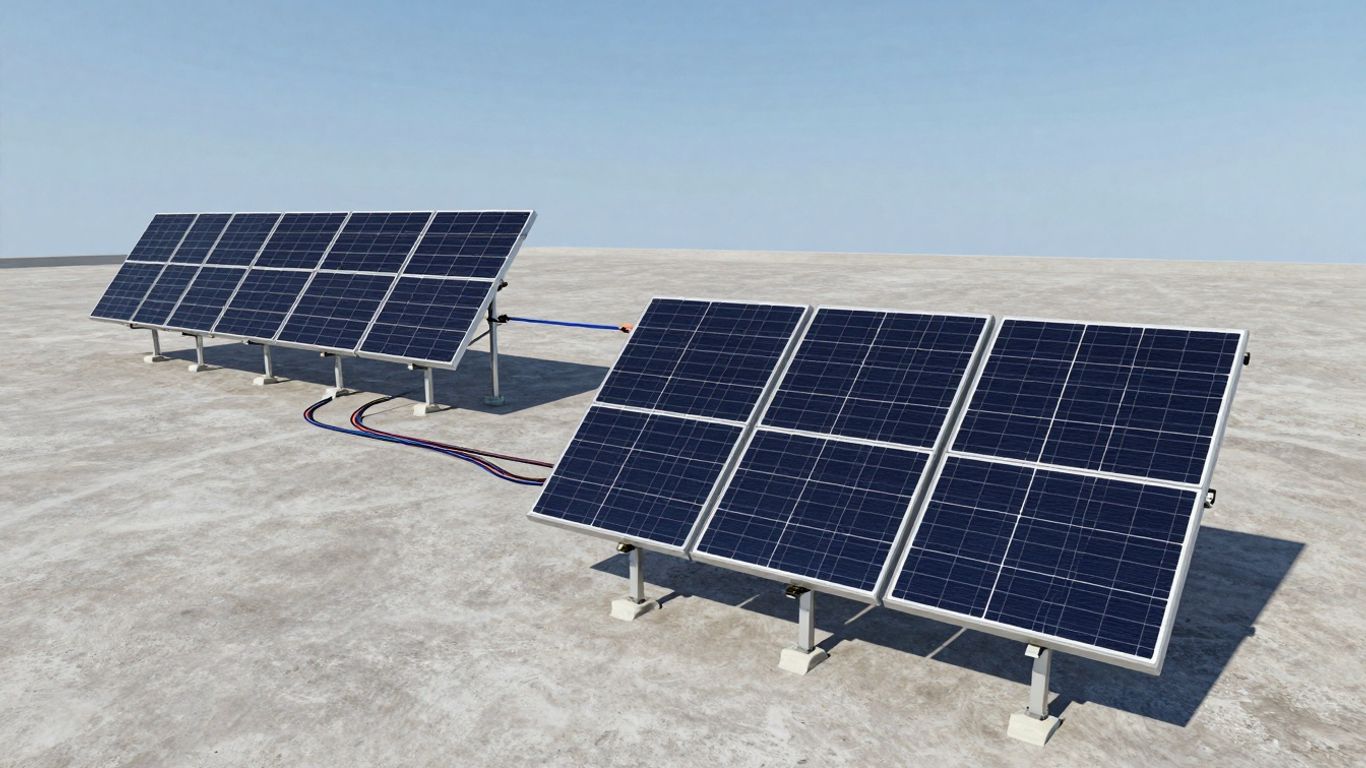
When considering installing solar panels, cost is often a determining factor. It’s important to know that the type of connection chosen, series or parallel, has a direct impact on the overall budget of your installation. Although the panels themselves represent a significant part of the investment, ancillary components can significantly alter the bill.
Cost of Additional Components for Series Mounting
Series connection, which involves connecting panels one after another (the positive of one panel to the negative of the next), increases voltage. To achieve this, it generally requires less cabling than parallel mounting, which can reduce some costs. However, to ensure safety and performance, specific components may be required. For example, if a panel is shaded, it can limit the production of the entire string. To overcome this, power optimisers or micro-inverters can be added to each panel, which increases the initial cost. These devices allow each panel to operate independently, thus improving overall performance, especially in variable shading conditions. The cost of these additional components is a point to consider seriously.
Cost of Thicker Cables for Parallel Mounting
Parallel mounting, where all positive terminals are connected together and all negative terminals likewise, maintains low voltage while increasing current. This configuration requires more cables to connect each panel. Furthermore, as the current is higher, the cables must be of a larger diameter to avoid overheating and energy losses. Thicker cables are more expensive to purchase and can also make installation a bit more complex. Specific connectors, such as Y-connectors, must also be provided for these connections. The advantage is that if a panel is partially in shade, it only affects its own production, not that of the others. For a more precise estimate of costs related to cabling and other elements, you can consult a simulation of your installation.
Potential for Financial Aid for Installation
It’s good to know that financial aid is available for solar panel installations. Depending on your country and region, you may be eligible for tax credits, local subsidies, or favourable feed-in tariffs for the electricity you produce. These aids can significantly reduce the net cost of your installation, regardless of the connection type chosen. It is therefore advisable to inquire about the available schemes before making your decision. Using an RGE (Reconnu Garant de l’Environnement) certified professional in France, for example, is often a condition for benefiting from these aids. This ensures an installation that complies with standards and optimises your chances of receiving financial support.
Here is a simplified comparative table of potential costs:
| Connection type | Cost of cables | Cost of additional components | Installation complexity |
|---|---|---|---|
| Series | Fewer cables, but potentially thinner | Optimisers/Micro-inverters (optional but recommended) | Generally simpler |
| Parallel | More cables, but thicker | Specific connectors (e.g., Y) | Potentially more complex |
It is important to note that these costs are indicative and may vary depending on the quality of the materials chosen and the installers’ rates.
When to Call a Professional for Solar Panel Connection
Importance of Technical Expertise for Complex Configurations
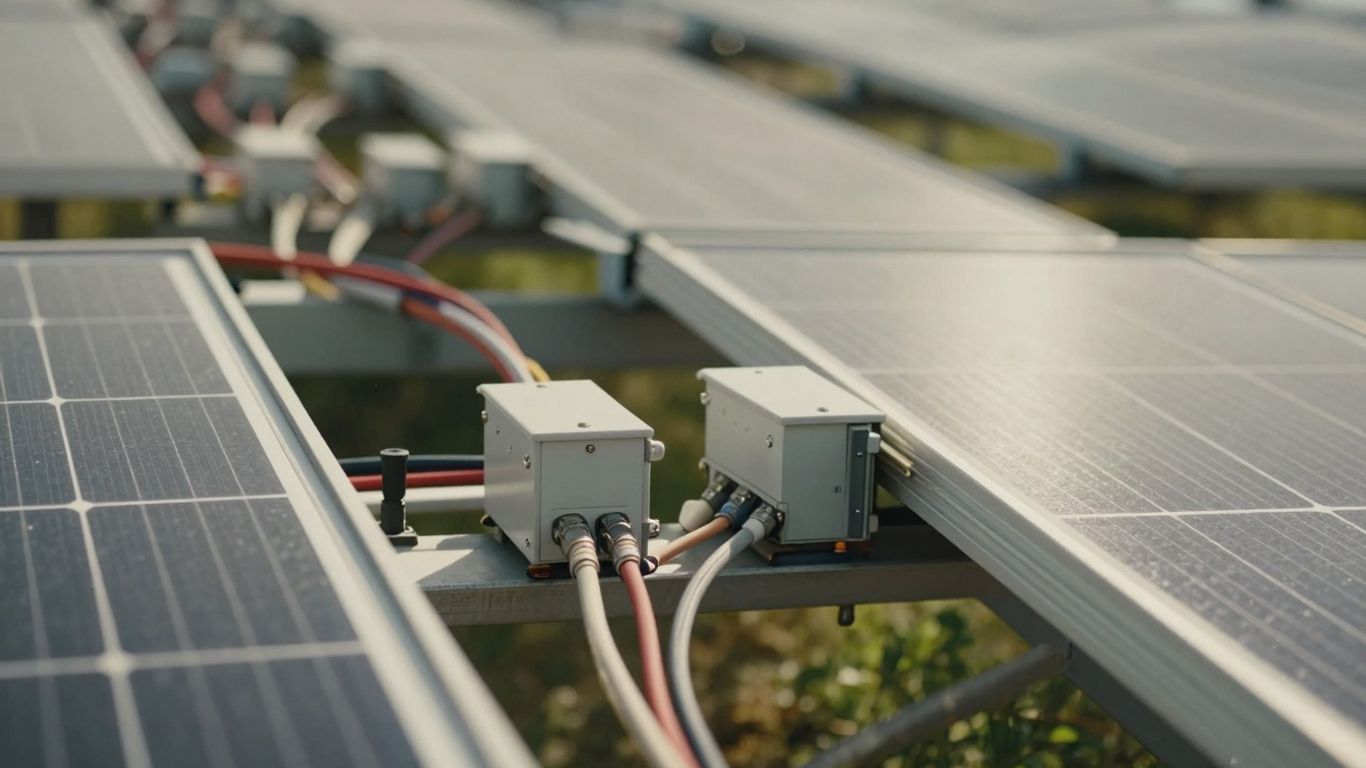
While the idea of installing your own solar panels might seem economical, it’s important to recognise that electrical connection, whether series or parallel, requires precise technical understanding. An error in wiring can not only reduce the efficiency of your installation but also pose serious safety risks. For configurations that are out of the ordinary, or if you are not entirely comfortable with electrical concepts, calling a professional is strongly recommended. They have the necessary knowledge to assess your specific situation and propose the most suitable solution.
Advice on Power, Orientation, and Equipment
A qualified installer doesn’t just connect your panels. They will guide you on crucial aspects that directly impact your system’s performance. This includes:
- Power sizing: Ensuring that the total power of your panels matches your energy needs and the capacity of your inverter or charge controller.
- Optimal orientation and tilt: Advising on the best placement to maximise solar exposure throughout the year.
- Equipment selection: Recommending appropriate cables, connectors, and protection devices to ensure the durability and safety of the installation. For example, for large-scale installations, a prior declaration of works or a building permit may be required, and a professional will know how to assist you with these procedures [a170].
Ensuring Optimal and Safe Installation
Entrusting the connection to an expert means ensuring that the installation complies with current standards and is carried out under the best safety conditions. This may include implementing specific protection devices, such as bypass diodes, and using certified equipment. Furthermore, a professional can inform you about any available financial aid and help you with the necessary paperwork. For public lighting works, specific training is even mandatory [174d]. In short, investing in a professional means investing in peace of mind and the long-term performance of your solar system.
Are you wondering when it’s time to ask for help installing your solar panels? That’s an excellent question! Sometimes, we can feel overwhelmed by the procedures, electrical connections, or technical aspects. If you have any doubts, or if the project seems a bit too complicated, it’s always safer to call in an expert. They will ensure everything is done correctly and safely, so you can make the most of your new installation. Don’t hesitate to contact us on our website to discuss your project and get personalised advice. We’re here to help you make your home more ecological and economical!
In Summary: Which Connection to Choose?
Ultimately, there is no single right answer to whether to connect your solar panels in series or parallel. Each method has its advantages and disadvantages. Series connection increases voltage, which can be useful in certain situations, but it is more sensitive to shading. Parallel connection increases current and is more resistant to shade, but may require more cabling. The choice will really depend on your specific installation, the space you have available, the sunlight conditions, and the equipment you are using, such as the type of charge controller. If you have any doubts, seeking professional advice is always a good idea to ensure everything is configured correctly and safely.
Frequently Asked Questions
What is the main difference between connecting solar panels in series and in parallel?
When you connect panels in series, it’s like putting them in a single file. The total voltage increases, but the current remains the same as that of a single panel. In parallel, it’s like placing them side-by-side; the total current increases, but the voltage remains the same as that of a single panel. It’s a bit like choosing between having more ‘strength’ (voltage) or more ‘flow’ (current).
In which situations is series connection preferable?
Series connection is great when you need higher voltage. For example, to charge batteries that require a certain minimum voltage, or to send electricity over longer distances without too much loss. It’s also better when the panels are not shaded at all, because if a single panel is hidden, the whole string slows down.
And when is it more advantageous to connect in parallel?
Parallel connection is ideal when you want to increase the total current while keeping the voltage lower. It’s safer because the voltage is lower. Also, if a panel is in shade, the others continue to produce electricity without being too affected. It’s perfect for systems where shade is a frequent problem.
Is it possible to mix the two types of connections?
Absolutely! It’s called a ‘hybrid’ or ‘mixed’ connection. You can create groups of panels in series, and then connect these groups in parallel. This allows you to combine the advantages of both methods: increasing voltage while having a higher total current. It’s a high-performance solution for optimising the installation.
What are the risks if a panel is in shade in a series installation?
If a single panel is shaded in a series installation, it’s as if the entire string slows down. The electricity production of all panels connected in series can drop significantly. That’s why series connection is mainly recommended in well-sunlit areas without obstacles.
Is parallel connection safer?
Yes, parallel connection is generally considered safer because the voltage remains lower, close to that of a single panel. This reduces the risk of electric shock. Furthermore, as the panels operate more independently, a fault or problem on one panel does not affect the rest of the system as much.
Do I need special equipment for each type of connection?
For series connection, especially if you are aiming for high voltage, it is often necessary to use an MPPT type charge controller. This type of controller is more efficient at adapting voltage and current. For parallel connection, a simpler controller (PWM) may sometimes suffice, especially for low-voltage systems.
When is it advisable to call a professional for the connection?
It is strongly recommended to call a professional if you are unsure, if your installation is complex, or if you want to guarantee optimal safety and performance. An expert can help you choose the best connection according to your needs, check equipment compatibility, and ensure everything is installed correctly and safely.
