
Wondering how to improve the electricity production of your solar panels? It’s a legitimate question when you consider the investment made. The efficiency of solar panels can vary quite a bit, and many factors play a role. Let’s look together at what makes a difference, from where you install them to the maintenance you provide. The goal is to ensure your panels give you the maximum return, without any fuss.
Key Points for Maximising Solar Panel Efficiency
- South-facing orientation and an adapted tilt, often around 30-35 degrees in France, are crucial for best capturing the sun’s rays throughout the year.
- It is absolutely essential to avoid shaded areas caused by trees, buildings, or other roof elements, as even minor shading can significantly reduce overall production.
- Environmental conditions such as your region’s sunshine and ambient temperature have a direct impact. Excessive heat can even decrease panel efficiency.
- Regular maintenance, including cleaning the panels to remove dust and dirt, is necessary to maintain optimal performance and extend the lifespan of the installation.
- Choosing quality components, from efficient cables to a suitable inverter, as well as exploring technologies like solar trackers or bifacial panels, can make a real difference to overall efficiency.
Understanding Solar Panel Efficiency
The efficiency of a solar panel is a bit like the fuel efficiency of a car: it indicates how much useful energy you get compared to what you put in. In our case, it’s the panel’s ability to convert sunlight into electricity. The higher this percentage, the more efficient the panel is, and the more profitable your installation will be.
Definition of Photovoltaic Efficiency
Photovoltaic efficiency, expressed as a percentage, represents the proportion of solar radiation that the panel’s cells manage to convert into usable electricity. Panel datasheets often indicate an efficiency calculated under Standard Test Conditions (STC). These conditions simulate an ideal summer day: 1000 W/m² irradiation, 25°C temperature, and an air mass of 1.5. The basic formula to calculate it is the panel’s nominal power divided by the panel’s surface area, multiplied by 1000 (which represents the sun’s power per m² under these ideal conditions). For example, a 400 Wp panel covering 2 m² would have a theoretical efficiency of (400 / 2) / 1000 * 100 = 20%.
It is important to note that the type of technology influences this efficiency:
- Monocrystalline panels: Generally the most efficient, with efficiencies ranging from 16% to over 23%.
- Polycrystalline panels: Slightly less efficient, their efficiency is between 14% and 18%.
- Amorphous panels (or thin-film): They have the lowest efficiency, often between 6% and 9%.
Although theoretical efficiency is a useful figure, it does not always reflect the actual performance of the installation under normal operating conditions. Many other factors come into play.
Factors Influencing Energy Conversion
A panel’s ability to produce electricity does not depend solely on its intrinsic technology. Several external elements can significantly alter its effectiveness. Regional sunshine, of course, plays a major role; a sunnier region will allow for greater production. But be careful, temperature also has an impact: solar panels are less efficient when they overheat. This is why good ventilation around the modules is recommended. The orientation and tilt of the installation are also crucial for capturing maximum solar rays throughout the day and year. Finally, even partial shading caused by trees, neighbouring buildings, or other obstacles can considerably reduce overall production. A thorough site assessment is therefore necessary for an accurate assessment of the potential.
These combined factors determine the actual amount of electricity your installation can produce, beyond the simple efficiency shown on the datasheet.
Optimising Orientation and Tilt for Maximum Efficiency
For your solar panels to produce the maximum amount of electricity, their positioning is absolutely key. It’s not enough to just place them anywhere; you need to consider how the sun will hit them throughout the day and year. This is where orientation and tilt come in.
The Importance of a South-Facing Exposure
In the Northern Hemisphere, where France is located, the sun moves from East to West via the South. To capture as much light as possible, a south-facing orientation is therefore the most logical. This allows you to benefit from solar radiation for most of the day. However, a south-east or south-west orientation can also yield good results, allowing you to adapt production to your consumption habits, for example, by producing earlier in the morning or later in the evening. A north-facing orientation, on the other hand, should be avoided as it significantly limits energy production.
Adjusting the Tilt Angle According to Latitude
Tilt is the angle your panels make with the ground. This angle must be adjusted to optimise the reception of solar rays. In France, an average tilt of 30 to 35 degrees is often recommended. This is a good compromise for satisfactory production throughout the year. In summer, when the sun is high, a lower angle would be ideal, while in winter, when the sun is low, a steeper angle would be preferable. Since a fixed installation cannot change its angle, an average angle is chosen. The ideal tilt also depends on your latitude; the further north you go, the slightly more the angle can be increased to compensate for the sun’s lower trajectory. It is possible to adjust this angle, even on an existing roof, using specific structures, especially on flat roofs. Good orientation and a well-thought-out tilt are decisive for maximising the profitability of your photovoltaic project.
Consequences of Inappropriate Orientation and Tilt
If you don’t pay attention to these two parameters, you risk losing some of your panels’ energy production. For example, a poorly oriented installation, even with good sunshine, will not capture as much light. Similarly, a tilt that is too low or too high for the latitude can limit the amount of solar rays received. This directly translates into lower electricity production and, consequently, lower profitability for your installation. It is therefore important to carefully study these aspects before installation, or to call on a professional to help you make the best azimuth choices.
Minimising Shading to Preserve Performance
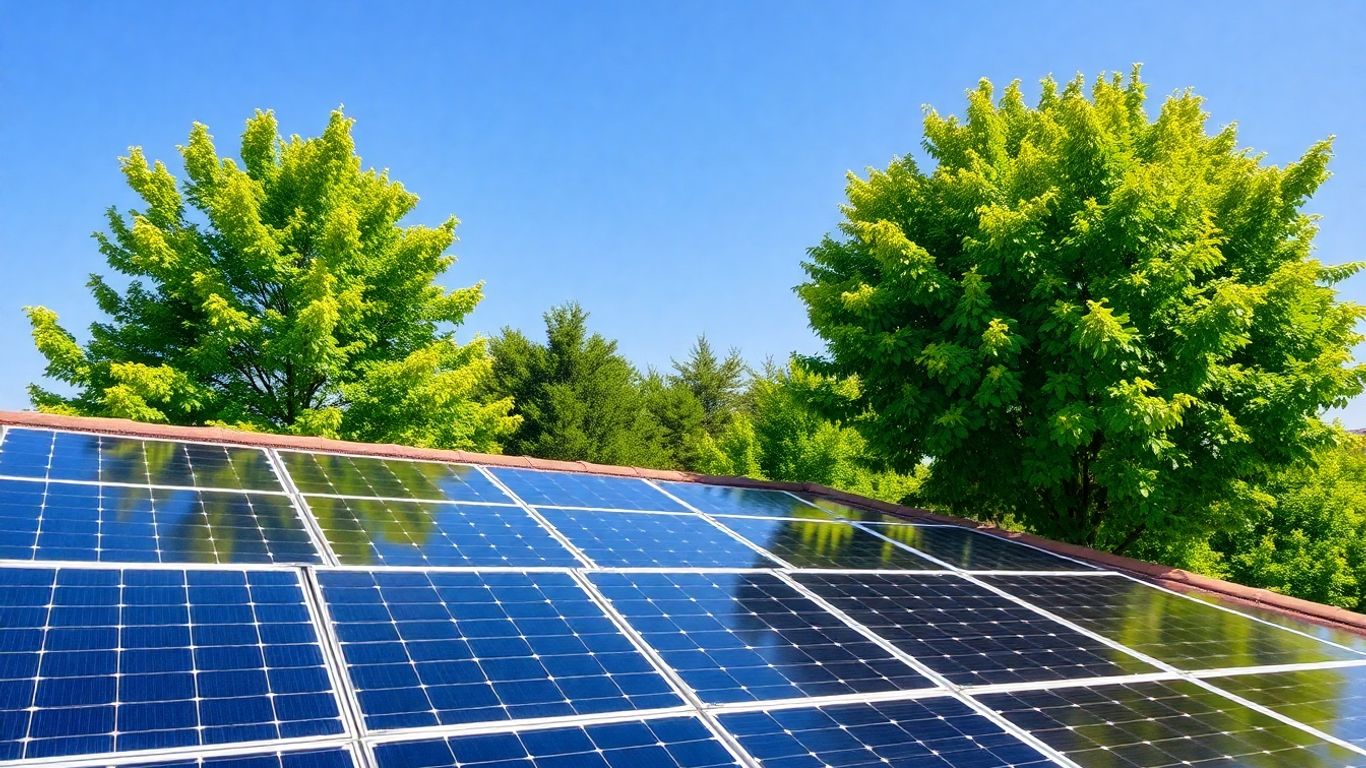
Shading, even partial, on your solar panels can have a disproportionate impact on their electricity production. It is therefore essential to anticipate and manage these shaded areas to maintain optimal efficiency.
Identifying Potential Shading Sources
Several elements can cast a shadow on your installation. It is important to identify them even before installation to choose the best possible location. The most common culprits include:
- Surrounding trees, whose growth can be seasonal or continuous.
- Neighbouring buildings, whether houses, garages, or other structures.
- Chimneys, aerials, or other elements present on your own roof.
- Electric poles or other urban infrastructure.
You need to consider the long-term evolution of these elements. A young tree can become a major source of shade in a few years, and a new construction nearby can change the situation.
Impact of Shading on Overall Production
Solar panels are generally connected in series. This means that if a single cell in a panel is shaded, its production decreases, which can affect the performance of the entire panel, or even the string of panels to which it is connected. A loss of sunlight on a small part can therefore lead to a greater than expected drop in efficiency. Performance losses due to shading can range from 5% to 25% depending on the severity and duration of the shade [9d9a]. It is therefore crucial to minimise these occultations to maximise energy production.
Shading on a solar panel is not just a minor inconvenience; it’s a direct brake on the conversion of light into electricity. Every ray of sunshine counts towards achieving your self-consumption goals [01f1].
Strategies for Anticipating and Managing Shaded Areas
To avoid or reduce the impact of shading, several approaches are possible:
- Location Choice: Prioritise an open area, away from potential obstacles. A sunshine study by a professional can help identify the most favourable areas.
- Tree Pruning and Trimming: If trees are the cause of shading, consider pruning or trimming them regularly. Sometimes a choice must be made between the beauty of the landscape and the performance of the installation.
- Use of Optimisers or Micro-inverters: These components allow for independent management of each panel’s production. If one panel is shaded, the others will continue to operate at their full potential, thus limiting overall losses. This is a technical solution that can make a noticeable difference [4121].
- Installation Design: In some cases, it is possible to slightly modify the arrangement of the panels to avoid the most critical shaded areas during peak sunshine hours.
The Impact of the Environment on Solar Production
The environment in which your solar panels are installed plays a significant role in their performance. It’s not enough to have the best panels to guarantee optimal production; the local context has a direct influence.
Influence of Regional Sunshine
Sunshine is the most obvious factor. A region benefiting from strong solar radiation, such as the south of France, will see its panels produce more electricity than a similar installation in a region further north, like Lille. The daily exposure time and the intensity of solar rays vary considerably from one geographical area to another. It is therefore important to find out about the solar potential of your locality before you start. For example, a 1 kWp installation in Nice can produce around 1400 kWh per year, while the same installation in Lille would only produce about 900 kWh. This difference highlights the importance of considering the local climate when estimating actual production. The rise of renewable energies, such as solar, shows impressive growth, even exceeding overall electricity demand, which testifies to their growing importance in the energy landscape Combined solar and wind energy production has surged by over 400 terawatt-hours, outpacing the growth in global electricity demand.
Microclimate Considerations
Beyond regional sunshine, attention must also be paid to microclimates. Two houses located in the same city can have slightly different sunshine conditions. Factors such as proximity to bodies of water, dense vegetation, or even urban configuration can create local variations. It is therefore relevant to consider these specificities when assessing the installation site. An on-site analysis by a professional can help to better understand these nuances.
Effects of Temperature on Module Efficiency
Contrary to what one might think, excessive heat is not always beneficial for solar panels. Beyond a certain temperature, generally around 25°C, the efficiency of photovoltaic modules decreases. Each additional degree can reduce efficiency by 0.25% to 0.5%. This is why good ventilation around the panels is important. Over-roof installation, which leaves a space between the panels and the roof, promotes this air circulation and helps maintain a lower operating temperature. This preserves the panels’ production capacity, even on the hottest days. It is also possible to consider alternatives such as a domestic wind turbine if your region benefits from constant winds Producing your own electricity involves choosing the right solar panels (monocrystalline, polycrystalline, or amorphous) based on efficiency, cost, and your location.
The local environment, whether it’s general sunshine, specific microclimatic conditions, or ambient temperature, has a direct and measurable impact on the performance of your solar installation. A good understanding of these elements allows for anticipating production variations and optimising the choice and installation of panels.
Regular Maintenance, a Key Performance Factor
Even the most efficient solar panels require regular attention to continue performing at their best. Neglecting this aspect can lead to a noticeable drop in energy production, sometimes estimated between 2% and 7% or even more if soiling is significant. Adequate maintenance is therefore essential to ensure optimal performance and maximise the return on your solar investment Neglecting solar panel maintenance can lead to a significant loss in energy production.
Preventing Soiling Accumulation
Over time, dust, pollen, dead leaves, or bird droppings can accumulate on the surface of your panels. These elements create a barrier that prevents sunlight from reaching the photovoltaic cells, thus reducing their ability to convert radiation into electricity. In coastal areas, salt and sand can accumulate more quickly, requiring more frequent cleaning.
Cleaning Panels to Maintain Efficiency
Regular cleaning is the most direct solution to counteract dirt accumulation. It is generally recommended to clean at least once or twice a year. The exact frequency will depend on your environment:
- Rural or low-exposure areas: Annual cleaning may suffice.
- Urban or industrial areas: Cleaning every six months is preferable.
- Coastal areas: Cleaning every 3 to 4 months is recommended.
It is important to use appropriate methods and products to avoid damaging the panels. Demineralised water and a soft brush are often recommended. A clean surface means maximum energy production.
Importance of Maintenance for Longevity
Beyond simple energy production, regular maintenance contributes to the longevity of your installation. It allows for early detection of potential problems, such as cracks in the modules, loose connections, or signs of corrosion. Periodic professional checks, including verification of cables, inverters, and other components, help anticipate costly breakdowns and ensure the overall smooth operation of the system in the long term. This optimises not only efficiency but also the profitability of your photovoltaic project.
Choosing Quality Components for Superior Efficiency
For your solar installation to work at its best, choosing good panels isn’t enough. Every part matters, really. Think of it like a chain: if one link is weak, the whole chain suffers. We’re talking about the quality of the inverter, the cables, and of course, the panels themselves.
Selecting Efficient Cables
Cables are a bit like the veins of your solar system. They transport the electricity produced by the panels to your home or the grid. If these cables are not of good quality, some of this precious energy can be lost along the way, especially in the form of heat. This is known as the Joule effect. Well-chosen cables, with the correct cross-section and good insulation, limit these losses. This means more electricity reaches where you need it, improving the overall profitability of your installation. Therefore, you need to ensure they are suitable for your system’s power and external conditions.
Importance of Inverter Choice
The inverter is a bit like the brain of the installation. Panels produce direct current, but our electrical appliances run on alternating current. It’s the inverter that performs this conversion. Its quality has a direct impact on the overall efficiency of your system, measured by what’s called the Performance Ratio (PR). A good inverter converts energy more efficiently, with fewer losses. There are different types, such as central inverters or micro-inverters that handle each panel individually. The choice depends on your setup and priorities, but investing in a reliable inverter is a key step to maximising your electricity production.
Impact of Module Quality on Production
Of course, the quality of the solar panels themselves is paramount. Not all panels are created equal. There are quality classes, often designated by terms like « Tier 1 ». These rankings give an idea of the manufacturer’s reliability and the quality of the panel manufacturing. Better quality panels tend to have higher efficiency from the start and maintain that efficiency for longer over the years. They are also often more resistant to harsh weather conditions. Although the initial cost may be slightly higher, the difference in production over the installation’s lifespan can largely offset this gap. Consider looking at the warranties offered by manufacturers, as they are often a good indicator of their confidence in their products. A thorough photovoltaic impact study will take these elements into account from the outset [cdee].
It is also important to consider the size of orders. Ordering a large quantity of equipment can allow for more advantageous prices, which can make investing in high-quality components more accessible [a920].
Innovative Technologies to Improve Efficiency
The field of photovoltaics is constantly evolving, and several technological advancements aim to push the boundaries of solar panel efficiency. These innovations not only increase electricity production but also pave the way for more flexible and higher-performing installations.
The Role of Solar Trackers
Solar trackers, also known as heliostat followers, are mechanical devices that orient solar panels to follow the sun’s path throughout the day. This dynamic orientation maximises direct exposure to solar rays, which can increase energy production by 25% to 40% compared to a fixed installation, depending on latitude and tracker type.
There are mainly two types of trackers:
- Single-axis trackers: They follow the sun on one axis, generally from east to west.
- Dual-axis trackers: They follow the sun on two axes, adjusting tilt and orientation for optimal capture.
Although their installation and maintenance costs are higher, solar trackers can be very profitable in regions with high sunshine and when space is not a major constraint.
Advantages of High-Efficiency Panels
Continuous research and development have led to the creation of solar panels with significantly higher energy conversion efficiency. New generation photovoltaic cells, such as those based on heterojunction (HJT) technology or tandem cells combining silicon and perovskites, are pushing efficiency thresholds. For example, silicon cells have achieved record efficiencies of over 33% in the laboratory, far surpassing current commercial panels which are generally between 18% and 22%. These technological advances are promising for reducing the surface area needed for a given production, making solar more accessible for confined spaces.
Improving the efficiency of individual cells has a direct impact on the energy density of installations, allowing for more electricity to be produced on the same surface area. This is particularly relevant in urban areas or industrial sites where space is limited.
Potential of Bifacial Panels
Bifacial solar panels are designed to capture sunlight on both their faces. The front face captures direct light, while the back face captures light reflected from the ground or the installation surface (such as a white roof or light-coloured ground). This additional capability can increase energy production by 5% to 20%, depending on the reflectivity of the underlying surface and the installation height. Bifacial panels are particularly interesting for large ground-mounted installations, flat roofs, or carports, where light reflection is more significant. Their robust design and ability to generate additional energy make them an increasingly popular option for maximising the overall production of a solar installation. Canadian companies, for example, are actively exploring these technologies for their sustainable development projects globally.
Calculating and Evaluating Your Installation’s Performance
Once your solar system is installed, it’s natural to want to know how it’s performing and whether it’s meeting its objectives. Evaluating the performance of your photovoltaic installation isn’t just about looking at the meter; it involves a more detailed analysis to understand the actual efficiency and profitability.
Methodology of Theoretical Efficiency
Theoretical efficiency gives an initial idea of your panels’ intrinsic capacity. It is calculated by dividing a panel’s peak power (expressed in Watts peak, Wp) by its surface area (in square metres, m²), then dividing the result by 1000 and multiplying by 100 to get a percentage. For example, a 400 Wp panel covering 2 m² has a theoretical efficiency of 20% ( (400 / 2) / 1000 * 100 ). This is a useful measure for comparing modules before purchase, but it does not reflect real-world usage conditions.
Determining Actual Production Efficiency
To get an accurate picture of what your installation is producing, you need to consider the actual annual production in kWh. This is then divided by the total installed capacity (in kWp) multiplied by the theoretical sunshine in your region. This approach takes into account the specificities of your location and weather conditions. It is important to note that a 400 Wp panel will not constantly produce 400 watts; its effective performance depends on many factors [f5bd].
Analysis of Financial Profitability
Beyond energy production, financial profitability is often the main driver of a solar project. To evaluate it, we compare the annual savings achieved (through self-consumption) and potential income from selling surplus electricity, against the total initial investment cost. The resulting ratio gives the payback period. Good consumption management, for example, by using home automation to trigger appliances during peak production hours, can significantly improve this self-consumption rate and thus the overall profitability [353f].
Regular performance evaluation not only verifies that the installation is working as expected but also identifies potential problems or areas for optimisation. This may involve adjusting consumption habits or early detection of a need for maintenance.
Here are some points to monitor for continuous evaluation:
- Production Monitoring: Use the app provided by your installer to observe daily, monthly, and annual production.
- Comparison with Forecasts: Compare actual production with the estimates made during your project’s study.
- Shading Check: Ensure no new obstacles have appeared and are affecting your panels.
- Component Condition: A poor-quality inverter or cabling can impact overall efficiency.
Anticipating the Evolution of Solar Panels
Future Technological Trends
The field of solar photovoltaics is evolving at an impressive speed. It is therefore wise to consider the advancements that will shape tomorrow’s installations. Current research aims to push the limits of efficiency while making panels more durable and affordable. Constant innovation is key to maximising long-term efficiency.
Prospects for New Materials
Traditional materials like silicon continue to improve, but new avenues are emerging. Perovskite-based cells, for example, promise much higher efficiencies than current technologies. Studies show that these panels could achieve significantly higher energy conversion rates, potentially around 30%, compared to 22% for the best current silicon panels. This breakthrough could revolutionise the sector, allowing for more electricity to be produced on the same surface area. It is interesting to follow developments in this field, as they could redefine performance standards in the coming years. The integration of these new materials into high-efficiency solar panels is an exciting prospect.
Evolution of Power Guarantees
Beyond the intrinsic performance of the modules, the guarantees offered by manufacturers are an indicator of their confidence in the longevity of their products. Traditionally, guarantees cover output power over 20 to 25 years. However, with the improvement of technologies and materials, there is a trend towards extending these periods. Some companies are already starting to offer linear power guarantees over 30 years or more. This means the panel is guaranteed to retain a certain percentage of its initial power over an extended period. It is therefore important to compare these guarantees when choosing your installation, as they reflect the expected reliability of the components and directly impact the profitability over the project’s lifecycle. A solid guarantee is a pledge of sustainable performance for your installation.
Solar panels are changing fast! They are becoming more efficient and cheaper. To find out what’s coming soon and how to benefit from it, it’s this way. Come discover how these new technologies can help you save money and protect the planet. Ready to switch to solar energy? Visit our website to learn more!
To Conclude
In summary, maximising the efficiency of your solar panels is no small feat. It requires careful attention to several aspects, from the perfect orientation and tilt of your panels to regular maintenance to prevent dust or debris from spoiling the party. Don’t forget the impact of temperature and shading, which can sometimes cause problems. By taking all these elements into account, you’ll be doing everything you can to ensure your solar installation works at its best and provides you with the energy you need. It’s an investment that, when well thought out and well maintained, can truly make a difference in the long run.
Frequently Asked Questions
What is solar panel efficiency and how is it measured?
Solar panel efficiency is its ability to convert sunlight into electricity. It is measured as a percentage. For example, 20% efficiency means the panel uses 20% of the solar energy it receives to produce electricity. The higher this figure, the more efficient the panel.
Why are panel orientation and tilt so important?
Orientation and tilt determine the amount of sunlight the panel receives. For maximum efficiency in France, it is best to face south and tilt the panels at about 30 to 35 degrees. This allows for capturing the most solar rays throughout the year, even in winter.
What can cause a drop in solar panel electricity production?
Several things can reduce production. Shading, even partial, caused by trees, buildings, or chimneys is a big problem because solar cells are connected in series. Dirt, dust, dead leaves, or snow on the panels also prevent light from reaching the cells.
Is heat good for solar panels?
Contrary to what one might think, excessive heat is not ideal. When it’s very hot, solar panels produce slightly less electricity. It is estimated that their efficiency decreases slightly for each degree above 25°C.
Is it necessary to clean solar panels regularly?
Yes, it’s a very good idea! Cleaning the panels removes dust, pollen, or bird droppings that block sunlight. A clean panel produces more electricity and thus maintains good efficiency in the long term.
What technologies can improve efficiency?
There are technologies like ‘solar trackers’ that move the panels to follow the sun all day, thus increasing production. ‘Bifacial’ panels can also capture light reflected on their rear side, which is useful in certain environments.
How do I know if my installation is producing the expected electricity?
You can calculate a theoretical efficiency by knowing the panel’s power and its surface area. For actual efficiency, compare the annual electricity production (in kWh) with the expected sunshine in your region. It is also useful to monitor the production trend over time.
Do solar panels lose a lot of their efficiency over time?
Modern solar panels are designed to last a long time. Their efficiency decreases very slowly, often less than 0.5% per year. Furthermore, many installations benefit from power guarantees over 25 or 30 years, ensuring they will still produce a good portion of their initial capacity.
