
For your solar self-consumption project, the orientation and tilt of your panels are really important. It’s a bit like choosing the right spot for a vegetable patch so it gets as much sun as possible. In this article, we’ll look at what angle to favour for your solar panels to maximise energy production, especially if you plan to consume your own electricity. We’ll break it all down simply.
Key Takeaways
- South orientation is generally best in the Northern Hemisphere to capture the most sun throughout the day. If this isn’t possible, an east or west orientation can help spread out electricity production.
- The ideal tilt varies with the seasons: steeper in winter (around 60°) when the sun is low, and flatter in summer (around 10-20°) when it’s high. An average tilt (around 30-35°) is often chosen for a good annual balance.
- For conventional roofs, the roof pitch often dictates the panel tilt. It’s rarely necessary to modify the roof, as current technologies capture diffuse light well.
- Orientation generally has a greater impact on energy production than tilt. Deviating from south can reduce yield, but solutions like splitting panels between east and west can smooth production.
- Solutions like solar trackers exist to follow the sun, but they are more complex and expensive, often reserved for ground-mounted installations. For self-consumption, the goal is often to smooth production rather than aim for maximum peak.
Understanding the Importance of Orientation for Solar Self-Consumption
The Impact of Orientation on Energy Production
When we think about installing solar panels for our own consumption, we often wonder what the best angle is. But before talking about angle, we absolutely must consider orientation. It’s a bit like choosing the best spot in a garden for your plants to make the most of the sun. For solar panels, it’s the same: their position relative to the sun has a direct impact on the amount of electricity they will produce. Good orientation is key to making your installation truly profitable and allowing you to consume the maximum amount of energy you produce.
Why is South Orientation Preferred in the Northern Hemisphere?
In our part of the world, the Northern Hemisphere, the sun follows a well-defined path. It rises in the east, peaks in the south at midday, and sets in the west. To capture as much solar energy as possible throughout the day, regardless of the season, a south-facing orientation is therefore the most logical. This is where the sun’s rays hit the panels for the longest and most directly. That’s why we often hear that south is best. It helps to smooth out production throughout the day and maximise energy harvesting.
The Influence of Azimuth on Sunshine
Azimuth is a bit like a cousin to orientation. It measures the horizontal angle of an object relative to true north. For solar panels, an azimuth of 0° corresponds to a north-facing orientation, 180° to south, 90° to east, and 270° to west. The closer your azimuth is to 180° (south), the more solar energy you will capture. Moving away from south, whether towards the east or west, will decrease production. For example, a full east or west orientation can reduce production by nearly 40% compared to a perfect south orientation. That’s why, even if your roof isn’t perfectly south-facing, it’s important to understand this impact to adjust your expectations or consider solutions.
The orientation of solar panels is a determining factor for energy production. In the Northern Hemisphere, south is preferred as it offers the longest and most direct exposure to the sun throughout the year. Azimuth, which measures the horizontal angle relative to north, plays a key role in this optimisation, with an azimuth close to 180° being the most favourable.
Here is a table illustrating the impact of orientation on the estimated annual production for a given installation:
| Orientation | Estimated Annual Production (kWh) | Payback Period (years) |
|---|---|---|
| South | 4200 | 13 |
| South-East | 4030 | 13 |
| South-West | 4030 | 13 |
| East | 3780 | 14 |
| West | 3780 | 14 |
Optimising Solar Panel Tilt for Annual Production
The tilt of your solar panels plays an important role in the amount of energy they can capture throughout the year. The sun does not follow the same path in the sky in summer as it does in winter. In winter, the sun is lower on the horizon, suggesting that a steeper angle would be ideal for capturing it directly. Conversely, in summer, the sun is higher, and a flatter angle would be more effective. Finding the right balance is therefore essential for consistent energy production.
Seasonal Variations in Solar Angle
The sun’s path in the sky changes considerably depending on the season. In France, for example, the sun is low in winter, requiring a tilt of about 60° for optimal capture. In spring, this ideal angle drops to about 45°. During the summer months, when the sun is at its highest, a tilt of only 10° to 20° would be most efficient. These variations clearly show that a fixed angle cannot be perfect all year round.
The Ideal Tilt According to the Seasons
As we have seen, the perfect angle changes. For winter, we aim for a higher angle, around 60°, to best capture the low sun. For summer, a lower angle, between 10° and 20°, is preferable. Spring is between the two, with an angle of about 45°.
| Season | Ideal Angle (approximate) |
|---|---|
| Winter | 60° |
| Spring | 45° |
| Summer | 10-20° |
The Recommended Average Angle for Consistent Production
It is generally impossible to change the tilt of solar panels several times a year, especially if they are integrated into a roof. Most installations are therefore set to an average angle. In France, a tilt of 30° to 35° is often recommended. Although this angle is never perfectly optimal for a given season, it offers a good compromise for stable energy production over the entire year. This is a pragmatic approach to maximise the overall yield of your solar installation.
Choosing an average tilt ensures reliable electricity production throughout the year, even if it doesn’t reach the peak performance of each individual season. It’s a strategic choice for self-consumption.
For installations on flat roofs or ground-mounted, it is sometimes possible to adjust the tilt, but this requires careful planning to avoid shading. The goal is always to maximise sunlight capture over time, taking into account technical constraints and the specific energy needs of your home. Good planning can significantly improve the performance of your solar panel.
Adapting Orientation and Tilt to Your Roof’s Specifics
Constraints of Pitched Roofs
In the majority of cases, solar panels are installed on an existing roof. The pitch of this roof then imposes a fixed tilt on the panels. Fortunately, most French roofs have a pitch between 30 and 35 degrees, which is an excellent basis for satisfactory annual solar production. However, some regional architectures, such as in Brittany or Alsace, may have steeper pitches, sometimes reaching 45 degrees. In these situations, the natural roof pitch may not be ideal for optimal year-round sun capture, especially in summer when a lower tilt would be preferable. It is therefore essential to assess whether your roof’s pitch is compatible with your production goals.
Solutions for Flat Roofs and Ground-Mounted Installations
Flat roofs and ground-mounted installations offer much greater flexibility. On a flat surface, it is possible to install support structures that allow the tilt and orientation of the panels to be adjusted. For flat roofs, ballasted systems allow panels to be positioned without drilling the covering. For ground-mounted installations, the freedom is even greater, although attention must be paid to potential shading. In these cases, installing panels with a tilt of around 10 degrees is often considered, but adjustable systems exist to adapt the angle to the seasons, although this represents an additional cost to consider. For a flat roof, a south orientation with a tilt of 30° to 35° is generally recommended for optimal solar performance [5cfa].
The Impact of Roof Pitch on Tilt Choice
The roof pitch is a determining factor. If it is close to the ideal angle (around 30-35° in France for consistent annual production [f324]), the panels can be installed directly, without adding complex structures. A pitch that is too steep can penalise summer production, while a pitch that is too shallow could reduce winter yield. In cases where the roof pitch is not optimal, several options are available:
- Panels on offset structures: On a flat roof or an outbuilding.
- Ground installation: If you have suitable land.
- Adjustable systems: On flat roofs or ground installations, to adjust the tilt.
It is important to note that a slight loss of yield due to a non-optimal tilt does not invalidate the profitability of an installation. Modern technologies are increasingly efficient at capturing diffuse light, even in less ideal conditions.
Analysing the Influence of Orientation versus Tilt
When we talk about installing solar panels for self-consumption, we often think about the perfect angle. But it’s important to know that orientation, meaning the direction the panels face, has a much more significant impact on energy production than their tilt. It’s a bit like choosing the best window to let sunlight into a room: the direction matters more than how you tilt the shutter.
The Predominance of Orientation on Yield
South orientation is generally considered the holy grail in the Northern Hemisphere. Why? Because the sun travels across the sky from east to west, passing through the south. A south-facing orientation therefore allows for the capture of maximum solar rays throughout the day, and this, over the entire year. Moving away from this ideal orientation leads to a noticeable drop in production.
For example, a south-facing installation can produce 100% of its potential. If you turn towards the east or west, this production can drop to less than 60%. This is a considerable difference that directly affects the amount of electricity you can self-consume or sell.
Understanding Production Losses When Moving Away from South
It’s important to visualise the impact of orientation. Imagine a graph where production is maximum when the panels face south. The further you move the orientation towards the east or west, the more the production curve drops. This loss is not linear; it can be quite rapid as soon as you deviate significantly from south.
Here’s an idea of the impact on annual production:
| Orientation | Relative Production |
|---|---|
| Full South | 100% |
| South-East/South-West | ~95% |
| East/West | ~60% |
| Full North | Very low (<10%) |
These figures are estimates and can vary depending on latitude and local weather conditions.
The Importance of Latitude for Sunshine
The latitude of your installation also plays a role. The further north you are, the lower the sun will be in the sky, especially in winter. This means that the ideal tilt angle may vary slightly depending on your geographical location. However, even taking latitude into account, south orientation remains the most advantageous in most cases in mainland France. Latitude mainly influences the daily duration of sunshine and the sun’s height, factors that are already taken into account when calculating the optimal orientation.
Orientation Strategies for Optimised Self-Consumption
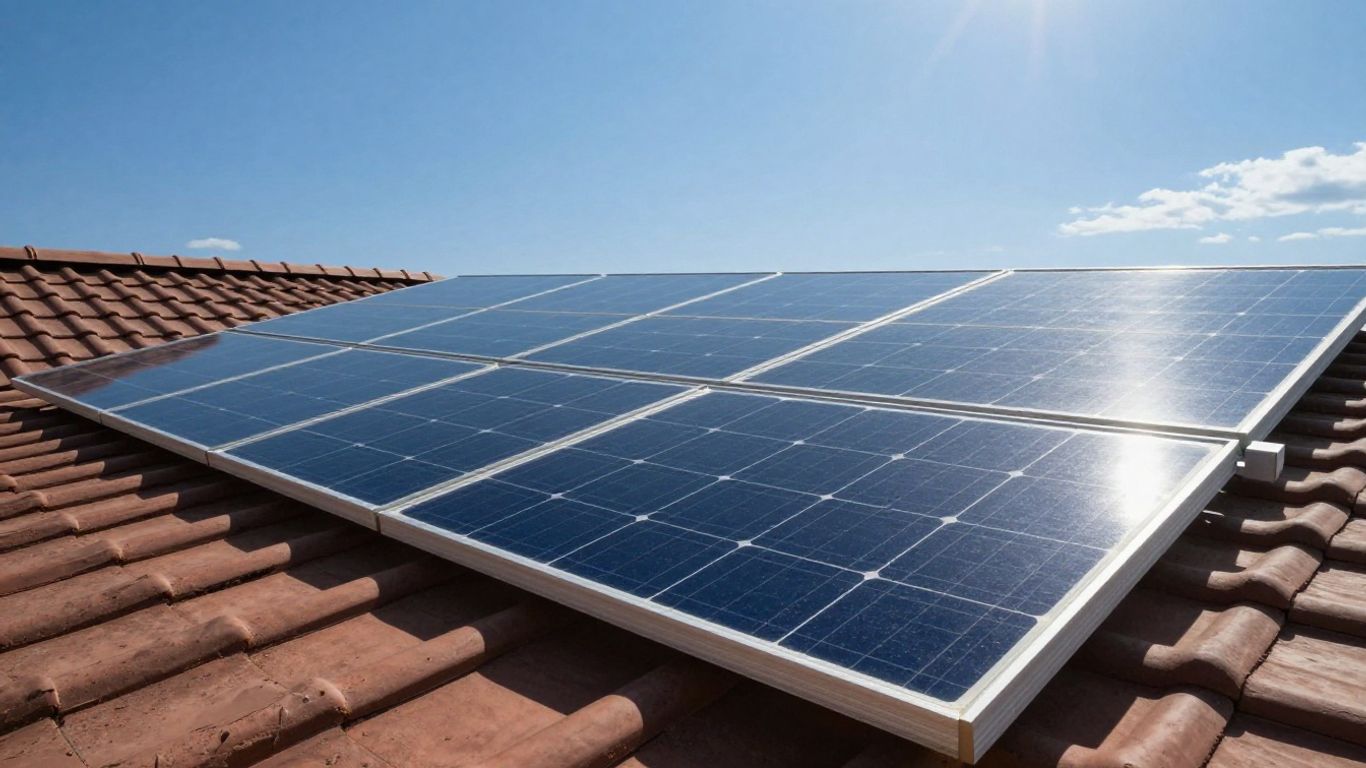
Although full south orientation is often presented as the royal road to maximise solar production, it’s important to know that other options exist and can be very interesting for successful self-consumption. It’s not always about aiming for south at all costs, especially when roof constraints or consumption habits come into play.
The Benefit of East-West Orientation for Smoothing Production
The idea here is not to concentrate all solar energy production on midday hours, but rather to spread it over a wider time frame. A split installation, with some panels facing east and others west, allows you to capture the sun from morning until late afternoon. This can be particularly relevant if your electricity needs are more pronounced in the morning and evening, rather than in the middle of the day. In practice, this means you could consume a larger portion of the electricity you produce, thus reducing your reliance on the grid for a longer period of the day.
| Orientation | Estimated Production (kWh/year for 3 kWp) | Estimated Payback Period | Total Savings over 30 years (€) |
|---|---|---|---|
| Full South | 4200 | 13 years | 22906 |
| South-East/West | 4030 | 13 years | 21980 |
| East/West | 3780 | 14 years | 20615 |
Note: These figures are indicative and based on an installation in the Lyon region with a 30° tilt.
How to Split Panels for Daily Coverage
To implement an east-west strategy, it is generally sufficient to distribute the panels over the available roof slopes. If you have a two-slope roof, one facing east and the other west, that’s ideal. Otherwise, it’s possible to consider installations on different slopes, or even use specific structures if the configuration allows. The goal is to achieve a flatter production curve throughout the day. This can improve the self-consumption rate, as the energy produced better matches the times you need it. Of course, the overall production loss compared to a perfect south orientation must be assessed, but this loss is often offset by better utilisation of the produced energy.
The Goal of Production for Energy Autonomy
Self-consumption is, above all, a move towards greater energy independence. By adapting the orientation of your panels, you can refine your strategy to better match your consumption profile. Smoothed production throughout the day, thanks to an east-west orientation, can help you achieve a higher self-consumption rate. This means you directly consume a larger share of the electricity produced by your panels, reducing your electricity bills and your carbon footprint. It is therefore relevant to consider this approach, especially if a perfect south orientation is not achievable or if your consumption does not follow the midday solar production peak.
It is essential to understand that south orientation, while theoretically optimal for annual production, is not the only viable option. East and west orientations, or a combination of both, can offer significant advantages in terms of smoothing production and improving the self-consumption rate, making the project more suited to your actual needs.
Alternative Solutions for Maximum Solar Capture
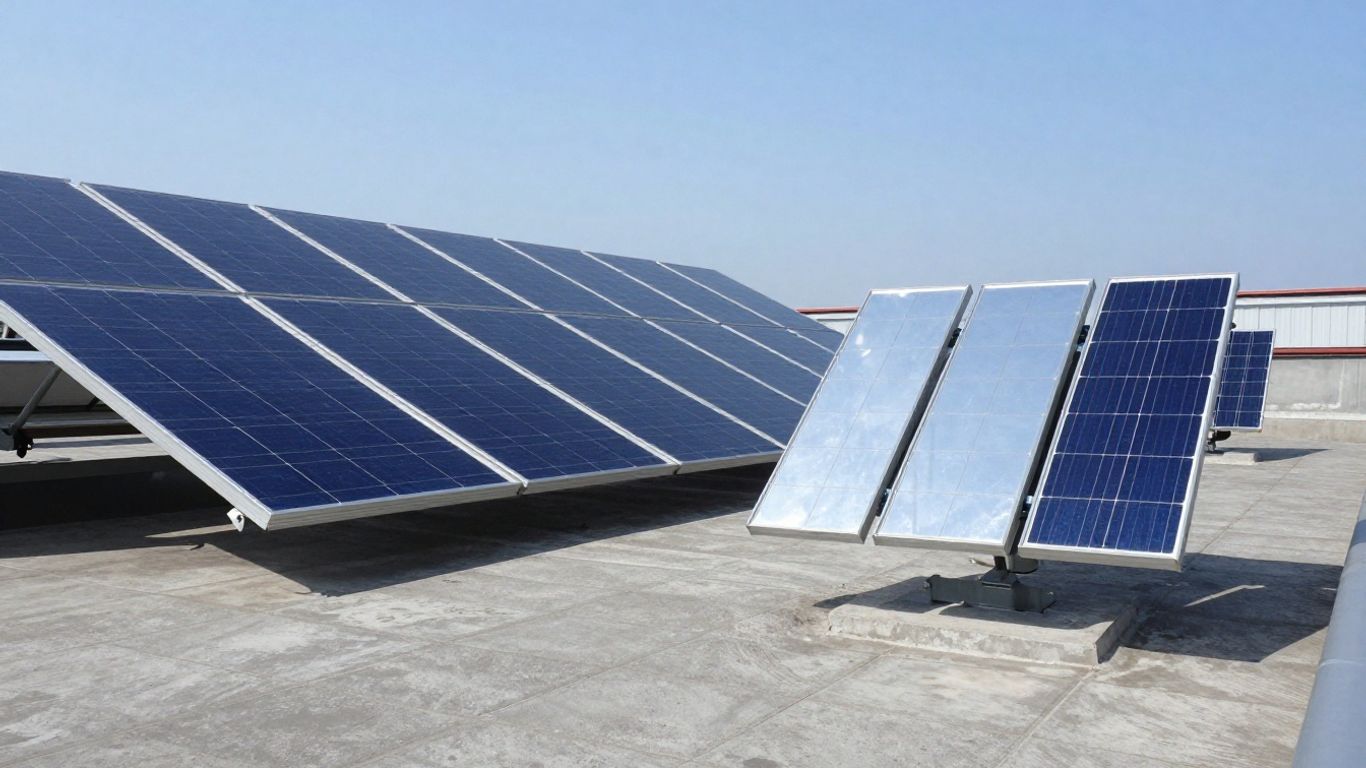
While south orientation and optimised tilt are generally recommended, there are situations where alternative approaches are necessary to maximise solar capture. These methods can be particularly useful when architectural or environmental constraints limit standard options.
Solar Trackers: How They Work and Their Limitations
Solar trackers, also known as solar followers, are mechanical devices that allow solar panels to be oriented so that they follow the sun’s path throughout the day. There are two main types: single-axis trackers, which pivot on one axis, and dual-axis trackers, which adjust on two axes. The main advantage is a significant increase in energy production, which can be up to 25-40% compared to a fixed installation, as the panels remain perpendicular to the sun’s rays. However, their installation cost is higher and they require regular maintenance. Furthermore, they are generally unsuitable for roofs due to their complexity and bulk, being more suited to ground-mounted or agricultural installations. Their installation is also subject to specific regulations, particularly concerning the electrical protection of solar systems.
Vertical Panel Installation in Specific Cases
In certain conditions, a vertical installation of solar panels can be considered. This is the case, for example, in mountainous areas where snow accumulation could otherwise cover the panels and reduce their efficiency. Facade installation avoids this problem and can also have an aesthetic appeal. Although production is generally lower than with optimal orientation, this solution can be the most viable for ensuring minimal production, especially in winter. East-west orientation can also be an alternative for smoothing production throughout the day, even if it doesn’t reach the production peak of a south orientation.
Adaptation to Specific Needs, Such as in High Mountains
For very specific needs, such as in high mountain refuges, solar installation engineering must adapt to local constraints. Besides snow, wind and access can be determining factors. In these contexts, tailor-made solutions are developed. Sometimes, it is even possible to modify the tilt of solar panels if they are installed on the ground or on a flat roof, although this represents an additional cost. The goal remains to maximise light capture, even if it means deviating from classic ideal configurations. It is always recommended to consult a professional to assess the best approach for your particular situation.
Assessing the Impact of Non-Optimal Tilt
Consequences of an Angle Different from the Seasonal Ideal
It is true that the perfect tilt to capture maximum sunlight varies with the seasons. In winter, the sun is low on the horizon, requiring a steeper angle (around 60°), while in summer, it is high, favouring a lower tilt (between 10° and 20°). If your installation cannot adapt to these variations, as is often the case with roof-integrated panels, slightly less performant production than the seasonal peak is to be expected. However, a fixed tilt of around 30° to 35° offers an excellent compromise for consistent and reliable annual production.
The Ability of Modern Technologies to Capture Diffuse Light
It should not be forgotten that solar panels do not rely solely on direct sunlight. Current technologies are increasingly efficient at capturing diffuse light, that which is reflected by clouds or the environment. This means that a tilt that is not perfectly aligned with direct sunlight does not doom your installation. Production will certainly be slightly lower on sunny days, but it will remain significant even in overcast weather.
The Profitability of Tilt Adjustments
Modifying the tilt of solar panels, especially if they are integrated into an existing roof, can be costly and complex. In most cases, the potential production gains do not justify the additional investment. Studies show that even with a non-ideal tilt, the difference in yield over the lifespan of the panels is often negligible compared to orientation. It is therefore generally more sensible to adapt to your roof’s pitch rather than undertaking costly work to change it.
Here is an overview of production variations according to tilt, for a south-facing installation:
| Tilt | Relative Production |
|---|---|
| 0° (flat) | 85% |
| 30° (annual ideal) | 100% |
| 60° (winter ideal) | 91% |
It is important to note that these figures are indicative and can vary depending on geographical location and specific weather conditions.
Specific Considerations for Different Types of Solar Panels
Optimisation for Grid-Connected Photovoltaic Panels
For photovoltaic installations intended to inject surplus electricity into the grid, the main objective is to maximise overall annual production. South orientation generally remains the most advantageous in the Northern Hemisphere, as it ensures maximum solar exposure during peak hours. However, the tilt must be considered as a compromise. An average tilt, often around 30° to 35°, effectively captures the sun both in summer, when it is high, and in winter, when it is lower. It is important to note that orientation often has a more significant impact on yield than tilt alone. Deviating from the south axis can lead to notable production losses, but this can be compensated by a more precise tilt if the orientation choice is constrained. The study of your installation site is therefore paramount.
Strategies for Solar Thermal Panels
Solar thermal panels, whose role is to produce heat (domestic hot water, heating), have slightly different requirements. Although a south orientation is also preferred to maximise solar gain, the tilt can be adjusted to optimise heat capture. In winter, when the sun is low, a steeper tilt (e.g., 60°) can be beneficial for more direct capture of solar rays. Conversely, in summer, a lower tilt is more suitable. For consistent production throughout the year, an average tilt remains a reasonable solution, but systems with adjustable tilt can be considered if the installation allows (flat roofs, ground-mounted installations).
Approach for Hybrid Solar Panels
Hybrid solar panels combine photovoltaic and thermal production. Their optimisation therefore requires finding a balance between the two functions. South orientation is always the most sensible choice to maximise light capture. Regarding tilt, specific needs must be considered. If the goal is to prioritise electricity production, an average tilt (30-35°) is often recommended. If hot water production is a priority, a slightly steeper tilt could be considered, especially in regions with harsh winters. A detailed analysis is essential to determine the angle that will provide the best overall yield, taking into account seasonal variations in sunshine and the household’s energy needs.
Each type of solar panel has its own characteristics. Whether you choose conventional, flexible, or even transparent panels, it’s essential to understand their differences to make the best choice for your home. To help you see more clearly and find the perfect solution, explore our complete guide on our website.
In Summary: What Angle for Your Solar Panels?
To put it simply, the ideal orientation for your solar panels is south. That’s where the sun shines longest. But, you know, we don’t always have a choice with the shape of our roof, do we? If south isn’t possible, south-east or south-west will do. And if it’s really complicated, we can even put half facing east and the other half facing west to have power all day long. For the tilt, it’s a bit more subtle. In France, we often say that 30 to 35 degrees is good for consistent year-round production. In winter, you’d need a bigger angle, like 60 degrees, and in summer, flatter, around 10-20 degrees. But since we can’t change the angle every day, this average angle of 30-35 degrees, which often corresponds to the natural slope of roofs, is a good compromise. The important thing is that the installation is done correctly so that it works as well as possible.
Frequently Asked Questions
Why is the orientation of my solar panels so important?
Orientation is like choosing the best spot for your panel so it catches maximum sun. In the Northern Hemisphere, south is generally the best choice because the sun shines there longer during the day. If south isn’t possible, south-east or south-west can also work well. Poor orientation is a bit like putting your panel in the shade: it will produce less electricity.
What is the best tilt for my solar panels?
The ideal tilt depends on the season. In winter, when the sun is low, a larger angle (around 60°) is better. In summer, when the sun is high, a smaller angle (around 20°) is preferable. To have electricity production that remains good all year round, we often choose an average angle, around 30 to 35 degrees, which is also often the angle of most roofs in France.
Do I need to change the tilt of my solar panels each season?
In theory, yes, to get the maximum electricity. But in practice, it’s very complicated, especially for panels installed on a roof. Most of the time, the tilt is fixed once and for all during installation. The important thing is to have good orientation and a tilt that works well most of the year.
My roof is not south-facing, is that a problem?
It’s not ideal, but it’s not a disaster! If you can’t have a full south orientation, facing your panels east or west can be a good solution. You can even split your panels into two groups: one facing east for the morning and one facing west for the afternoon. This allows you to have electricity produced over a longer part of the day.
What is azimuth and why is it important?
Azimuth is a way of measuring how much your panels deviate from a south-facing orientation. If your panels are slightly turned towards the east or west, it has an impact on the amount of sun they receive. The lower the azimuth (meaning, the closer you are to south), the better it is for electricity production.
Do solar thermal and photovoltaic panels have the same orientation and tilt needs?
Not exactly. Photovoltaic panels produce electricity, and we aim to capture maximum sun all year round. Solar thermal panels produce heat. For heating, we might prefer a tilt that captures the sun better in winter, even if it means producing a little less in summer. Hybrid panels are somewhere in between.
Is the tilt of my roof sufficient for good production?
Often, yes! In France, most roofs have a pitch between 30 and 35 degrees. This is precisely a very good angle for year-round solar electricity production. So, if your roof has this pitch, you already have a good foundation without needing to do any extra work.
What is a solar tracker?
A solar tracker, or solar follower, is a system that allows panels to move to follow the sun’s path throughout the day. It’s as if the panel turns to always face the sun. This allows for even more electricity production, but these systems are often more expensive and cannot be installed on roofs.
