
Choosing the right type of solar panel is an important step for any photovoltaic installation. Between monocrystalline and polycrystalline panels, the differences may seem subtle at first glance, but they have a real impact on the performance, cost, and aesthetics of your system. This article guides you through understanding the specifics of each technology and making the choice that best suits your needs.
Key Takeaways
- Monocrystalline panels, made from a single silicon crystal, generally offer higher efficiency and a more uniform (black) appearance.
- Polycrystalline panels, made from multiple silicon crystals melted together, are often more affordable but have slightly lower efficiency and a speckled blue appearance.
- In terms of lifespan, both technologies are very similar, often estimated at 40 years, with regular maintenance recommended for both.
- The choice will depend on your budget, available space (monocrystalline panels are more compact for the same power output), and the sunshine conditions in your region.
- Although the manufacturing of monocrystalline panels has a slightly higher environmental footprint, their better efficiency helps to compensate for this difference more quickly.
Understanding the Fundamental Differences Between Solar Panel Types
When considering the installation of solar panels to generate electricity, two main technologies are available: monocrystalline and polycrystalline panels. Although they share the same goal – converting sunlight into energy – their origins and characteristics differ significantly. Understanding these distinctions is the first step towards making an informed choice.
The Composition of Photovoltaic Cells
The most striking difference between monocrystalline and polycrystalline solar panels lies in the very structure of their photovoltaic cells. These cells are generally made from silicon, a semiconductor material. The way this silicon is processed determines the technology.
- Monocrystalline Panels: They are manufactured from a single crystal of high-purity silicon. This process, often called the Czochralski method, produces highly homogeneous cells. The uniform crystalline structure is a key factor in their performance.
- Polycrystalline Panels: For these panels, silicon is melted and then poured into a mould before being cut into wafers. This results in a structure composed of multiple silicon crystals. This method is generally less expensive but produces less uniform cells.
This difference in composition has direct repercussions on the visual appearance and performance of the panels.
The Distinct Visual Appearance of Panels
Beyond their internal composition, monocrystalline and polycrystalline solar panels are easily distinguished by their appearance. These aesthetic differences can play a role in the final choice, especially when architectural integration is a concern.
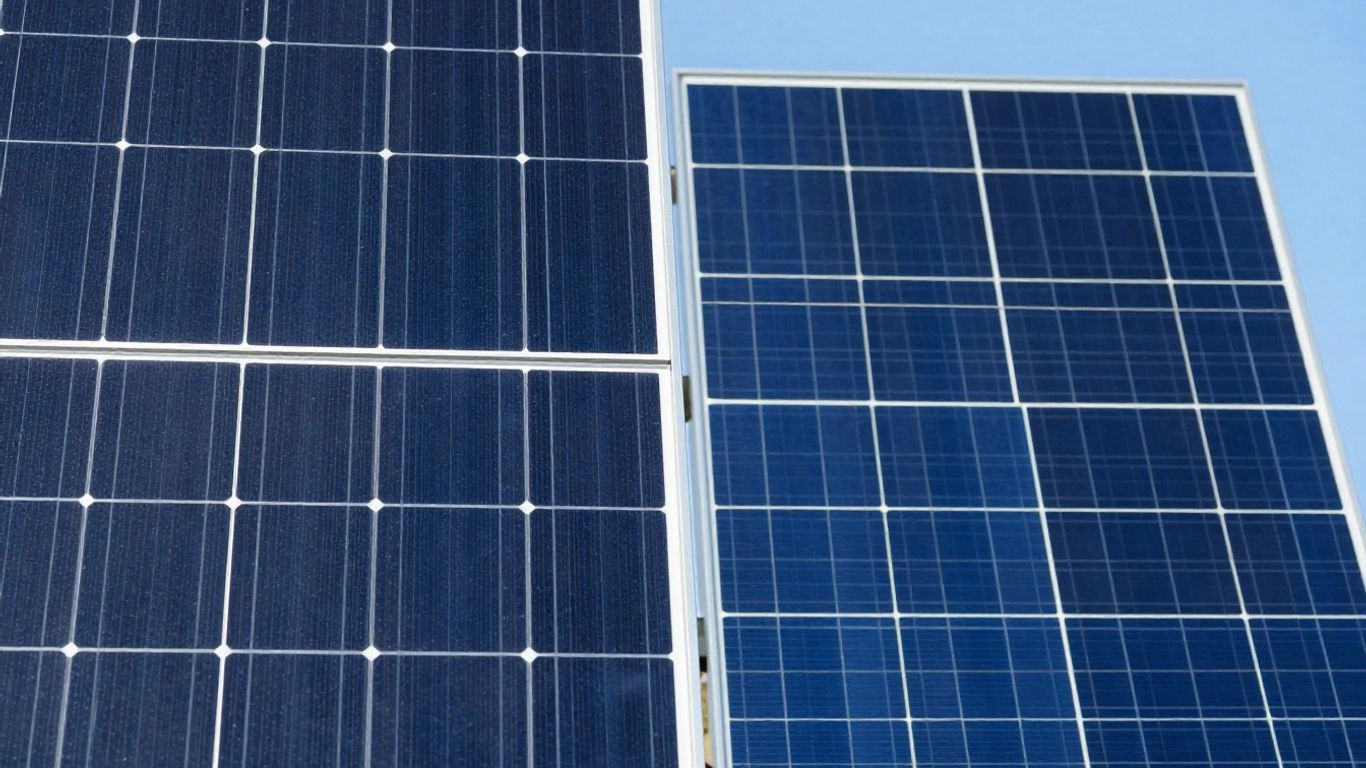
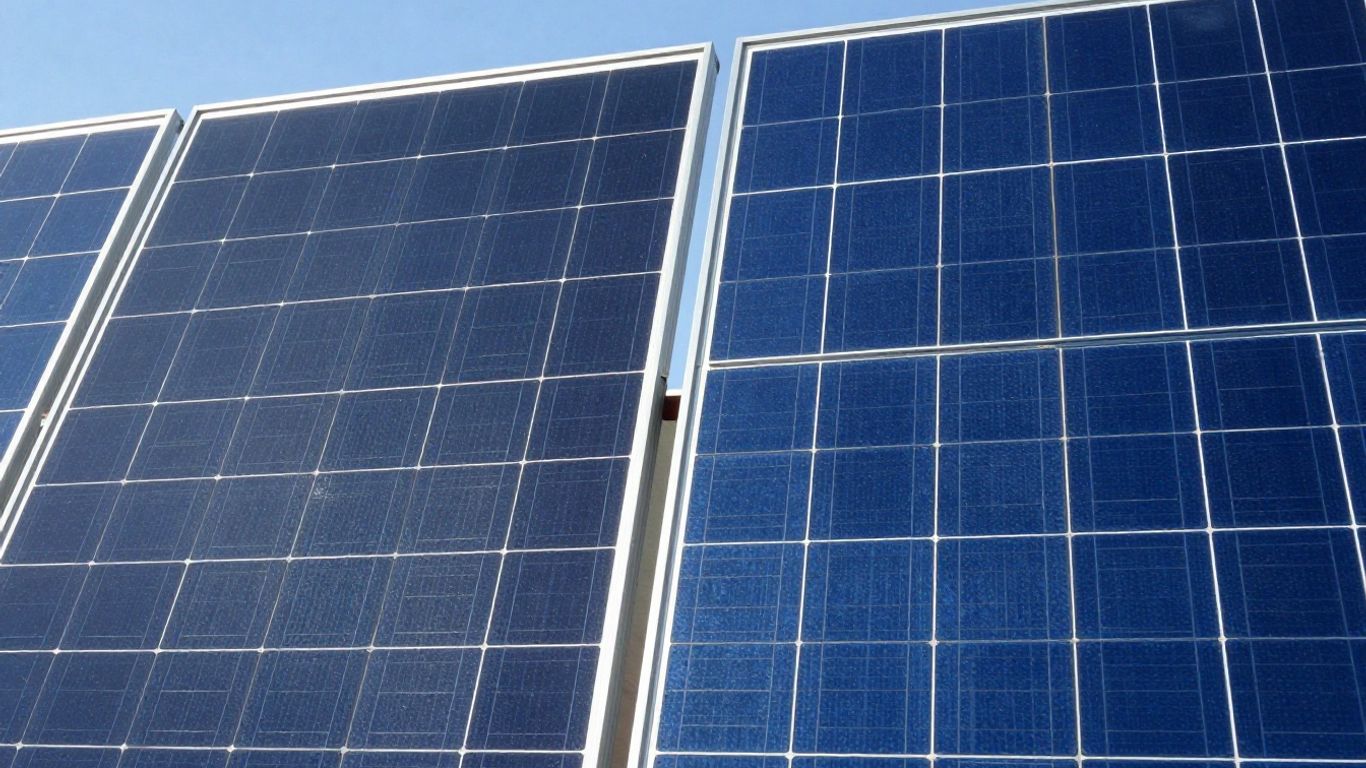
- Monocrystalline Panels: They generally have a uniform black colour. The cells themselves are often octagonal in shape, with slightly rounded or cut corners, due to the cylindrical shape of the silicon ingot from which they are derived. This dark hue gives them a more discreet and modern look.
- Polycrystalline Panels: Their colour is typically a more or less dark blue, sometimes marbled. This bluish appearance is due to the presence of multiple silicon crystals, which reflect light differently. The cells are generally square in shape, without the cut corners characteristic of monocrystalline panels.
The choice between these two types of panels is not just a matter of taste. It is a technical decision that impacts energy production, profitability, and the integration of your solar installation. It is therefore important to carefully weigh the advantages and disadvantages of each technology to find the one that best meets your specific needs and environment. Monocrystalline panels, for example, are often favoured for their high power output.
These fundamental distinctions are the starting point for a more detailed evaluation of the performance, durability, and cost of each technology.
Assessing Energy Performance: Solar Panel Efficiency
Solar Panel Efficiency: A Key Metric
The efficiency of a solar panel is, in a way, its ability to convert sunlight into electricity. The higher this figure, the more effective the panel is at producing energy from a given surface area. It is expressed as a percentage and represents the proportion of received solar energy that is actually converted into electricity, with the remainder generally lost as heat. Higher efficiency therefore means greater electricity production for the same installation area.
Monocrystalline Panel Efficiency
Monocrystalline panels are made from a single silicon crystal. This uniform structure gives them excellent conductivity. As a result, they generally display higher efficiencies than their polycrystalline counterparts. Observed values are often between 16% and 24% [4fba]. This increased performance makes them particularly attractive when the available space for installation is limited. Furthermore, their electricity production can start earlier in the morning and continue later in the evening, thus optimising the exploited sunshine duration.
Polycrystalline Panel Efficiency
Polycrystalline panels, on the other hand, are made up of multiple silicon crystals melted together. This manufacturing method, while less expensive, results in a less homogeneous structure. Consequently, their efficiency is generally a little lower, typically ranging between 14% and 18% [c27f]. Although their efficiency is lower compared to monocrystalline panels, they remain a viable option, especially if cost is a determining factor and installation space is not a major constraint.
Impact of Efficiency on Profitability
The efficiency of a solar panel has a direct impact on the overall profitability of your photovoltaic installation. A panel with higher efficiency will produce more electricity over the same period, which can accelerate the return on investment. It is therefore important to consider this factor, especially if you aim to maximise your energy production and reduce your reliance on the electricity grid. The choice between monocrystalline and polycrystalline must therefore take this aspect into account for a successful solar project [0ec7].
The efficiency of a solar panel is not solely determined by its intrinsic efficiency. The quality of manufacture, the orientation of the installation, regular maintenance, and local weather conditions also play a significant role in the overall performance of your photovoltaic system.
Lifespan and Reliability of Solar Panel Technologies
The Common Lifespan of Both Technologies
When we talk about the longevity of solar panels, whether monocrystalline or polycrystalline, we find that the differences are minimal. Most photovoltaic panels are designed to operate reliably for a period of about 35 years. This is a considerable duration that attests to the robustness of this equipment. Manufacturers also offer performance guarantees that often extend over 25 years, ensuring that the panels will maintain a significant percentage of their initial electricity production. For example, an 80% performance guarantee after 25 years means the panel will still produce 80% of what it produced in the first year.
Resistance to Time and Maintenance
Although both technologies share a similar lifespan, some details are worth highlighting. Monocrystalline panels tend to show slightly greater resistance to the vagaries of weather. However, this difference remains subtle and should not be the deciding factor in your choice. Maintenance, on the other hand, is generally simple for all types of panels. Thanks to their tilt on roofs, rain helps to clear them of dirt. For areas more exposed to pollution, such as in cities, the countryside, or near the sea, occasional cleaning with water and a soft cloth, without abrasive products, is recommended. Hiring a professional for this task is also an option.
Here is an overview of common warranties:
- Product Warranty: Covers manufacturing defects and material damage. It generally ranges from 15 to 30 years.
- Performance Warranty: Guarantees that the panel will retain a certain percentage of its initial performance over a given period, often 25 years.
The choice of manufacturer is as important as the choice of panel technology. Opt for those who offer the best warranties for long-term peace of mind.
Aesthetic Considerations for Your Solar Installation
Beyond the technical and financial aspects, the appearance of your solar installation on your roof or in your garden is a point worth considering. The visual integration of the panels can have a significant impact on the overall aesthetics of your property. It is therefore relevant to consider this aspect before making your choice.
The Discreet Appearance of Monocrystalline Panels
Monocrystalline panels are distinguished by their uniform colour, generally a deep black or a very dark blue. This uniformity comes from the fact that they are made from a single crystal of pure silicon. This chromatic homogeneity gives them a more sober and modern look, allowing for better architectural integration. They tend to blend in more easily on dark roofs or contemporary facades, offering a discreet solution for those who prefer a clean aesthetic.
The More Visible Appearance of Polycrystalline Panels
Polycrystalline panels, on the other hand, have a slightly speckled texture and a more pronounced blue colour. This appearance is due to their manufacture from multiple fragments of melted silicon crystals. Although less discreet than their monocrystalline counterparts, they have a charm that may appeal to some. Their distinctive blue hue can harmonise with more traditional roof styles or add a touch of colour to an installation. It is important to note that this difference in appearance does not affect the energy performance of the panels, but it can influence the visual perception of your installation.
It is interesting to note that the aesthetic choice can also be guided by long-term practical considerations. Given that the lifespan of a solar panel extends over several decades (often 25 years of performance warranty and over 40 years of effective lifespan), the initial appearance takes on a certain importance. An installation that integrates well visually from the start will likely do so throughout its useful life.
Here is a simplified comparative table to visualise the aesthetic differences:
| Characteristic | Monocrystalline Panels | Polycrystalline Panels |
|---|---|---|
| Main Colour | Black / Very dark blue | Blue |
| Cell Appearance | Uniform, smooth | Speckled, textured |
| Visual Integration | Discreet, modern | More visible, traditional |
When making your decision, think about the visual aspect that will best suit your built environment and your personal preferences. After all, your solar installation is a long-term investment that should also satisfy you aesthetically.
Environmental Impact of Solar Panel Manufacturing
The Ecological Footprint of Manufacturing Processes
The production of solar panels, whether monocrystalline or polycrystalline, involves industrial processes that have an impact on the environment. These panels are primarily made from silicon, a material that does not exist in its pure form in nature. It is extracted from silica, abundant in the Earth’s crust, then purified and crystallised. These transformation steps are energy-intensive and can generate polluting emissions. It is therefore important to consider the entire product lifecycle.
The manufacturing of monocrystalline cells, which requires a single silicon crystal, is generally more complex and consumes more energy than that of polycrystalline cells, which are made of multiple melted crystal fragments. This results in a slightly higher environmental footprint for monocrystalline panels during their production. However, it should be noted that solar panels do not contain rare earth elements, unlike other technologies [bca1].
Offsetting the Footprint Through Efficiency
Although the manufacturing of solar panels has an environmental footprint, this is largely offset by the environmental benefits they provide during their long operating period. Monocrystalline panels, thanks to their higher efficiency, produce more electricity over the same area and over the same lifespan. This increased efficiency means they can
Cost Analysis: Which Type of Solar Panel to Choose?
The Acquisition Cost of Monocrystalline Panels
Monocrystalline panels, known for their efficiency, generally have a higher purchase price than their polycrystalline counterparts. This difference is due to the more complex manufacturing process, which uses high-purity silicon and a unique crystalline structure. Although the initial investment is higher, it is important to consider this cost in light of their increased performance and potentially longer lifespan. Investing in monocrystalline panels can prove more profitable in the long term.
The Acquisition Cost of Polycrystalline Panels
Polycrystalline panels are often more affordable to purchase. Their manufacturing, which involves melting multiple silicon crystals, is less expensive. This translates into a lower price per peak watt, which can be a determining factor for tighter budgets. However, their slightly lower efficiency must be taken into account in the overall assessment of the installation’s profitability.
Long-Term Cost-Effectiveness
When evaluating cost-effectiveness, one should not limit oneself to the initial purchase price. Energy production over the entire lifespan of the panels must be considered. Monocrystalline panels, thanks to their better efficiency, can produce more electricity over the same area and in less optimal sunshine conditions. This can offset their higher acquisition cost. Available financial aid, such as investment grants or reduced VAT rates, can also significantly influence the final cost and profitability of your solar project.
It is essential to carry out a personalised simulation to accurately estimate the return on investment, taking into account the cost of the panels, their efficiency, potential aid, and the sunshine conditions at your site.
Here is a comparative overview of costs and performance:
| Characteristic | Monocrystalline Panels | Polycrystalline Panels |
|---|---|---|
| Acquisition Cost | Higher | More affordable |
| Average Efficiency | 16-20% | 12-17% |
| Space Required (for same power) | Less space | More space |
| Long-Term Profitability | Potentially better | Good |
For a solar installation, several financial aid options can reduce the cost:
- The investment grant, paid in a single instalment.
- The reduced VAT rate of 10% for low-power installations.
- Local aid offered by your local authority.
- The obligation to purchase for selling surplus electricity.
It is always recommended to consult a professional for advice tailored to your situation and to assist you with the aid application process. Installing solar panels is a significant investment, and choosing the right technology is a key step to optimising your installation.
Adapting the Choice of Solar Panel Type to Your Environment
The choice between monocrystalline and polycrystalline solar panels is not solely a matter of raw performance or initial cost. It is also strongly influenced by the specific conditions of your installation site. Understanding how these technologies adapt to your environment can make a real difference to the efficiency and profitability of your solar project.
Relevance for High Sunshine Areas
In regions blessed with abundant and constant sunshine, both types of panels can perform effectively. However, if space is a constraint, monocrystalline panels, with their higher efficiency, can be more advantageous. They allow for more electricity production from a given area, which is ideal for maximising output when the sun is generous. Consider optimising your solar installation to make the most of these conditions.
Adaptation to Diffuse Sunshine Conditions
For areas where the sky is often overcast or sunshine is less direct, monocrystalline panels show a notable advantage. Their structure, based on a pure silicon crystal, gives them a better ability to capture light, even in low light or diffuse light conditions. This means they can continue to produce electricity more reliably when the sun is not shining, unlike polycrystalline panels which are more sensitive to variations in light intensity.
Optimisation for Limited Installation Spaces
When the available surface area for solar panel installation is restricted, whether on a small roof or in a modest garden, the efficiency per square metre becomes a determining factor. Monocrystalline panels excel in this area. Their superior efficiency allows for generating a greater amount of energy with fewer panels. This can be the key to achieving your energy production goals without overloading your space.
Here is a simplified comparative table to help you visualise:
| Characteristic | Monocrystalline Panels | Polycrystalline Panels |
|---|---|---|
| Efficiency | High (16-20%) | Medium (12-16%) |
| Performance in low light | Good | Less good |
| Space occupancy | Low | More significant |
| Ideal for | Limited spaces, less sunny areas | Very sunny areas, tight budgets |
The final choice will always depend on a precise analysis of your site, your energy needs, and your spatial constraints. It is often wise to consult a professional to assess the best option for your particular situation.
The Current Market for Photovoltaic Solar Panels
The Predominance of Monocrystalline Panels
The current landscape of the solar panel market is clearly marked by a growing preference for monocrystalline panels. This trend is explained by several factors, notably their increased efficiency in a given area. Indeed, for the same installed power, monocrystalline panels generally occupy less space than their polycrystalline counterparts. This is becoming a significant advantage, especially in areas where available installation space is limited.
Evolution of Technologies and Prices
The solar industry is undergoing rapid technological evolution. Research continues to improve panel efficiency and durability. At the same time, there is a downward trend in prices, making solar energy more accessible. Although monocrystalline panels often have a higher initial acquisition cost, their superior performance and the general decrease in prices contribute to a better long-term cost-effectiveness. Available financial aid, such as investment grants or reduced VAT rates, can also alleviate the initial budget.
It is interesting to note that the market is moving towards more integrated and efficient solutions. Solar panel leasing is also gaining popularity, offering an alternative for those who wish to reduce their energy costs without the significant initial investment. Innovation does not stop there, with the development of technologies such as transparent or flexible solar panels, although the latter are still less common for classic residential installations.
Here is an overview of current trends:
- Continued Market Growth: Interest in energy independence and reducing carbon footprint is driving the adoption of solar panels.
- Monocrystalline Dominance: For space and performance reasons, this type of panel is taking up more and more market share.
- Falling Costs: Technological advancements and increased production are lowering the price of solar installations.
- Diversification of Offers: In addition to purchasing, solar panel leasing is developing as an attractive option.
The evolution of the solar market shows a clear shift towards more efficient technologies and increased accessibility. Monocrystalline panels are establishing themselves thanks to their spatial efficiency, while the general decrease in prices and financial support schemes make solar investment more attractive than ever.
The world of solar panels is constantly changing! It’s a bit like a video game where the rules evolve. Prices fluctuate, new tricks for producing green electricity appear. If you want to know what’s happening in this market right now, take a look at our website. We explain simply how it works and what’s new. Come and discover how the sun can help you save money and protect the planet.
In Brief: Which Panel to Choose?
Ultimately, the choice between monocrystalline and polycrystalline solar panels really depends on your situation. If you have space and a tighter budget, polycrystalline panels might suffice, especially if your region has plenty of sunshine. On the other hand, if space is limited or you want to maximise your energy production, even in less favourable weather, monocrystalline panels are often the best option, despite a slightly higher initial cost. Also consider the visual aspect: monocrystalline panels, often black, blend in more easily on a roof. Whatever your decision, investing in solar is a step towards cleaner energy and long-term savings. Don’t hesitate to seek advice from professionals to refine your choice.
Frequently Asked Questions
What is the main difference between a monocrystalline and a polycrystalline solar panel?
The difference lies in how the cells are manufactured. Monocrystalline panels use a single large silicon crystal, making them more efficient. Polycrystalline panels are made from several small silicon crystals melted together, making them slightly less efficient but often cheaper.
Which type of panel produces the most electricity?
Generally, monocrystalline panels have better efficiency. This means they convert more sunlight into electricity than polycrystalline panels, especially when there is less sunshine.
Do solar panels last a long time?
Yes, both types of panels are designed to last. They are estimated to function for about 35 to 40 years. With good maintenance, they can even last longer.
Which panel looks best on a roof?
Monocrystalline panels are often black and have a more uniform appearance, making them more discreet and modern on a roof. Polycrystalline panels are generally blue with colour variations, which can make them more visible.
Which panel is best suited if I have limited space on my roof?
If you have limited space, it is best to choose monocrystalline panels. As they are more efficient, they produce more electricity from the same area, optimising the space you have available.
Which panel is the cheapest to buy?
Historically, polycrystalline panels were cheaper to produce and therefore more affordable. However, with technological advancements, prices are converging, but polycrystalline panels can still represent a more economical purchase option.
Which panel should I choose if my region doesn’t get much sun?
In regions where the sun is less present or often hidden by clouds, monocrystalline panels are a better choice. Their higher efficiency allows them to better capture energy even with low or diffuse sunlight.
Does the manufacturing of solar panels cause pollution?
The manufacturing of silicon and solar cells requires a lot of energy and can have an impact on the environment. However, the electricity produced by solar panels compensates for this ecological footprint over time, especially for more efficient monocrystalline panels.
