You have solar panels and are wondering what to do with the surplus electricity you produce? Virtual photovoltaic storage could well be the solution you’re looking for. Forget complicated installations and bulky batteries; this approach promises to simplify your energy management. But before you dive in headfirst, it’s important to understand how it works, what the real benefits are, and if there are any pitfalls to avoid. This article guides you through everything you need to know about virtual storage to make an informed choice.
Key Takeaways
- Virtual photovoltaic storage allows you to defer the use of your surplus solar electricity. Your surplus is fed into the grid and credited to a virtual account, which can be used later.
- Unlike a physical battery, there is no additional hardware installation at your home. Management is entirely dematerialised by your energy provider.
- The main advantages include optimising your self-consumption without heavy investment, potentially reducing electricity bills, and offering great flexibility.
- It is important to note that virtual storage does not grant access to state subsidies for storage and often requires you to switch electricity providers.
- Before signing up, carefully compare supplier offers, including prices, included services, and reputation, and simulate your potential profitability.
Understanding the Principle of Virtual Photovoltaic Storage
What is a Virtual Battery?
A virtual battery, also known as virtual storage, is not a physical device installed in your home. It is rather a service offered by certain electricity providers. Imagine a savings account for your excess solar electricity production. When your solar panels produce more energy than you consume at a given moment, this surplus is not lost. It is fed into the public grid and, through a accounting system, credits your virtual « account ». This system allows you to make the most of your surplus energy without having to invest in a costly physical battery. It’s a smart way to manage the energy produced by your photovoltaic installation, making it available for later use. This concept is based on the idea of dematerialised energy management, where the public electricity grid serves as a temporary storage medium. This service is particularly relevant for those who wish to optimise their self-consumption without additional material constraints. It is a solution that relies on technology to offer increased flexibility in managing solar energy, transforming the grid into a kind of shared energy reservoir. The principle is to be able to
The Advantages of Virtual Storage for Self-Consumption

Virtual photovoltaic storage presents itself as a particularly interesting solution for those who wish to maximise the use of their solar production without investing in a complex physical installation. It offers a flexible approach to managing the energy produced by your solar panels.
Optimising Your Solar Energy Consumption
The very principle of virtual storage is to allow you to consume the electricity you produce to the maximum. Instead of letting the surplus energy you don’t immediately consume go into the grid, it is recorded by your provider. Thus, when your solar production is low, for example in the evening or at night, you can draw from this virtual reserve. This means you use your own solar energy before having to buy electricity from the grid, thereby reducing your dependence on traditional suppliers and optimising the use of your installation.
Reducing Energy Costs
By consuming more of your own production, you mechanically decrease the amount of electricity you buy from the grid. Virtual storage converts your surplus energy into energy credits, which are then deducted from your bill when you consume electricity from the grid. This can result in a significant reduction in your annual energy expenses. It is important to note that, although you do not pay for the production of this stored energy, grid connection fees and taxes still apply when you reuse it. Nevertheless, the overall balance is often very positive compared to self-consumption without this surplus valorisation system.
Flexibility and Adaptability of the System
One of the major assets of virtual storage lies in its great flexibility. Unlike a physical battery, there is no real storage capacity limit; it is the provider who manages the amount of energy fed in and returned. This allows you to easily adapt to variations in your production or consumption without worrying about physical space or battery capacity. Furthermore, the absence of additional hardware installation greatly simplifies the process. It is a solution that adapts to your situation, even if it involves changing electricity providers to benefit from this service. The absence of maintenance is also a significant advantage, as all management is handled by the provider. This system is an excellent option if you are looking to valorise a significant production surplus without heavy material investment, as offered by some physical battery installations.
Here is an overview of the advantages:
- Maximising Self-Consumption: Use your own solar energy for longer.
- Reducing Electricity Bills: Decrease your energy purchases from the grid.
- No Physical Installation: Avoids space constraints and significant material costs.
- Simplified Management: The provider handles the monitoring and return of your energy.
Virtual storage allows you to transform a surplus of energy, which would otherwise be lost or sold at a low price, into a resource available for your own future needs, all without additional equipment at your home.
Identifying the Limitations of Virtual Storage
Although virtual photovoltaic storage has undeniable advantages for self-consumption, it is important to consider its limitations before committing. This solution, while attractive due to its apparent simplicity, is not without its drawbacks that should be known.
Absence of State Subsidies
Unlike the installation of a physical battery, virtual storage does not benefit from state financial aid or subsidies intended to encourage the installation of energy storage devices. The initial investment is therefore the only cost to consider, with no possibility of tax deductions or specific subsidies for this type of dematerialised solution. This means that the return on investment will depend solely on optimising your consumption and valorising your surplus.
Dependence on the Energy Provider
The very principle of virtual storage relies on a contract with a specific electricity provider. Your surplus production is fed into the grid and credited to this provider, who returns it to you in the form of electricity when you need it. This interdependence means you are bound by the pricing and contractual conditions of this provider. Changing electricity providers may involve administrative procedures and potentially the loss of accumulated credits or transfer fees. Furthermore, you do not have direct control over the management of your stored energy; the provider handles it. It is therefore essential to carefully compare offers and read the proposed contracts thoroughly, as prices can change [8912].
Questionable Environmental Impact
It is sometimes argued that virtual storage contributes to the energy transition by promoting self-consumption. However, this argument needs to be nuanced. Virtual storage is not energy storage in the strict sense of the term; it is a surplus accounting system. The electricity you feed in is consumed by other grid users, and when you need it, you are supplied with electricity from the grid. If the grid is predominantly powered by fossil fuels, the environmental impact of this solution may be less positive than it appears. Moreover, in the event of a general grid outage, you do not benefit from any backup power, unlike a physical battery which provides a certain degree of autonomy.
Here are some points to keep in mind:
- Lack of Energy Independence: You remain dependent on the electricity grid and your provider.
- No Solution in Case of Power Outage: Unlike a physical battery, virtual storage offers no protection against power cuts.
- Contractual Complexity: Contracts can sometimes be opaque, requiring careful reading to understand all fees (grid connection, taxes, etc.).
Necessary Conditions to Benefit from Virtual Storage
To be able to take advantage of a virtual battery, certain conditions must be met. It is not a universal solution, but rather a system that is aimed at specific households with a certain energy configuration.
Changing Electricity Provider
The first, and by no means least, step is to know that adopting a virtual battery generally involves changing electricity providers. Indeed, the provider offering the virtual storage service becomes your main energy supplier. This means you cannot keep your current contract if it does not include this service. It is therefore important to carefully compare the offers available on the market, as this step can have implications for your tariffs and associated services. This constraint may be a barrier for some, but it is necessary for the energy credit system to function correctly. It should be noted that this offer is available even if your solar panels were not installed by your new provider, which offers a certain flexibility compared to other offers.
Being Connected to the Electricity Grid
A fundamental condition for virtual storage is to be connected to the public electricity distribution grid. The very principle of a virtual battery relies on feeding your surplus energy into this grid, and then retrieving this energy when you need it. Without a connection, there is no possibility of exchanging energy with the grid, and therefore no possibility for the virtual battery to function. This therefore excludes completely isolated sites that do not depend on the national grid.
Generating Sufficient Surplus Electricity
Finally, for virtual storage to be financially attractive, it is essential to produce a sufficient surplus of electricity. The virtual battery operates on a credit system: the energy you feed into the grid entitles you to withdraw an equivalent amount later, only paying grid connection fees and taxes. If your solar production just covers your consumption, or if you have very little surplus, the benefit will be minimal, or even non-existent. Therefore, you must have a photovoltaic installation sized to generate more energy than you consume over a year. It is important to note that virtual storage does not allow you to benefit from state subsidies related to self-consumption as it is not a direct sale.
Here is a summary of the conditions to be met:
- Change provider to one offering the virtual battery service.
- Be connected to the public electricity grid.
- Produce a significant surplus of electricity thanks to your solar panels.
Comparing Virtual Storage Offers on the Market
Criteria for Comparing Providers
Before you commit to virtual photovoltaic storage, it is essential to carefully compare the different offers available. Not all providers offer the same conditions, and an informed choice can make a noticeable difference to your bill and your satisfaction.
Several elements should capture your attention:
- The pricing model: Some providers charge a monthly subscription, others a cost per installed kilowatt-peak (kWp), and some even offer a one-time purchase with no recurring subscription. It is important to understand which pricing structure best suits your situation.
- Storage capacity: Although often presented as theoretically unlimited, the way this capacity is managed and valued can vary. Check how your surplus is accounted for and returned.
- Included services: Some contracts include consumption monitoring tools, intelligent energy management, or dedicated technical support. These services may justify a slightly higher cost.
- Commitment conditions: Most offers do not require a commitment period, but it is always good to check to ensure maximum flexibility.
Analysis of Tariffs and Included Services
Virtual battery tariffs can seem complex at first glance. They generally consist of provider service fees, which can be in the form of a monthly subscription or a one-time fee. Added to this are the electricity grid connection fees and taxes, which remain your responsibility, as you use the grid to feed in and retrieve your energy. It is therefore crucial to clearly distinguish the cost of the
Evaluating the Cost and Profitability of a Virtual Battery
The decision to use a virtual battery for your photovoltaic installation is primarily based on a precise calculation of its cost and profitability. The subject may seem technical, but it is actually about demystifying a few simple elements.
Understanding the Pricing Structure
Generally, the cost of a virtual battery is linked to a subscription model. It varies depending on the provider, the volume of energy to be virtually stored, and the services included (such as online monitoring or customer service). The absence of hardware eliminates the high installation costs associated with a physical battery. For example, monthly subscriptions range from €8 to €20 for individuals, sometimes included in a global self-consumption package. For comparison, purchasing a physical battery costs between €5,000 and €10,000, depending on the investment for a physical battery.
Here is a simple table to illustrate the cost differences over 3 years:
| Solution | Initial Cost (€) | Monthly Fee (€) | Maintenance Costs | Estimated Total Cost over 3 Years (€) |
|---|---|---|---|---|
| Physical Battery | 7,000 | 0 | 200 | 7,600 |
| Virtual Battery | 0 | 15 | 0 | 540 |
Analysis of Grid Connection Fees and Taxes
Even in virtual mode, some additional charges must be taken into account:
- Grid connection fees, levied on each kWh consumed.
- Electricity taxes (including CSPE and VAT).
- Any management fees, or even activation fees when the service is set up.
These expense items are sometimes included in the subscription, but their details must be carefully checked in the contract. Do not forget that some providers may impose conditions on the validity period of virtually stored energy credits.
Simulation for a Personalised Quote
Before committing, it is recommended to simulate your solar production and consumption over a year:
- Estimate how many surplus kWh your panels produce.
- Deduct the portion of energy you will no longer buy from the provider, thanks to virtual storage.
- Compare this saving to the total amount of your annual subscription.
This provides a clear view of the benefit of virtual storage for your profile. For a credible simulation, do not forget to compare the price of stored kWh with the standard grid tariff: this helps to calculate the profitability of the system.
Comparing offers and reading the conditions carefully is essential: a cheap subscription may hide significant limitations, and each use case is different. Do not neglect to evaluate your consumption profile before choosing.
In summary, virtual storage represents an affordable alternative to physical batteries, with fewer constraints and zero initial investment. However, its profitability will primarily depend on the volume of surplus produced, the cost of the subscription, and the contractual conditions imposed by the provider.
Choosing Between a Physical Battery and a Virtual Battery
With the rise of solar self-consumption, two main solutions emerge for managing surplus electricity: the physical battery and the virtual battery. Each has distinct characteristics that make them more or less suitable for specific user profiles and needs.
Use Cases for a Physical Battery
A physical battery is a storage unit installed directly at your home. It stores the surplus energy produced by your solar panels to return it later, for example in the evening or at night, when the sun is no longer shining. It is a concrete solution that offers a degree of independence from the grid. It is particularly relevant for households wishing to maximise their energy autonomy, or for those located in areas where grid connection is less reliable or non-existent. The initial investment is higher, as you need to purchase the equipment, but it allows for direct management of your energy. You also need to consider the space required for its installation and its regular maintenance.
Use Cases for a Virtual Battery
A virtual battery, on the other hand, is a dematerialised approach. It requires no additional hardware installation at your home. Your surplus electricity is fed into the public grid and credited to your customer account with your energy provider. This credit can then be used to offset your electricity consumption at any time, including when your installation is not producing. It is a solution that requires less initial financial commitment and is very flexible. It is ideal for those who want to maximise the valorisation of their surplus without worrying about managing physical equipment. The main advantage lies in its ease of use and lack of maintenance. However, it makes you more dependent on your provider’s pricing conditions and does not offer you autonomy in the event of a general grid outage.
Selling Surplus as an Alternative
There is a third, even simpler, option: selling your surplus electricity directly to the grid. In this case, the excess energy produced is sold at a fixed rate, generating additional income. This option is often the most straightforward if your main goal is to make your solar installation profitable without seeking to maximise your self-consumption rate. It is particularly interesting when feed-in tariffs are attractive. Compared to virtual storage, it offers more immediate financial visibility, although potentially less optimised in terms of personal consumption. The choice between these different options will therefore depend on your priorities: autonomy, simplicity, financial profitability, or flexibility.
Here is a comparative table to better visualise the differences:
| Criterion | Physical Battery | Virtual Battery | Selling Surplus |
|---|---|---|---|
| Installation | Equipment to be installed at home | No additional hardware installation | No additional hardware installation |
| Storage | Physical, located at the user’s premises | Dematerialised, via the grid | Not applicable (direct sale) |
| Grid Autonomy | Yes, in case of outage | No | No |
| Initial Cost | High (equipment purchase) | Low (often included in subscription) | Low (often included in subscription) |
| Maintenance | Required | None | None |
| Flexibility | Less flexible (fixed capacity) | Very flexible | Flexible (depends on production volume) |
| Provider Dependence | Less dependent | High dependence | High dependence |
The choice between these solutions should be carefully considered based on your geographical location, your consumption habits, and your long-term solar energy goals. It is often advisable to consult a professional to assess the best option for your household. Making a simulation can also help to clarify things.
Technical Aspects to Consider for Virtual Storage
Absence of Additional Hardware Installation
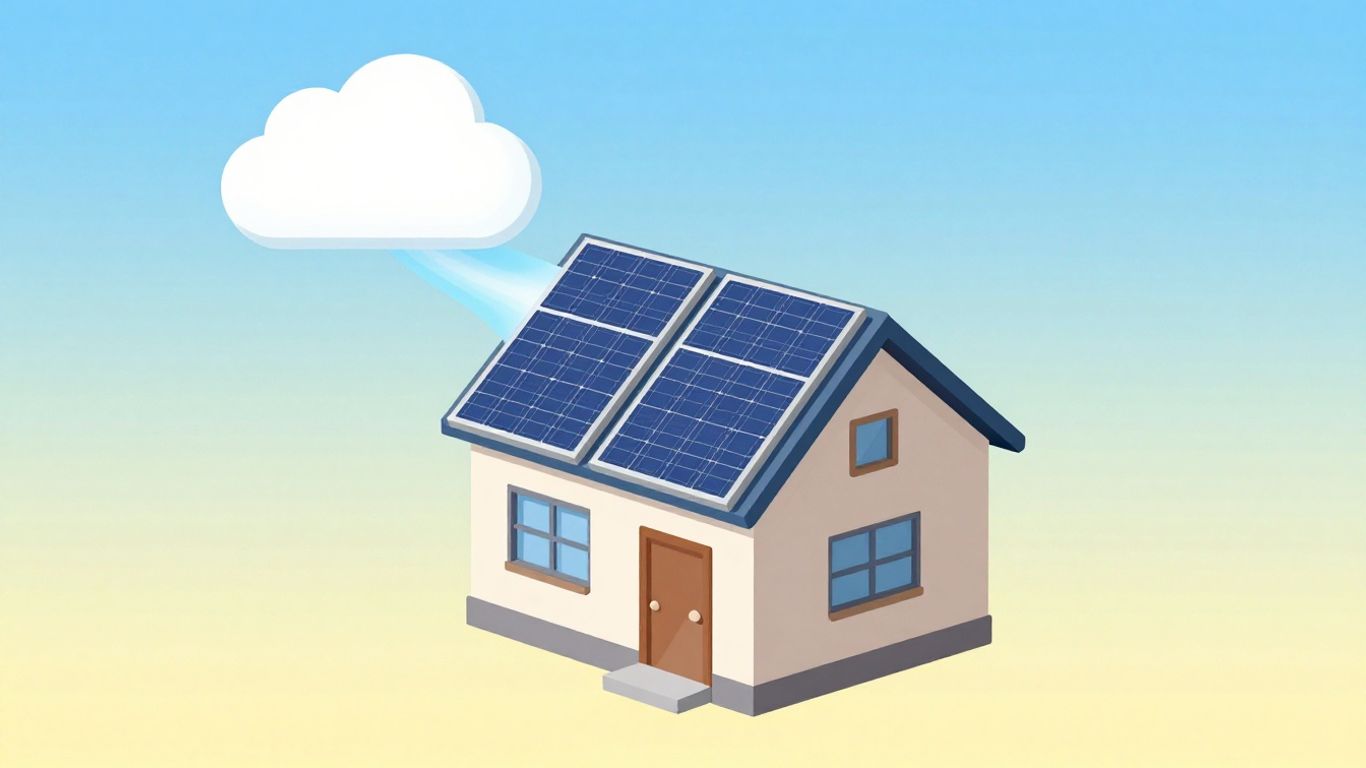
One of the main technical attractions of virtual storage lies in its installation simplicity. Unlike a physical battery that requires dedicated space, specific connections, and regular maintenance, a virtual battery requires no hardware intervention at your home. Your existing photovoltaic installation is sufficient. The surplus electricity you produce is simply fed into the public grid. It is a dematerialised solution that avoids the constraints of physical equipment.
Centralised Management by the Provider
With virtual storage, the management of your surplus energy is entirely handled by your electricity provider. They precisely track the amount of electricity you feed into the grid and the amount you withdraw. This system relies on precise IT monitoring of your energy flows. You therefore do not have to worry about the technical management of storage; the provider takes care of it, which greatly simplifies daily use. This centralisation allows for precise valorisation of your production over the year.
Theoretically Unlimited Storage Capacity
A notable technical advantage of virtual storage is its theoretically unlimited storage capacity. Since your surplus energy is fed into the public grid, you are not constrained by the physical capacity of a battery. If your solar production far exceeds your consumption, all of this surplus is credited. You can therefore benefit from your entire production, without risk of energy loss or waste. This is a valuable flexibility for installations producing a large volume of electricity. This approach aims to optimise the valorisation of your production over the year and improve your self-consumption rate [66d4].
It is important to understand that virtual storage does not actually store electricity at your home. It is more of an accounting and offsetting system. The energy you feed in is used by other grid users, and when you need it, you draw from the general grid, benefiting from an advantageous rate for the energy you initially produced.
Here is a comparative table of the technical aspects:
| Criterion | Virtual Battery | Physical Battery |
|---|---|---|
| Installation | No additional hardware installation | Requires physical installation and a dedicated space |
| Management | Centralised by the electricity provider | Managed by the user or an installer |
| Storage Capacity | Theoretically unlimited (via the grid) | Limited by the battery’s capacity |
| Maintenance | No hardware maintenance required | Regular maintenance required |
| Outage Autonomy | None (dependent on the grid) | Possible (if configured for it) |
Potential Risks Associated with Virtual Storage
Vulnerability to Power Outages
One of the major weaknesses of virtual storage is its inability to provide backup power during a general electricity grid failure. Unlike a physical battery installed at your home, which can continue to power your appliances, a virtual battery is entirely dependent on the availability of the public grid. If the grid goes down, your virtual storage system becomes inoperable. This means you will have no alternative energy source for your essential needs in the event of a prolonged outage. It is therefore important to consider this risk, especially if you live in an area prone to electricity interruptions.
Potential Contractual Complexity
The contracts offered by energy providers for virtual storage can sometimes be complex. They often include specific clauses regarding surplus management, feed-in tariffs, grid connection fees, and applicable taxes. Careful reading and a thorough understanding of these terms are necessary to avoid any unpleasant surprises. It is recommended to seek clarification on any point that seems ambiguous before signing. A misunderstanding of the contract could lead to unexpected costs or a less favourable valorisation of your surplus than anticipated. It is sometimes useful to compare different offers to better understand contractual variations, as offered by some online comparison tools for virtual battery offers.
Evolution of Offered Tariffs
The pricing conditions for a virtual battery are not fixed over time. Energy providers can adjust their price lists, which can impact the cost of your virtual storage or how your surplus is remunerated. These changes can occur based on developments in the energy market, regulations, or the provider’s commercial strategy. It is therefore wise to inquire about your provider’s tariff revision policy and remain vigilant about any potential changes. A personalised simulation can help anticipate these changes, but it should be kept in mind that the final cost may vary over the lifespan of your installation.
When to Opt for Virtual Photovoltaic Storage?
Virtual photovoltaic storage proves to be a relevant solution in several scenarios, particularly if you are looking to maximise the use of your solar production without the initial investment of a physical battery. It is worth considering this option if you meet certain conditions and your objectives align with the benefits it offers.
To Optimise Self-Consumption Without Material Investment
If the idea of installing a physical battery deters you due to its cost, the space it requires, or installation constraints, virtual storage offers an attractive alternative. It allows you to use your surplus solar electricity when you need it, even outside of production hours, without having to purchase and install additional equipment. It’s a way to consume your own energy to the maximum, thereby reducing your dependence on the traditional electricity grid. The principle is simple: your surplus is fed into the grid and you can retrieve it later, as if you had stored it at home. It is a dematerialised solution that greatly simplifies the process for the end-user. This system offers appreciable flexibility for those who wish to improve their energy autonomy without material complications.
To Valorise a Significant Production Surplus
Do you have a photovoltaic installation that regularly generates more electricity than you consume? Virtual storage is then an excellent way to avoid wasting this excess energy. Instead of selling it at a often unattractive rate through a feed-in tariff contract, you can
Are you wondering when it’s wise to install a solar energy storage system? That’s an excellent question! Think of it like a battery for your home, which stores the electricity produced by your panels so you can use it later, even when the sun isn’t shining. It’s perfect if you want to be less dependent on the electricity grid or if you want to make the most of the energy you produce. To find out if it’s the right solution for you, discover all the benefits on our website!
In Conclusion: Virtual Storage, an Option to Consider with Discernment
At the end of this exploration of virtual photovoltaic storage, it is clear that this solution offers an innovative approach to managing surplus solar energy. It stands out for its lack of physical installation and its flexibility, allowing for optimisation of self-consumption without the material constraints of a traditional battery. However, it is imperative to weigh its advantages against its disadvantages, particularly the dependence on the energy provider, the absence of state subsidies, and the fact that it does not intrinsically encourage a reduction in overall consumption. Before committing, a thorough analysis of your specific needs, a rigorous comparison of market offers, and careful reading of contracts are essential. Virtual storage can be a relevant solution for certain profiles, but it is not a universal answer. An informed decision, based on a clear understanding of the mechanisms and implications, is key to making your photovoltaic project a lasting success.
Frequently Asked Questions
What exactly is a virtual battery?
A virtual battery is a bit like a savings account for your solar electricity. Instead of storing energy in a large device at your home, your surplus electricity is recorded by your provider. You can then use this energy later, when your panels aren’t producing enough, as if you were withdrawing it from your account.
How does virtual storage work?
When your panels produce more electricity than you use, this excess is sent to the electricity grid. Your provider notes this and gives you an energy ‘credit’. Later, when you need electricity (e.g., in the evening), you first use this credit. Once it’s used up, you use electricity from the grid, but you’ve already saved on the portion you produced yourself.
Do I need to install anything special at my home?
No, that’s one of the big advantages! Unlike a real battery, you don’t need to install anything at your home. Everything is managed digitally with your energy provider. No work, no clutter!
What are the main advantages of this solution?
The main advantage is that you can use all the energy you produce, even at night or when the weather is cloudy. This allows for significant savings on your electricity bill and prevents your surplus energy from being wasted. Plus, it costs less upfront than a physical battery.
Are there any disadvantages to be aware of?
Yes, you should know that you won’t be eligible for certain government aid, such as self-consumption subsidies. Furthermore, you will have to switch electricity providers to one that offers this service. And if the electricity grid fails, you will also be without electricity, as there is no physical storage at your home.
Can I choose any energy provider?
No, you cannot. To have a virtual battery, you must choose an electricity provider that specifically offers this service. You will therefore need to compare offers to find the one that best suits you.
Is a virtual battery expensive?
The initial cost is generally lower than a physical battery. There are often annual service fees or a subscription. You should also be aware that even if you use your surplus, you will still have to pay taxes and fees for transmitting electricity over the grid.
When is this solution really worthwhile for me?
It’s a great option if you want to make the most of your solar energy without investing in a large battery, if you produce much more electricity than you consume, and if you are looking for a simple and flexible solution to manage your surplus.

Journaliste spécialisée en transition énergétique et consultante RSE. À 42 ans, Claire combine une formation en journalisme (Master Sciences Po) et un diplôme d’ingénierie environnementale (École des Mines / INSA). Après 10 ans dans la presse économique et 7 ans en cabinet de conseil RSE, elle écrit pour aider les décideurs B2B à comprendre les réglementations, les enjeux climatiques et les innovations énergétiques.