
Installing solar panels at home is a great idea for reducing your electricity bill and doing your bit for the planet. However, you produce energy when the sun is shining, and you often consume more in the evening or when it’s cloudy. This is where the concept of a virtual solar panel battery comes into play. Let’s look at how it works together, because it’s not as simple as a battery you have at home.
Key takeaways from the virtual solar panel battery
- A virtual battery is a solution that allows you to virtually store the excess electricity from your solar panels, without needing to install a physical battery at your home.
- When your panels produce more than you consume, the electricity is sent to the grid and recorded as a credit on your virtual account.
- You can then retrieve this stored electricity when you need it, for example at night, when your panels are not producing.
- This system is managed by your energy supplier, who acts as the link between your production, the grid, and your deferred consumption.
- While practical and without material investment, the virtual battery depends on the grid and may have management costs specific to each supplier.
Understanding the concept of a virtual battery for solar panels
The idea of a virtual battery for your solar panels might seem a bit abstract at first. After all, where is this electricity stored? In reality, the term « virtual battery » is a metaphor to describe a management system for your surplus solar energy. It’s not a physical device you install at home, but rather a service offered by some electricity suppliers. This service allows you to make the most of the energy your panels produce beyond your immediate consumption.
Definition of a virtual electricity battery
A virtual battery, also called virtual storage, is a device that allows for the management of excess photovoltaic electricity production. Unlike a physical battery, it does not involve any local storage equipment. When your solar panels generate more electricity than you consume at a given moment, this excess is fed into the public electricity grid. It is then accounted for by your supplier as a credit on a dematerialised energy account. This credit represents the equivalent of the energy you can retrieve later, when your solar production is insufficient to cover your needs.
The principle of virtual solar energy storage
The operation is based on a simple principle: maximising the use of the energy you produce. Here are the key steps:
- Solar production: Your photovoltaic panels convert sunlight into electricity. This electricity is first used to power your household appliances.
- Surplus injection: If your production exceeds your consumption, the surplus is sent to the general electricity grid.
- Accounting: Your supplier records the amount of energy injected. This energy is credited to your « virtual account, » much like a bank balance.
- Deferred retrieval: When your panels are not producing enough (e.g., at night, in cloudy weather, or during peak consumption periods), you can draw from your virtual stock. You then consume electricity from the grid, but this is deducted from your accumulated credit.
This system significantly increases your self-consumption rate without the need to invest in an expensive physical battery. It’s a smart way to make the most of every kilowatt-hour produced by your solar installation.
Comparison with physical storage
The fundamental difference lies in the nature of the storage. A physical battery stores electricity in chemical cells (often lithium) installed at your home. It allows for complete autonomy from the grid during discharge periods. A virtual battery, on the other hand, uses the electricity grid as a storage medium. The energy is not physically stored at your home, but its value is credited. This means you still depend on the grid for retrieval. While the virtual battery offers flexibility and a lower entry cost, it does not provide the same energy independence as a physical battery. The choice between the two will depend on your specific needs, your budget, and your desire for energy independence.
Virtual storage is an innovative solution for optimising self-consumption, but it’s important to understand that it’s about managing energy credit rather than physical storage. The electricity injected is consumed by other users, and you benefit in return from an equivalent right to draw from the grid.
It is essential to fully understand this mechanism to assess the relevance of this solution for your household. This system is managed by electricity suppliers who offer specific packages. The principle of virtual solar energy storage is therefore based on energy accounting rather than physical conservation.
Detailed operation of the solar virtual battery
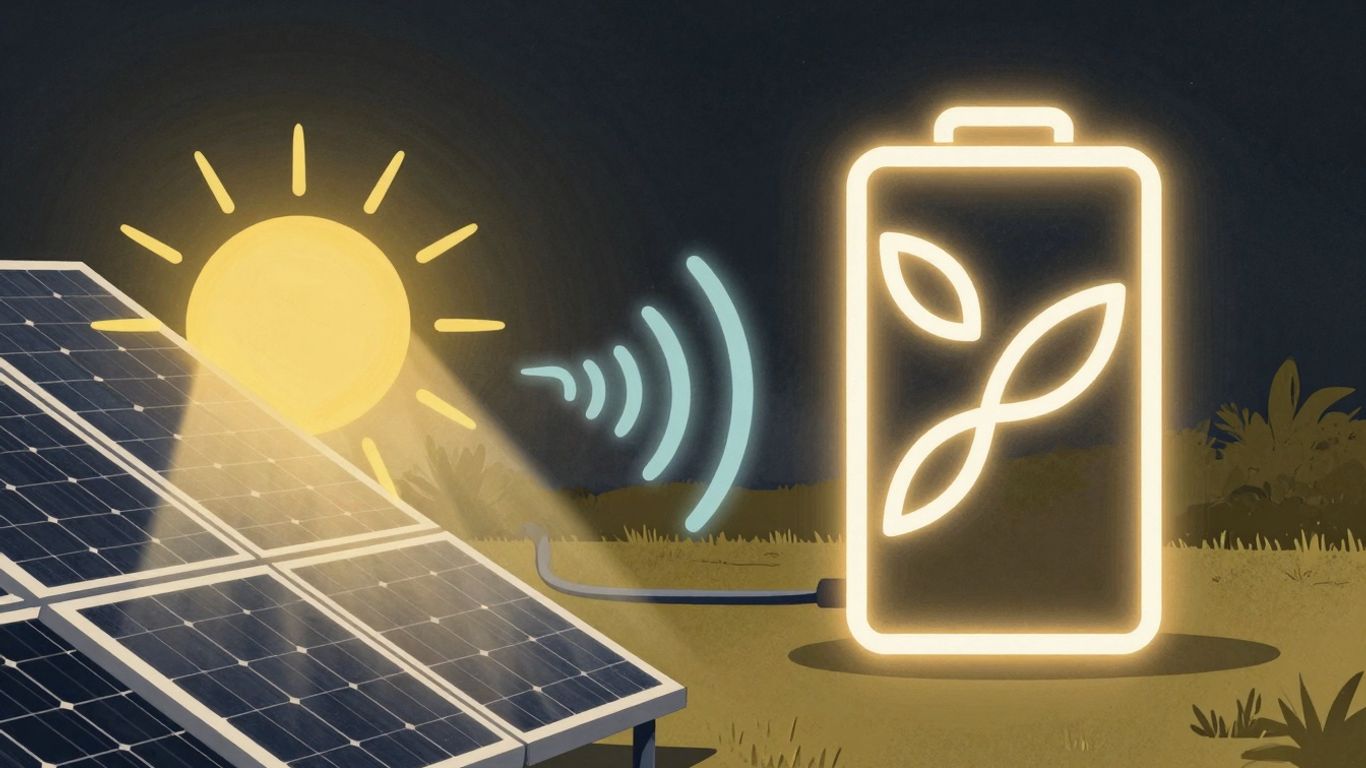
The principle of the virtual battery relies on intelligent management of your solar electricity production and your consumption. It is a dematerialised solution that allows you to virtually store your surplus energy for later reuse, without having to install bulky equipment at your home.
The role of photovoltaic production surpluses
When your solar panels produce more electricity than your household consumes at a given moment, this excess should not be lost. Instead, it is fed into the public electricity grid. This is where your electricity supplier’s role comes in: they precisely record the amount of energy you have injected. This injected energy feeds into your virtual battery’s « account, » thus creating an electricity credit that you can use later.
Injection and accounting on the grid
The injection of your surpluses into the grid is a key step. A smart meter, such as the Linky meter in France, plays an essential role by accurately measuring the electricity produced and that which is fed back. This data is transmitted to your supplier, who uses it to update your virtual balance. This accounting system allows for real-time tracking of the amount of energy you have made available to the grid and which you can retrieve. It is important to understand that this energy is not physically stored in a device at your home, but its value is recorded and managed by your supplier.
Deferred retrieval of stored electricity
When your solar panels do not produce enough to cover your needs – for example, at night, during very cloudy days, or during periods of high demand – you can draw from your virtual reserve. Your supplier will then credit you with the equivalent of the electricity you had previously injected into the grid. This mechanism allows you to consume your own solar energy even when your panels are not working, thus increasing your self-consumption rate and reducing your dependence on the traditional electricity grid. If your virtual credit is depleted, the supply will then switch to your supplier’s standard electricity.
Here are the key steps in the process:
- Solar production: Your panels convert light into electricity, which is consumed on-site first.
- Surplus recording: Any excess kWh is injected into the grid and credited to your virtual battery « account ».
- Deferred use: When solar production is insufficient, you virtually consume the accumulated kWh.
- Grid top-up: If credits are depleted, supply is provided via standard electricity.
This system offers valuable flexibility for optimising the use of your photovoltaic production, without the constraints of a physical battery. It is important to carefully study the contractual terms with your supplier to understand the retrieval conditions and any potential management fees. For a complete assessment of your solar project, analysing the site’s solar potential is a crucial step for a well-sized project.
Key players in the virtual battery system
The operation of a virtual battery relies on the interaction of several entities. Each plays a specific role to ensure the system functions optimally.
The role of solar energy producers
Solar energy producers, i.e., you, the owners of photovoltaic panels, are at the heart of the system. Your main role is to generate electricity. When your production exceeds your immediate consumption, this surplus is injected into the public grid. It is this excess electricity that will be accounted for and virtually stored. Without this production, there is nothing to store, whether physical or virtual. It is therefore important to properly size your installation to maximise production and, consequently, the virtual storage potential. Good management of your installation, including components like the charge controller, is therefore essential.
Management by electricity suppliers
Electricity suppliers are the orchestrators of the virtual battery. They provide the software platform that manages your « energy account. » They are the ones who record the electricity you inject into the grid and credit it to your virtual account. When you need this stored energy (e.g., in the evening or on less sunny days), it is the supplier who ensures you can retrieve it via the grid. They define the contractual terms, any management fees for energy retrieval, and storage limits. Your choice of supplier will therefore have a direct impact on how your virtual battery functions and its profitability.
Involvement of grid operators
Distribution network operators (DNOs) are the guarantors of the stability and availability of the electricity grid. They ensure that the electricity injected by producers, including the surpluses from your solar installation, can circulate and be distributed. They also guarantee that the electricity you retrieve from your virtual battery reaches you. Although they do not interact directly with you as a virtual battery user, their role is essential for the system to exist. They maintain the infrastructure that allows for energy injection and retrieval, making virtual storage possible.
Advantages of the virtual battery for self-consumption
Maximising self-consumption without material investment
One of the major attractions of the virtual battery lies in its ability to optimise your self-consumption rate without requiring the purchase and installation of a physical battery. This represents substantial savings, as traditional batteries represent a significant initial cost. With a virtual battery, you benefit from the advantages of energy storage, such as using your solar production even when the sun isn’t shining, without the heavy financial commitment. It’s a smart way to make the most of the electricity you produce.
Reduced dependence on the electricity grid
By using virtually stored electricity, you naturally reduce your reliance on the public electricity grid. This translates into a lower electricity bill and greater energy autonomy. The system allows you to smooth out your consumption over the year, using summer surpluses to cover your winter needs, for example. This flexibility contributes to better management of your energy budget and a reduced carbon footprint.
Optimal valorisation of renewable energy
The virtual battery transforms your surplus photovoltaic production into a usable energy credit for later. Instead of selling this excess at a often low rate, you feed it back into your consumption when you need it, thus reducing your electricity purchases from the grid. This is an effective method to prevent waste of the green energy you produce and to maximise the return on investment of your solar installation. Precise monitoring of flows thanks to smart meters is at the heart of this optimisation, allowing for fine-grained management of your solar production.
- Access to stored energy at any time: Night, bad weather, or even several months after production.
- Contractual flexibility: Often without commitment, allowing adaptation to your evolving needs.
- Ease of use: Management is handled by the supplier, without any technical intervention from you.
The virtual battery offers an accessible solution for those who wish to improve their self-consumption without the material and financial constraints of a physical battery. It allows for better control of consumption and a reduction in electricity bills, while contributing to better integration of renewable energies into the energy mix.
Limitations and disadvantages of the virtual battery
While the virtual battery offers undeniable advantages for self-consumption, it is important to consider its limitations. This solution, although innovative, is not without its constraints that may affect its appeal for some users.
Dependence on the electricity grid and supplier
Unlike a physical battery which can offer some autonomy during outages, the virtual battery is intrinsically linked to the proper functioning of the public grid. If the grid fails, access to your virtual « stock » becomes impossible. Indeed, the electricity injected into the grid is pooled; it is not physically reserved for your exclusive use. Furthermore, your electricity supplier plays a central role. Pricing, management terms, and energy retrieval depend entirely on the subscribed offer. Changing suppliers can sometimes lead to the loss of accumulated credits, so it is important to carefully study contracts before committing or switching operators.
Ineligibility for financial aid
An often overlooked point is that the virtual battery is generally not eligible for financial aid schemes, such as the self-consumption bonus. These aids are often reserved for physical installations or for selling surpluses through specific contracts. This can make the initial investment in solar panels less profitable on paper, compared to solutions that benefit from this financial support.
Management costs and contractual terms
It is essential to carefully examine the terms of each offer. Some suppliers may charge management fees for each kilowatt-hour (kWh) retrieved from your virtual stock. Others may impose annual flat rates or specific subscriptions. It is therefore necessary to precisely calculate profitability by taking into account your annual solar production, your consumption profile, and these potential fees. Furthermore, contracts may set storage limits or time limits for deferred energy consumption. Some contracts provide for the cancellation of unused balances at the end of the year, while others allow for carry-over. Therefore, you must read the general terms and conditions carefully to avoid unpleasant surprises and ensure that the chosen contract allows for the carry-over or valorisation of unused credits.
Contractual flexibility and hidden costs are therefore elements that should not be overlooked when choosing a virtual battery offer.
Technical and technological specificities
Monitoring by smart meter
For a virtual battery to function correctly, it must be possible to precisely monitor what is happening on the grid. This is where the smart meter, such as Linky in France, comes in. This meter records in real-time the amount of electricity you produce with your solar panels, the amount you consume directly, and the amount you inject into the grid. This information is then transmitted to the energy supplier managing your virtual battery. Without this precise monitoring, it is impossible to know how much energy is virtually stored and when it can be retrieved. It’s a bit like having a detailed bank statement for your solar energy.
Energy management platforms
Behind the virtual battery, there is often a software platform. This is what links your meter, your supplier, and the grid. It allows you to view your production, your consumption, and your virtual stock. Some suppliers offer mobile applications or online portals where you can track all of this. These platforms also help optimise the retrieval of your stored energy, for example, by suggesting the best times to use virtual electricity. It’s a bit like the brain of the operation, ensuring that everything works well and that you make the most of your solar production. They are designed to make energy management simpler for the user.
Underlying technologies
The virtual battery relies on several technologies. Firstly, there are of course the solar panels and their inverter system to convert direct current into alternating current that can be used. Then, the smart meter plays a key role in measurement. But the most important technology is what allows the supplier to manage energy flows. It’s not physical storage, but a sophisticated accounting system. When you inject your surplus, the supplier credits you with a certain amount of energy. When you need it, they return it to you by deducting it from your virtual stock. It’s a form of digitally managed energy credit. The idea is to be able to benefit from your own production, even if it’s not consumed immediately. This system allows for great flexibility, as there is no physical storage limit like with a conventional battery. Suppliers can therefore offer very large virtual capacities, sometimes even unlimited, which is a definite advantage over hardware solutions. Integration with electric vehicles is also a developing technological avenue.
Comparison between virtual and physical batteries
With the rise of solar self-consumption, two energy storage solutions are available: the physical battery and the virtual battery. Although both aim to optimise the use of your photovoltaic production, their operating methods, costs, and benefits differ considerably.
Fundamental differences in storage
The main distinction lies in where the energy is stored. A physical battery, as its name suggests, is equipment installed directly at your home. It stores production surpluses for later use, for example, at night or during less sunny days. It is a solution that offers a degree of energy independence, as it works even in the event of a grid outage. It allows for total self-consumption without depending on a third party for the storage itself.
Conversely, a virtual battery stores nothing physically at your home. It is a service offered by certain electricity suppliers. When you produce more than you consume, your surpluses are injected into the grid and accounted for in a virtual account. You can then retrieve this energy when you need it, by drawing it from the grid, as if it were stored. This system relies on smart meters and digital platforms to track energy flows.
Comparative advantages and disadvantages
Here is a comparative table to better visualise the differences:
| Characteristic | Physical Battery | Virtual Battery |
|---|---|---|
| Initial investment | High (several thousand euros) | None (no equipment to buy) |
| Recurring costs | Maintenance, potential replacement | Service subscription, taxes on re-injected and retrieved energy |
| Storage | Limited by equipment capacity | Theoretically unlimited (often capped by the supplier) |
| Grid autonomy | Yes, works during outages | No, depends on the grid functioning correctly |
| Installation | Requires dedicated space and technical installation | No physical installation required |
| Management | Managed by the owner (or installer) | Managed by the electricity supplier |
| Environmental impact | Manufacturing and end-of-life of components | Reduced (no equipment to produce or recycle) |
A physical battery represents a greater financial commitment, but it offers increased independence and security. It can be more profitable in the long term for households with high consumption that is out of sync with their production. The virtual battery, on the other hand, is appealing due to its simplicity and lack of installation costs, making it accessible to a wider audience. It is an excellent option for those who wish to valorise their surpluses without heavy material investment. It is important to note that the virtual battery involves changing electricity suppliers to benefit from the virtual storage offer.
Choice criteria for individuals
The choice between these two solutions will depend on several factors specific to each household:
- Available budget: If the initial investment is a major constraint, the virtual battery is an interesting alternative.
- Need for autonomy: For those who prioritise energy independence and security in case of outages, a physical battery is preferable.
- Desired storage capacity: If you have very large and variable storage needs, the theoretical flexibility of the virtual battery can be an asset, although physical options are increasingly modular.
- Management complexity: The ease of use of the virtual battery, entirely managed by the supplier, suits people who do not want to bother with the technical aspects.
- Eligibility for aid: Physical batteries can sometimes benefit from financial aid, which is not the case for virtual systems.
It is essential to carefully analyse your own consumption and production habits to make the most suitable choice for your situation, aiming for self-consumption optimisation without heavy material investment if the budget is limited.
Profitability and calculation of the solar virtual battery
The question of the profitability of a solar virtual battery is at the heart of concerns for individuals wishing to optimise their photovoltaic installation. It is important to understand that the calculation of this profitability is based on several interdependent factors, ranging from your consumption profile to the cost structure imposed by your supplier.
Factors influencing profitability
Several elements determine whether a virtual battery will be a good investment for you. It’s not just about the amount of electricity your panels produce.
- Your consumption profile: The mismatch between your peak solar production and your peak consumption times is the most determining factor. If you consume a lot in the evening or at night, when your panels are not producing, the virtual battery can be very beneficial to you.
- The electricity purchase price: The price at which you buy electricity from the grid when your virtual stock is depleted directly influences your savings.
- Supplier’s contractual terms: Each virtual battery offer has its specificities. You need to carefully examine management fees, any storage limits, and the validity period of your energy credit.
- Performance of your photovoltaic installation: Higher solar production means more surplus to inject and therefore potentially more virtual credit accumulated.
Analysis of management and transmission costs
It is essential not to overlook the costs associated with using a virtual battery. Unlike a physical battery where the investment is material, here, the costs are mainly related to services and grid infrastructure.
The electricity you inject into the grid for
Ecological aspects and sustainability of the virtual battery
Reduced environmental impact
One of the major advantages of the virtual battery lies in its considerably reduced ecological footprint compared to a physical storage solution. Indeed, it avoids the often energy-intensive manufacturing processes and the extraction of rare materials needed for the production of traditional batteries. It thus fits into a more responsible consumption approach, by valorising solar energy without generating additional material waste. This approach limits the overall environmental impact associated with photovoltaic self-consumption.
Promotion of renewable energies
The virtual battery plays a significant role in promoting and integrating renewable energies into the electricity grid. By offering a simple and accessible solution for managing production surpluses, it encourages more households to equip themselves with solar panels. This helps to increase the share of green energy in the national energy mix. Furthermore, it allows for better valorisation of locally produced electricity, thereby strengthening energy independence and citizen production.
Prevention of energy waste
Without a storage solution, surplus solar electricity produced during peak sunlight hours, but not consumed immediately, is often fed back into the grid without being fully valorised. The virtual battery offers an intelligent alternative to this waste. It allows for the deferred use of this excess energy at times when demand is higher or solar production is lower. This optimises the use of each kilowatt-hour produced, thus reducing energy losses and maximising the benefit of the photovoltaic installation. It is important to note that, unlike a physical battery which provides backup power in case of an outage, the virtual battery depends on the availability of the public grid to function. For complete autonomy, a physical battery remains an option to consider.
User profiles benefiting from the virtual battery
Households with a production-consumption mismatch
The virtual battery is particularly suitable for households whose consumption habits do not align with periods of high solar production. This is the case, for example, for households where occupants work outside the home during the day, or for large families whose electricity needs (appliances, lighting) are higher in the evening. Excess energy produced during daylight hours can thus be virtually stored and reused later, when the sun no longer shines. This allows for maximising self-consumption without having to change daily routines.
Individuals seeking an economical solution
For those who wish to optimise their electricity bill without making a significant material investment, the virtual battery represents an interesting alternative. Unlike a physical battery which requires a high initial purchase and installation cost, the virtual battery often operates on a subscription model, without long-term commitment. This offers valuable flexibility and allows for testing the benefits of solar energy storage at lower risk. It allows for valorising production surpluses without significant upfront costs.
Users unable to install a physical battery
Certain situations prevent the installation of a traditional storage battery. This is the case for tenants, who do not have permission to modify their property, or for homeowners whose available space is limited or unsuitable. The virtual battery then offers an accessible solar energy storage solution, regardless of technical or property constraints. It makes the benefits of extended self-consumption accessible to a wider audience.
Here is a simplified comparative table of profiles:
| User profile | Main characteristic | Benefit of the virtual battery |
|---|---|---|
| Production-consumption mismatch | Increased consumption in the evening or at night | Deferred reuse of solar energy produced during the day. |
| Seeking an economical solution | Limited budget for material investment | No high initial purchase cost, subscription model, contractual flexibility. |
| Inability to install a physical battery | Tenants, limited space, technical constraints of the dwelling | Storage solution without physical equipment, accessible to all. |
Discover who are the users who benefit most from the virtual battery. These profiles show how this technology can help you save money. Want to learn more about how the virtual battery can be useful to you? Visit our website to discover all the benefits and how you can take advantage of them today.
In summary: the virtual battery, an option to consider
To summarise, the virtual solar battery presents itself as an interesting solution for those who wish to better manage the electricity produced by their photovoltaic panels without having to install bulky and expensive equipment at their home. It allows for smoothing out the differences between solar production, which varies with the sun, and our consumption, which is more constant. Basically, it’s like having a bank account for your electricity: you deposit the surplus when there’s too much, and you withdraw when you need it. Of course, you need to carefully check the conditions of each supplier, as it’s not always free and there are rules to follow. But for many, it’s a simple way to save money and make the most of their solar installation.
Frequently Asked Questions
What is a virtual battery for solar panels?
Imagine a battery, but without the big physical block at your home. That’s a virtual battery! It’s a service offered by some electricity suppliers. When your solar panels produce more electricity than you consume, the surplus is kept in virtual ‘stock’ with your supplier. You can then use this electricity later, when your panels are not producing enough, like at night.
How does this virtual storage work in practice?
It’s quite simple. Your panels produce electricity. If you don’t need it right away, it goes onto the public grid. Your supplier notes this amount of electricity as a credit on your virtual ‘account’. Later, when you need electricity and your panels aren’t producing, you use your credit. It’s as if you were using your own electricity, but it comes from the grid at that moment.
Is the virtually stored electricity free?
The electricity you have injected and credited to your virtual account allows you to retrieve an equivalent amount later. However, this retrieved electricity is not entirely free. You will still have to pay taxes and fees for the electricity to travel to your home via the grid.
What are the advantages compared to a real battery?
The big advantage is the price! No need to buy an expensive battery and do renovation work. It’s a more economical solution. Furthermore, there is no equipment to install at your home, so less hassle with maintenance, breakdowns, or replacement. It’s also more flexible if you move.
Are there any disadvantages to using a virtual battery?
Yes, there are. Your virtual battery is totally dependent on the electricity grid. If the grid fails, you lose access to your virtual ‘stock’. Furthermore, you cannot benefit from certain financial aids like the self-consumption bonus, which is reserved for those who sell their surplus or install a physical battery.
Who are the main suppliers offering this service?
Several energy suppliers offer virtual battery packages in France. Among them, we can mention companies like Ekwateur, Ilek, or Plüm Énergie. It’s always a good idea to compare their offers to find the one that suits you best.
Is the virtual battery a real battery?
No, it’s not a real battery in the material sense. There is no electricity physically stored in a device at your home. It’s more of an accounting system. Your supplier keeps track of the electricity you have sent to the grid and allows you to retrieve an equivalent amount later. It’s a bit like a bank account for your electricity.
Who can really benefit from the virtual battery?
The virtual battery is ideal for those who produce more electricity than they consume during the day, but who need electricity in the evening or at night. It’s perfect for households whose consumption habits don’t always match the times when the sun is shining. It’s also an excellent option for those on a limited budget who cannot afford a physical battery.
