
When we think of solar energy, we often imagine panels on the roof and a house that runs almost by itself. But concretely, what can you power with a 3000W solar panel? Many people ask themselves this question before embarking on an installation. This type of panel offers interesting power, but there are limits to be aware of. In this article, we will look at what is possible to power, how to optimise the use of this energy, and what to keep in mind to avoid unpleasant surprises.
Key takeaways
- A 3000W solar panel allows you to run most everyday appliances, such as a refrigerator, freezer, and several electronic devices.
- It is important not to use several high-consumption appliances at the same time, such as a washing machine and an oven, to avoid exceeding the installation’s capacity.
- Adding a storage battery allows you to benefit from solar energy even at night or on cloudy days, thus increasing self-consumption.
- A 3000W installation does not cover all the needs of a house, especially for electric heating, which remains difficult to power solely with solar.
- The cost of a 3000W installation varies between 8,000 and 12,000 euros, but there are aids available to support self-consumption and reduce the final bill.
Understanding the power of a 3000W solar panel
Definition and production capacity
When we talk about a 3000W solar panel, it is important to grasp what this measurement actually represents. This power, often expressed in peak watts (Wp), indicates the maximum production capacity of the installation under ideal conditions. It is not a single panel, but a complete installation, generally composed of several individual panels (between 6 and 10, depending on their individual power) to reach this total capacity. These ideal conditions include solar irradiation of 1000 W/m², an ambient temperature of 25°C, and no shade at all. In practice, the power delivered fluctuates constantly depending on sunshine and other environmental factors. The distinction between peak Watt (Wp) and Watt-hour (Wh) is fundamental: Wp measures the maximum instantaneous power, while Wh quantifies the energy produced over a given period. A 3000 Wp installation, if operating at its maximum for one hour, would theoretically produce 3000 Wh. For a more concrete view of your potential, you can use a simulator to estimate the ideal power of your solar plant. A 3000W installation is also the standard threshold for benefiting from certain tax advantages.
Optimal conditions for maximum performance
For a 3000W solar installation to approach its maximum potential, several elements must be in place. Geographical location plays a major role, with more sunshine in the south of France than in the north. The orientation of the panels is also crucial; a south-facing exposure is generally the most favourable. The tilt of the panels must be adapted to the latitude to best capture the sun’s rays throughout the year. Finally, regular maintenance, particularly cleaning the panels to remove dust and debris, is essential to avoid any loss of performance.
- Orientation: Favour South.
- Tilt: Adapted to local latitude.
- Absence of shade: Clear the panels of shade cast by trees or buildings.
- Maintenance: Periodic cleaning.
The role of the inverter in energy conversion
The energy produced by solar panels is in the form of direct current (DC). However, the majority of household appliances and the domestic electrical grid operate on alternating current (AC). This is where the inverter comes in, an essential component of any photovoltaic installation. Its role is to convert the direct current generated by the panels into alternating current usable by your home. The efficiency of this device is therefore a determining factor in the amount of energy that can actually be exploited. An efficient inverter can have an efficiency of over 90%, thus minimising losses during conversion. The choice of the appropriate inverter is therefore as important as the choice of the panels themselves to optimise the overall production of your installation.
Household appliances powered by a 3000W installation
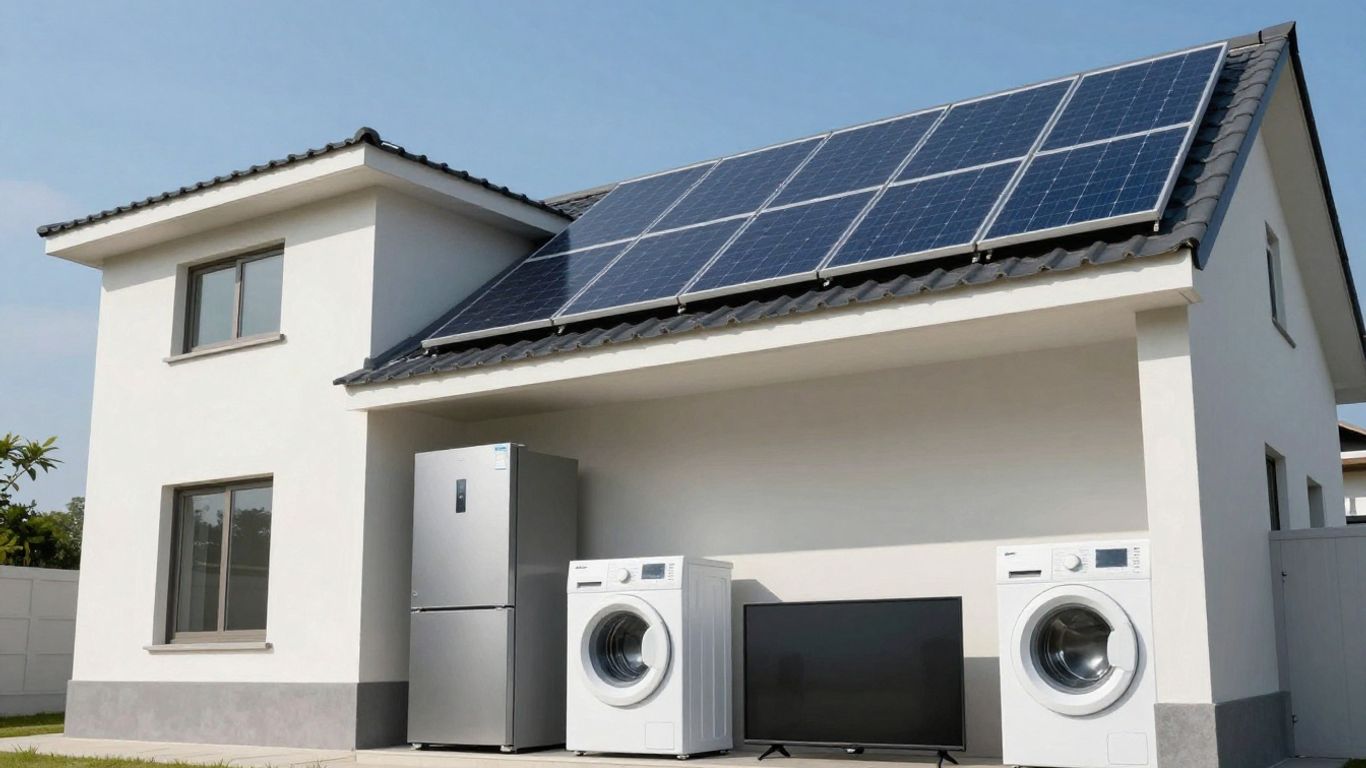
A 3000W solar installation offers interesting power for your home. It allows you to power a good portion of your everyday appliances, and even some that consume a lot. Let’s see what you can actually run with this capacity.
Powering common appliances: refrigerator and freezer
Appliances that run constantly, such as refrigerators and freezers, are good candidates to be powered by your solar installation. A refrigerator generally consumes between 100 and 300W, and a freezer in the same range. These two appliances, running together, represent a constant but manageable load for a 3000W system. The advantage is that they are often the first consumption points after lighting, and running them on solar energy ensures direct savings on your bill. It is important to note that their consumption can vary, especially when doors are opened or the compressor starts up.
Managing high-consumption appliances: washing machine and dishwasher
Appliances like washing machines and dishwashers are more power-hungry, but can be integrated. A washing machine can consume between 500 and 1500W, while a dishwasher is more in the range of 1200 to 2400W. The trick here is not to run them at the same time as other high-consumption appliances. For example, running a washing machine while the oven is on is not recommended. It is better to use them during hours of strong sunshine, ideally when your solar production is at its peak. This maximises self-consumption and reduces reliance on the grid. Remember to check the exact power of your appliances to better plan their use. Good management of your solar kit is key.
Using cooking and drying appliances
Cooking appliances, such as electric ovens (2000-4000W) and induction hobs (2000-3000W), as well as tumble dryers (1800-5000W), are among the biggest energy consumers in a household. With a 3000W installation, it is possible to run one at a time, and only occasionally. It is strongly advised not to use them simultaneously or in combination with other power-hungry appliances. For example, using a tumble dryer on its own is feasible, but combining it with an oven would exceed the instantaneous production capacity. The ideal is to use them during peak solar production hours, and if possible, to favour less energy-consuming appliances if your goal is maximum autonomy. The estimated annual production in France for such an installation is between 3000 and 4500 kWh, which gives an idea of the amount of energy available in the long term depending on your region.
It is important to understand that the 3000W power represents the maximum instantaneous production capacity. The actual consumption of your appliances, combined with the availability of sunshine, will determine what you can power at any given time. Careful planning of your usage is therefore necessary to make the most of your solar installation.
Lighting and compatible electronic devices
Low-consumption lighting solutions
Lighting accounts for a significant portion of a household’s electricity consumption. Fortunately, with a 3000W solar installation, you can efficiently power your lighting needs. LED bulbs, for example, are particularly economical, typically consuming between 5 and 15W per unit. This means a solar installation can easily handle the lighting for an entire house, including outdoor areas, without significantly impacting energy production.
- LED bulb: 5 to 15W
- Compact fluorescent lamp: 15 to 20W
- Outdoor lighting (spots, wall lights): Variable, but optimisable with LED models.
Adopting LED lighting solutions is therefore a logical step to maximise the energy autonomy of your home.
Powering multimedia and IT equipment
Electronic devices such as televisions, computers, game consoles, internet boxes, and phone chargers have become ubiquitous. A 3000W solar installation is perfectly capable of powering them. The consumption of these devices is generally moderate, allowing for comfortable daily use.
Here are some examples of typical consumption:
- Internet box: around 10W
- Laptop computer: 50 to 100W
- Desktop computer: 60 to 300W (depending on configuration)
- Television (LED): 80 to 200W (depending on size)
- Smartphone charger: around 5W
It is important to note that the 3000W power can be used simultaneously by several devices. For example, you could power your internet box, a laptop, a television, and charge several phones at the same time. For optimal management, it is always advisable to check the exact consumption of your devices, often indicated on a label or in their manual. Good planning of the use of these devices, by running them during daylight hours, allows you to increase your self-consumption rate and make the most of your solar system. Consider integrating self-consumption solar kits for finer management of your production and consumption.
Estimating annual energy production
Understanding how much electricity your 3000W solar installation can produce each year is a key step in evaluating its relevance. However, this production is not a fixed value; it depends on several factors, the most obvious being the geographical location of your home.
Production variability according to geographical location
Sunshine varies considerably from one region to another in France. For example, the southeast benefits from significantly more sunshine than the northwest. An identical installation will therefore produce more in sunny regions. It is therefore relevant to consult sunshine maps to anticipate the potential of your installation.
Average annual production in France
In France, a 3 kWp (kilowatt-peak) solar installation, which corresponds to a power of 3000W, can reasonably produce between 2700 and 4200 kWh per year. This range is a national average. For a more precise idea, an installation in Brest could produce around 3372 kWh annually, while a similar installation in Nice could reach 4305 kWh. The national average is around 3200 kWh per year.
Here is a more detailed estimate by zone:
| Geographical zone | Estimated annual production (kWh) |
|---|---|
| Northern France | 2700 to 3000 |
| Central France | 3000 to 3500 |
| Southern France | 3500 to 4200 |
Factors influencing actual production
Beyond location, other elements directly impact the amount of energy produced:
- Panel orientation and tilt: A south-facing orientation and a tilt of around 30° are generally ideal for maximising solar capture.
- Shading: The presence of trees, neighbouring buildings, or even surrounding vegetation can significantly reduce production if it casts shade on the panels.
- Maintenance: The cleanliness of the panels is important. Dust, dead leaves, or pollution can form a layer that reduces efficiency. Regular cleaning with fresh water is recommended.
- Temperature: Paradoxically, solar panels work less well when it is very hot. Optimal conditions are around 25°C.
It is important to note that the nominal power of a solar panel is measured under ideal laboratory conditions. Actual production will therefore always be lower than this theoretical value. Good planning and careful installation are therefore essential to achieve the best possible results and optimise your solar self-consumption.
Optimising solar energy use
To make the most of your 3000W solar installation, it’s not enough to just install it and forget about it. You need to think about how you use the electricity you produce. This is where optimisation comes in, and it can really make a difference to your bills.
The importance of battery storage
Solar energy is great when the sun is shining. But what do you do when it’s not, for example at night or on a very grey day? This is where storage batteries become interesting. They allow you to keep the surplus energy produced during daylight hours to use later. Think of it as an energy reserve. Without storage, the surplus is often lost or sold cheaply. With a battery, you increase your autonomy and your ability to use your own production. It’s an investment, certainly, but one that can pay for itself in the long run by further reducing your reliance on the grid. Brands like Victron Energy offer solutions for this.
Increasing the self-consumption rate
Self-consumption is the idea of directly consuming the electricity you produce. The more you consume your own energy, the less you need from the grid. To achieve this, you need to adapt your habits a little. For example, if you have a washing machine, try to run it during the hours when your panels produce the most, generally between 11 am and 3 pm. The same applies to the dishwasher or other power-hungry appliances. It’s about synchronising your needs with your panel production. This requires a bit of organisation, but it is very effective in maximising the benefits of your installation. Control applications can help you monitor your production in real-time and adjust your consumption. This is a key strategy to maximise your self-consumption.
Adapting consumption to sunshine periods
Ultimately, it’s all about timing. If you know your panels produce a lot between noon and 4 pm, it makes sense to schedule the tasks that consume the most electricity during these periods. This may seem simple, but it is often the most overlooked point. We tend to use appliances when we need them, without necessarily thinking about solar production. By changing this perspective, you can significantly reduce your bill. Consider programming your water heater, your dishwasher, or even charging your electric vehicle during peak production hours. It’s a smart way to make your solar installation work for you, and to reduce your carbon footprint. To help you with your project, professionals like those at EDF solutions solaires can help you understand how to best optimise your installation.
Limitations and considerations for a 3000W installation
Even though a 3000W solar installation offers interesting possibilities, it is important to be realistic about its capabilities and to fully understand its limitations. A power of 3000W, while significant, does not mean total energy independence. It must be kept in mind that solar energy production is intermittent and heavily dependent on weather conditions and the time of day.
The impossibility of total energy autonomy
It is rare for a 3000W installation to cover 100% of a household’s energy needs, especially without a battery storage system. At night, for example, production is zero. Furthermore, consumption peaks, even brief ones, can exceed the installation’s instantaneous capacity. To compensate for this, it is often necessary to remain connected to the traditional electricity grid or to invest in storage solutions. Self-consumption, i.e., consuming electricity produced on-site, can be optimised, but rarely total.
Electric heating, a challenge for solar installations
Electric heating appliances, such as radiators or electric water heaters, are among the most energy-intensive in a household. A 3000W system may struggle to power these appliances continuously, especially if they are running at full power. For example, an electric radiator can consume between 1000W and 2000W, or even more. Using heating and other power-hungry appliances like an oven or washing machine simultaneously could quickly saturate the production capacity. It is therefore often recommended to shift the use of these power-hungry appliances to periods of strong solar production or to consider alternative, less energy-intensive heating solutions.
The need for careful power management
To make the most of your 3000W installation, careful management of your consumption is essential. This involves understanding the power of each appliance and planning their use. Here are a few points to consider:
- Identify high-consumption appliances: Knowing which appliances consume the most (tumble dryer, oven, hob, heating) is the first step.
- Adapt your consumption: Prioritise the use of the most power-hungry appliances during periods of optimal sunshine. For example, run the washing machine or dishwasher in the middle of the day.
- Avoid overloads: Do not run too many powerful appliances at the same time. An overload can cause a shutdown or damage the system.
- Use energy-efficient appliances: Opting for A+++ rated appliances and LED lighting can significantly reduce energy demand.
A 3000W installation is an excellent addition to reduce your electricity bill and increase your energy independence, but it does not entirely replace the public grid, especially for the most significant needs such as heating. Good planning and sensible consumption are the keys to successful use.
It is also important to note that to achieve a power of 3000W, it is generally necessary to install between 7 and 11 solar panels, depending on their individual power and installation conditions [f00c]. The orientation of these panels, ideally south-facing, is also a determining factor in maximising their yield [81f4].
Cost and financial aid for a solar installation
Investing in a 3000W solar installation represents a certain initial budget, but it is important to consider it as a long-term investment. The overall cost can vary considerably, generally between €7,000 and €10,000 for a complete installation, including fitting. Several factors influence this price: the type of panels chosen (monocrystalline, polycrystalline), the quality of materials, the complexity of the installation, and any additions such as battery storage systems.
Estimating the budget for a 3000W installation
The price of a 3 kWp photovoltaic installation is often in the range of €7,000 to €8,500 including VAT. This amount includes the equipment, installation by qualified professionals, and administrative procedures. It should be noted that this price can be reduced thanks to various financial aids.
- Type of panels: Monocrystalline panels, which are more efficient, can increase the initial cost.
- Conversion system: The choice between a central inverter and micro-inverters can also affect the budget.
- Installation complexity: An over-roof or building-integrated installation, as well as roof accessibility, play a role.
It is strongly recommended to use an RGE (Reconnu Garant de l’Environnement – Recognised Guarantor of the Environment) certified professional to ensure the quality of the installation and eligibility for aid.
Support schemes for self-consumption
To encourage the adoption of solar energy, several aid schemes are available:
- The self-consumption bonus: This is paid in a single instalment after installation and connection. For a 3 kWp installation, its amount is fixed and can significantly reduce the remaining cost.
- Selling surplus electricity: Unconsumed electricity can be resold to EDF Obligation d’Achat (EDF OA) at a guaranteed rate for 20 years, generating additional income.
- Reduced VAT: Value Added Tax is generally reduced to 10% for installations of 3 kWp or less, and can even drop to 5.5% under certain conditions.
- Tax exemption on solar income: Income from the sale of electricity produced by a 3 kWp installation is often completely exempt from income tax.
- Local aid: Some regions or departments offer additional subsidies that can further reduce the cost of your project.
Choosing the inverter for efficient conversion
Efficiency of modern inverters
The inverter is an absolutely essential component in a solar installation. Its role? To transform the direct current produced by your panels into alternating current, the type your electrical appliances use daily. Without it, solar energy would remain unusable at home. The performance of this device therefore has a direct impact on the amount of electricity you can actually consume. Modern models are increasingly efficient. Today, we can find inverters with efficiencies exceeding 90%. In practice, this means that for every 100 kWh produced by your panels, more than 90 kWh will be available to power your appliances. This is a minimal loss, but it can add up over a year.
Comparison between central inverter and micro-inverters
There are mainly two main types of inverters for residential installations: the central inverter and micro-inverters.
- Central inverter: This is the most classic solution. A single device manages the conversion for all the panels in your installation. It is often more economical to purchase.
- Micro-inverters: Here, each solar panel is equipped with its own small inverter. This allows for individual optimisation of each panel’s production. If one panel is partially shaded, it will not affect the production of the others. This is a more expensive solution, but it can be more efficient in situations where shading is a problem.
The choice between these two technologies will depend on several factors: your budget, the configuration of your roof, and the risk of shading on your panels. A personalised study is often necessary to make the right choice.
The efficiency of energy conversion is a point often overlooked, yet it determines a large part of your autonomy and savings. An efficient inverter, well-suited to your installation, is an investment that pays off in the long run.
Choosing the right inverter is like choosing the right engine for a car: it needs to be efficient for everything to work well. An efficient inverter transforms solar energy into usable electricity for your home, and doing so in the best possible way saves you money. It’s a key step for a solar installation that truly pays off. To learn more about how to choose your equipment and optimise your energy production, visit our website today!
In summary: a step towards energy independence
At the end of this exploration, it is clear that a 3000W solar installation represents a significant step forward for many households wishing to reduce their dependence on conventional energy sources. Although it does not allow for total energy independence, especially without a battery storage system, it offers the capacity to power a wide range of everyday appliances, from the most modest to the most power-hungry, provided their use is managed wisely. Optimising production, adding storage, and thoughtful consumption are the keys to maximising the benefits of this technology. Investing in such a system is therefore a concrete choice to reduce electricity bills and contribute positively to the energy transition.
Frequently Asked Questions
What is the actual power of a 3000W solar panel?
A 3000W solar panel, also called 3 kWp, can produce up to 3000 watts (or 3 kilowatts) in perfect conditions, such as intense, cloudless sun. This is its maximum capacity. In reality, production varies depending on the weather and sunshine.
What household appliances can I run with 3000W?
With 3000W, you can run several common appliances such as a refrigerator, a freezer, a television, a laptop, or a washing machine. It is advisable not to use them all at the same time at full power to avoid exceeding the production capacity.
Is 3000W enough for electric heating?
No, a 3000W installation is generally not sufficient to power the electric heating of an entire house, as it is one of the most energy-intensive appliances. It can cover part of the needs, but not the entire heating.
How much electricity does a 3000W solar panel produce per year?
In France, a 3000W panel can produce between 2700 and 4200 kWh per year. This depends heavily on the region where you live: the south benefits from better sunshine than the north.
Should I store the energy produced by my solar panels?
It is not mandatory, but it is strongly recommended. Storing energy in batteries allows you to use it when the sun is not shining, such as at night. This increases your autonomy and allows you to use up to 70-80% of the energy produced, compared to 30-40% without batteries.
Is it possible to be completely independent with 3000W?
It is very difficult to achieve total energy independence with a 3000W installation, especially without a battery storage system. You will consume part of the electricity produced, but you will likely still need the electricity grid, particularly for very power-hungry appliances or at night.
What is the average cost of a 3000W installation?
The budget for installing a 3000W solar system, including panels, inverter, and fitting, generally ranges from 8,000 to 12,000 euros. There are financial aids available that can reduce this cost.
What role does the inverter play in my solar installation?
The inverter is essential. It transforms the current produced by the solar panels (direct current) into current usable by your electrical appliances (alternating current). Choosing a good inverter ensures that the maximum energy produced is actually usable, with minimal loss.
