Key points
An auxiliary heater meets a specific need: to warm a room, supplement an existing system, or cope with a breakdown. However, the choice must take into account consumption, comfort, air quality, and safety regulations.
- Define the intended use before comparing technologies.
- Adapt the power output to the volume, insulation, and duration of use.
- Distinguish between the purchase cost and the actual energy expenditure.
- Reserve combustion appliances for well-ventilated spaces.
- Check safety features, warranty, and ease of maintenance.
Understanding the role of an auxiliary heater
An auxiliary heater does not necessarily replace the main heating system. It provides localised or temporary heat when the existing system does not fully meet the need. To choose methodically, you must first specify the room concerned, the frequency of use, and the desired level of comfort.
When to use a supplementary heater
An auxiliary heater is particularly suitable for a room occupied for a few hours, an office far from the main heating circuit, or a transitional period between seasons. It can also be used to compensate for a localised feeling of cold, without increasing the temperature of the entire home.
Usage should remain proportionate to the appliance. A model designed for a small area will not achieve the same result in a large, poorly insulated living room. To explore different uses further, this comparison of auxiliary heaters contrasts several technologies and their constraints.
Main heating, occasional supplement, or emergency solution
The main heating system is sized to maintain a stable temperature throughout the home. Conversely, an auxiliary appliance is generally chosen for limited use, while an emergency solution must be quick to install in case of failure.
This distinction influences the power output, robustness, and acceptable budget. Daily and prolonged use requires particular attention to operating costs, even if the purchase price seems low.
Thermal comfort criteria to consider
The displayed temperature is not enough to describe comfort. The heating speed, regularity of heat distribution, air movement, and noise significantly alter the perception in the room.
The position of the appliance also matters. Heat directed towards a workstation can be pleasant, whereas a continuous airflow becomes bothersome in a bedroom. Comfort therefore depends as much on the technology as on the actual use of the home.
Limitations of an auxiliary appliance in the home
A portable appliance can improve a specific situation, but it does not correct building heat loss or a general undersizing issue. In a very poorly insulated home, the heat produced escapes quickly, and consumption can increase.
Space occupied, storage, electrical supply, or fuel storage must also be considered. Auxiliary heating should remain a targeted solution, not a permanent mask for insulation or installation problems.
Comparing different types of auxiliary heaters
The available technologies do not all provide the same type of heat or flexibility. Electric heaters are often distinguished by their simplicity, while gas and paraffin heaters require more precautions related to fuel and ventilation. Modern solutions sometimes add more precise control or targeted heat.
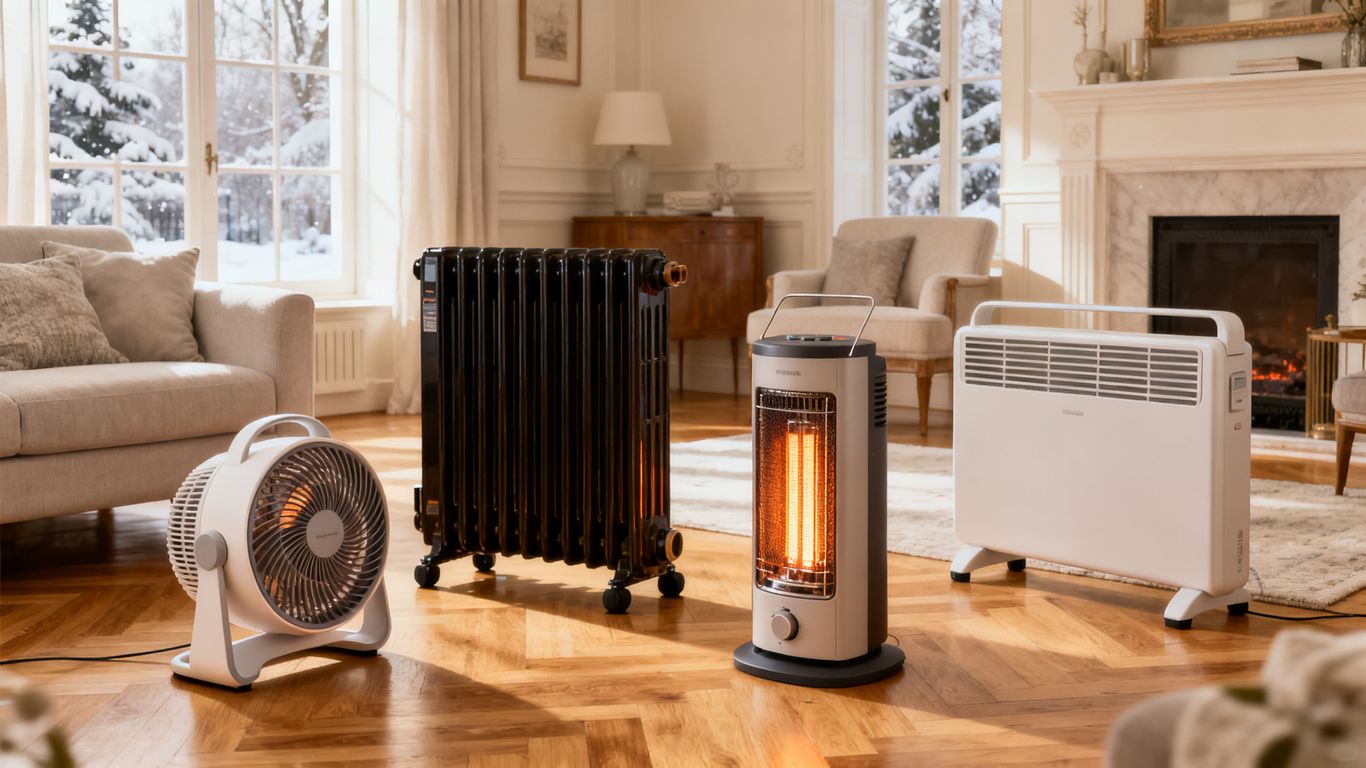
Fan, convection, and oil-filled electric radiators
Fan heaters heat up quickly and are easy to move, but their fan can generate noise. Convection or oil-filled models provide more gradual heat, often better suited for prolonged presence.
In all cases, power consumption and duration of use remain decisive. The choice must also include the location of the socket, the stability of the appliance, and the ability to precisely adjust the temperature.
Gas appliances: power and autonomy
Gas appliances can provide significant heat without directly relying on an electrical outlet. Their autonomy depends on the type of cylinder, the setting, and the power required.
However, this technology requires adequate ventilation and careful monitoring of connections. It should only be used under the conditions specified in the instructions, with fuel stored away from heat sources.
Paraffin heaters: operation and constraints
A paraffin heater heats by burning liquid fuel stored in a tank. It can be moved from room to room, but this portability does not exempt you from observing ventilation and maintenance rules.
Odour, potential noise, and fuel management can affect daily comfort. Before purchasing, it is useful to check fuel availability, ease of cleaning, and automatic shut-off features.
Modern solutions: infrared panels, mobile heat pumps, and connected appliances
Infrared panels primarily heat surfaces and people within their range, while a mobile heat pump draws heat from the air according to its operating principle. Connected appliances generally add remote control or programming, provided a compatible installation is available.
These solutions do not meet the same need. A panel may be suitable for a specific area, while a mobile heat pump requires appropriate air extraction. A comparison of technologies, particularly fan, ceramic, and infrared models, can help clarify the choice with this guide to available solutions.
Assessing performance and comfort
The advertised power is only one indicator among others. Two appliances of comparable power can offer a different experience depending on their heat distribution, thermostat, noise, and ability to maintain a consistent temperature. The assessment should therefore start with the room and the occupancy pattern.
Speed of temperature rise
A fan heater or a direct radiant appliance can produce a rapid sensation of warmth. This responsiveness is useful in a bathroom or an intermittently used office, but it does not guarantee a uniform temperature throughout the room.
Conversely, convection heaters react more slowly, while providing more gradual heat distribution. The choice is then between immediacy and stability, depending on the duration of presence.
Even heat distribution
The shape of the room, ceiling height, and airflow influence heat distribution. An appliance placed in a corner may leave some areas cold, even if it is functioning correctly.
An adjustable outlet grille, an oscillating movement, or a radiant surface can improve coverage. Furniture arrangement should also allow sufficient space around the appliance.
Noise level and indoor air quality
The fan in a fan heater can be noticeable during conversations or at night. Fanless technologies are often quieter, but they are not automatically more suitable for all rooms.
Combustion appliances require extra vigilance as they alter indoor air and necessitate appropriate ventilation. Regular maintenance and sufficient air renewal directly contribute to comfort.
A visual comparison can help understand distribution differences, but it does not replace reading the manual or observing the specific constraints of the home.
Portability, size, and ease of use
The presence of wheels, a handle, and a sufficiently long cable facilitate movement. On the other hand, a compact appliance may be easier to store while offering limited heating coverage.
Controls should be legible and accessible. Ease of use is particularly important when the appliance is installed in a bedroom, a second home, or a room used by multiple people.
Calculating consumption and cost of use
The actual cost of an auxiliary heater depends on its power output, operating time, and energy price. The purchase price therefore only provides a partial view of the budget. A simple estimate before purchase can prevent unpleasant surprises.
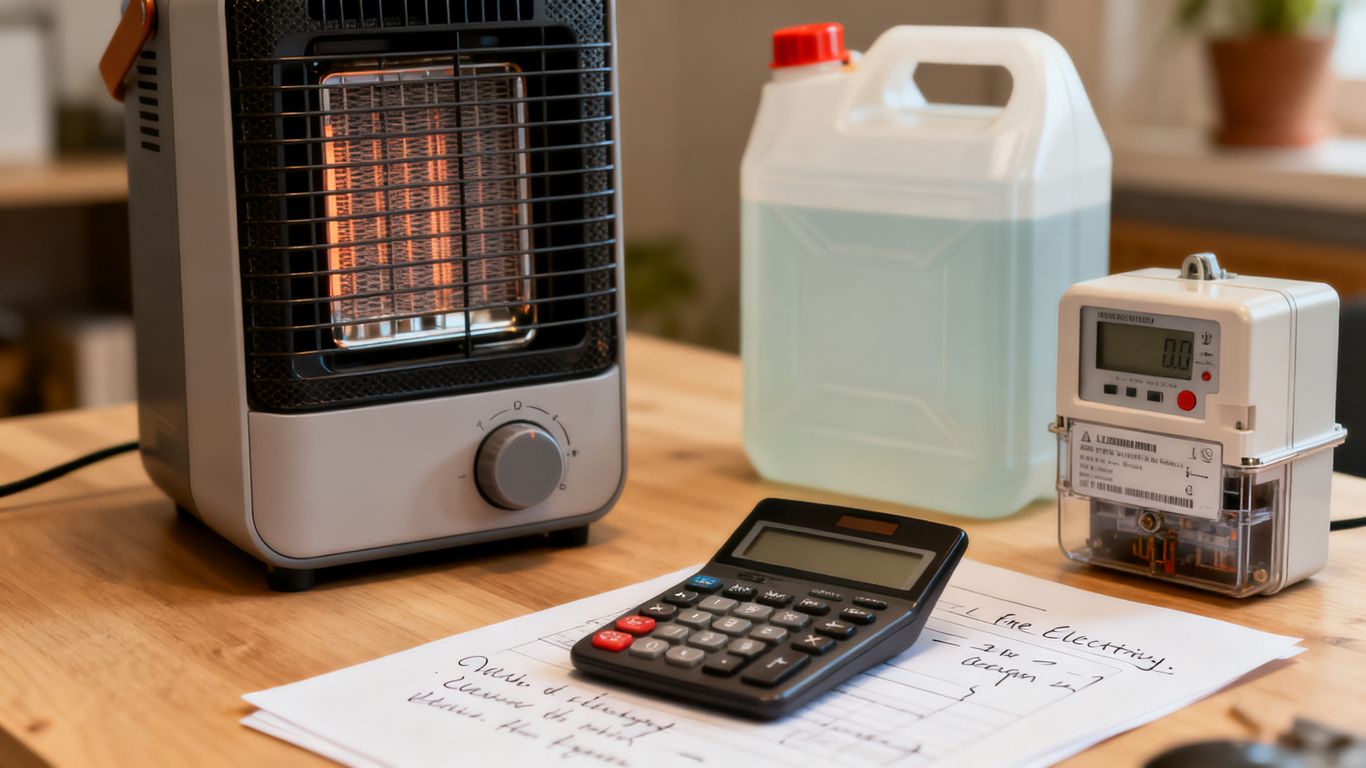
Estimating the consumption of an electric appliance
For an electric appliance, theoretical consumption is calculated by multiplying its power in kilowatts by its operating time in hours. A 1.5 kW appliance used for two hours thus consumes 3 kWh, before accounting for the actual operation of the thermostat.
The cost is then obtained by multiplying this consumption by the price per kilowatt-hour of the contract. This method provides a clear basis for comparing two appliances and planning for daily or occasional use.
Including the price of gas, paraffin, and electricity
Fuels are compared by considering their packaging, calorific value, and appliance efficiency. The price of a cylinder or canister is not enough to determine the cost per hour.
For both electricity and gas, it is best to use the tariffs actually applicable to the home. This analysis of heater consumption puts power output, duration of use, and estimated budget into perspective.
Distinguishing purchase cost from long-term cost
An inexpensive appliance to buy can become expensive if it is used frequently or consumes a lot. Conversely, a more expensive model may offer a more precise thermostat, better repairability, or more comfortable use.
Fuel, maintenance, accessories, and probable lifespan must be included. The correct calculation is not to consider the displayed price, but to relate the investment to the frequency of use.
Identifying factors that increase the energy bill
Several elements cause expenditure to vary beyond the nominal power output. A poorly insulated room or an appliance placed near an opening requires more operation to maintain the same temperature.
The main factors to monitor are:
- daily operating time;
- the requested temperature and the difference from the outside;
- the insulation of walls, windows, and ceilings;
- the accuracy of the thermostat and the stability of the setting.
These points allow for action on usage, not just on the choice of appliance. Closing doors, limiting air infiltration, and reducing the temperature when the room is empty can decrease consumption.
Ensuring safety according to the chosen technology
Safety relies first and foremost on appropriate installation and use in accordance with the manufacturer’s instructions. Risks differ depending on whether the appliance is electric or combustion-based. In any case, a portable heater should not be treated as unattended equipment.
Preventing risks associated with electric appliances
A functional socket, an intact cable, and power compatible with the circuit are essential. Overloaded multi-sockets, unsuitable extension cords, and textiles placed on the appliance increase the risk of overheating.
The appliance must remain stable, and its grilles must never be obstructed. Before each period of use, a quick visual inspection can identify a damaged plug or an accumulation of dust.
Ensuring ventilation with gas or paraffin heating
A combustion appliance consumes oxygen and produces gases. The room must therefore have the intended air inlets and outlets, unobstructed, even when the outside temperature encourages closing everything.
An appliance intended for indoor use must not be used in an unintended space, nor should a cylinder or tank be moved without following the instructions. Ventilation is a condition of operation, not just a comfort feature.
Avoiding carbon monoxide poisoning
Carbon monoxide is an invisible and odourless gas that can be produced by incomplete combustion. A suitable detector can supplement precautions, but it does not replace maintenance or regulatory ventilation.
Any unusual symptom, such as headaches, nausea, or sudden fatigue, should prompt you to turn off the appliance, ventilate the area, and leave the premises before seeking help. Professional inspection is necessary before any re-commissioning.
Respecting safety distances and manufacturer’s recommendations
Distances around the appliance protect curtains, furniture, walls, and flammable objects. These vary depending on the technology: the manual is therefore the reference to follow.
Indications regarding the floor, bathroom, fuel storage, and cleaning must also be respected. A modified appliance or one used outside its intended scope loses some of the expected safety guarantees.
Choosing an auxiliary heater suited to each situation
The best auxiliary heater is one that matches a specific use, rather than a model presented as universal. The surface area, insulation, occupancy time, and possibility of ventilation quickly guide the choice. A sensible decision combines expected performance with practical constraints.
Quickly heating a small room
For a small room occupied briefly, a compact electric appliance can provide rapid temperature rise. It is important to check the available power, the distance from water sources, and the presence of a thermostat.
The setting should remain moderate to avoid unnecessary heating when the room is already at the desired temperature. Portability is an advantage if the appliance needs to be stored after each use.
Improving comfort in a bedroom or office
In a bedroom or office, noise level, temperature stability, and ease of programming become priorities. An appliance that is too noisy or too bright can disturb sleep and concentration.
A model with gradual heat distribution may be suitable for several hours of occupancy. For a workstation, localised heat may also be sufficient without trying to bring the entire home to a high temperature.
Warming a poorly insulated home or a rarely occupied room
In a poorly insulated home, power output alone does not solve heat loss. First, air inlets must be limited and unused spaces closed off, then an appliance suited to the actually occupied area must be chosen.
For a rarely used room, portability and setup time may be more advantageous than permanent equipment. However, consumption must be monitored, as heat loss makes prolonged use costly.
Selecting a solution for heating outages
An emergency solution must be easy to start, stored in an accessible location, and compatible with available resources. An electric appliance will only be useful if the power supply remains operational, while a fuel-burning appliance requires strict ventilation conditions.
It is wise to periodically test the equipment, check cables, and keep the manual. Preparation reduces improvisation when the main heating fails.
Purchase criteria to check before choosing
A technical data sheet should not be read in isolation. Power, noise, settings, safety, and maintenance costs form a coherent whole. Before comparing prices, it is best to establish the real constraints of the room and the user.
Power, heated area, and temperature setting
The area indicated by the manufacturer is indicative and depends on insulation, ceiling height, and the desired temperature. An underpowered appliance will run for a long time without providing the expected comfort, while an oversized model can cause unpleasant fluctuations.
The thermostat should allow for sufficiently fine adjustment. Adjustable power offers more flexibility for transitional periods or irregularly occupied rooms.
Thermostat, programming, and energy-saving functions
A thermostat switches off or reduces operation when the target temperature is reached. Programming can limit heating periods to occupancy hours, which is often more useful than permanent maximum power.
Energy-saving functions should remain understandable and easy to disable if necessary. A clear display, a timer, and simple resumption after a power cut can improve daily use.
Maintenance, parts availability, and lifespan
Grilles, filters, burners, or tanks must be cleanable according to instructions. An appliance that is difficult to maintain risks losing efficiency and becoming noisier or less safe.
It is useful to check for after-sales service, parts availability, and warranty duration. These elements become particularly important when the appliance is intended for use over several seasons.
Labels, guarantees, and precautions for entry-level models
Markings and conformity information must be present and legible. The manual should specify authorised uses, installation precautions, and warranty conditions.
A very low price does not necessarily represent savings if the regulation is imprecise or if maintenance becomes impossible. Comparing features, documented reviews, and return conditions helps limit choices based solely on price.
A choice to be proportionate to the use
An auxiliary heater can quickly improve comfort, provided it is suited to the room, the usage time, and the available energy. The comparison should focus on consumption, heat distribution, noise, maintenance, and safety, not just the initial price. For a larger energy project, requesting an initial consultation can help examine the situation methodically.
Frequently asked questions
Can an auxiliary heater replace the main heating?
It can temporarily provide heating for a limited area, but its continuous use is generally not equivalent to a properly sized main system. Consumption and comfort should be assessed over time.
Which appliance heats the fastest?
Fan heaters and some direct radiant models usually provide a quick sensation of heat. This responsiveness does not mean that the heat will be evenly distributed throughout the room.
How to calculate the cost of an electric heater?
Multiply the power in kilowatts by the number of hours of use, then by the price per kilowatt-hour. The thermostat can reduce actual consumption once the appliance reaches the requested temperature.
Are gas or paraffin suitable for a bedroom?
These combustion appliances require appropriate ventilation and strict precautions. For a bedroom, follow the manual, observe local regulations, and favour a solution explicitly authorised for indoor use.
How to reduce the consumption of an auxiliary heater?
Heat only occupied rooms, limit air infiltration, and use a thermostat or programming. A reasonable temperature and regular maintenance also help reduce operating times.
What power output to choose for a small room?
Power depends on the surface area, volume, insulation, and desired temperature. Manufacturer’s indications provide an initial estimate, to be adjusted according to the actual characteristics of the home.
What precautions to take with a portable appliance?
Place it on a stable surface, away from textiles and furniture, without obstructing its air inlets. Check the condition of the cable and do not let the appliance operate in a situation not covered by its manual.

Thibault Mouillefarine est responsable éditorial de Solencia, une plateforme dédiée à la compréhension, à la qualification et à l’accélération des projets photovoltaïques professionnels. Fondateur de Millennium Digital, agence spécialisée en stratégie digitale B2B, il accompagne les entreprises dans la transformation de sujets complexes en parcours de décision clairs et orientés résultats. Les contenus publiés sur Solencia s’appuient sur des sources publiques et institutionnelles : textes réglementaires, documentation Enedis, données CRE, informations EDF OA, ressources ADEME et publications officielles liées à l’énergie.