Ah, carports! A topic that’s generating a lot of discussion, especially with new regulations. If you manage a car park, you’ve surely heard about this solarisation obligation. It’s not just a minor trend; it’s a law requiring our car parks to contribute to renewable energy production. But how do you navigate all of this? Between the surfaces to cover, deadlines, and potential exemptions, it can quickly become complicated. This article is here to clarify everything, so you know exactly what needs to be done to be compliant, without too much hassle. We’ll look at the basics, technical solutions, and even how to make these installations profitable. Ready to get a handle on carports?
Key Takeaways
- The obligation to install carports, often photovoltaic, applies to outdoor car parks over 1500 m², with different deadlines depending on their construction or management date.
- At least 50% of the car park surface must be covered, with a significant portion integrating solar panels (minimum 17.5% of the total surface).
- Exemptions are possible under certain conditions, particularly for heritage or urban planning reasons, but a request procedure is necessary.
- Failure to comply can result in annual fines of up to €40,000, depending on the car park’s size.
- There are strategies to make the investment profitable, such as selling the electricity produced or self-consumption, and recent legislative changes, like the Huwart law, aim to simplify and relax these obligations.
Understanding the Carport Obligation
For several years now, new regulations have been in place in France concerning car parks, aiming to integrate more renewable energy into our landscape. This involves the obligation to install photovoltaic carports on certain parking areas. This measure is part of a broader effort towards energy transition and combating climate change. The objective is twofold: to reduce the carbon footprint and improve user comfort through shading.
Legal Basis for Car Park Solarisation
The obligation to equip car parks with photovoltaic carports originates from the law of 10 March 2023, often referred to as the APER law (Acceleration of Renewable Energy Production). This legislative text follows growing concerns about the environment and the need to increase the share of renewable energy in overall consumption. It specifies that outdoor parking areas of a certain size must incorporate solar energy production systems. This law has been supplemented by implementing decrees that detail its application. It’s important to note that this obligation is in addition to other environmental regulations, such as those concerning rainwater management.
Definition of Affected Car Parks
The obligation primarily applies to outdoor car parks whose surface area exceeds a certain threshold. Currently, this threshold is set at 1,500 square metres. The surface area taken into account includes the parking spaces themselves, as well as internal circulation routes. Green spaces or storage areas are generally not included in this calculation. Therefore, it is essential to accurately measure the total area of your car park to determine if you are affected by this regulation. For car parks over 10,000 m², specific rules also apply.
Key Deadlines for Compliance
The implementation of this obligation is being phased in. For new car parks, the obligation came into effect upon the law’s promulgation. For existing car parks, deadlines have been set. Car parks over 1500 m² managed under concession or public service delegation must comply by July 2026. For other existing car parks over 1500 m², the deadline is set for 2028. It is therefore important to plan these works in advance to meet these deadlines. Failure to comply with these deadlines may result in financial penalties.
It is crucial to fully understand the deadlines for each category of car park to anticipate the necessary steps and avoid any penalties. Rigorous planning is key to successful compliance.
Here is an overview of the deadlines:
- New car parks: Immediate compliance.
- Existing car parks (> 1500 m²) under concession/public service delegation: Deadline set for July 2026.
- Other existing car parks (> 1500 m²): Deadline set for 2028.
It should also be noted that exemptions are possible under certain conditions, particularly for heritage or urban planning reasons, but they require a specific procedure. The Huwart law, enacted at the end of 2025, has introduced flexibility to these obligations, making the regulatory framework more adaptable for certain projects.
Technical Aspects of Carport Installation
The installation of carports, as part of the solarisation obligation, involves considering several technical aspects for effective and compliant implementation. It’s not just about covering parking spaces, but about integrating a renewable energy production solution.
Minimum Surface Area to Cover and Carport Composition
The law requires a minimum parking surface area to be covered. For car parks over 1,500 m², the coverage must extend over at least 50% of their surface area. The surface area used for calculation is the vertical projection onto the ground of the carport and associated panels. Carports can be composed of various structures, ranging from simple awnings to more elaborate systems integrating photovoltaic panels.
Integration of Renewable Energy Production
The primary objective is to produce renewable energy. Therefore, carports must integrate energy production devices, mainly photovoltaic solar panels. The installation must enable electricity production, dimensioned proportionally to the covered area. It is possible to fulfil this obligation through alternative systems, provided they ensure energy production equivalent to that expected from photovoltaic carports. This flexibility is a notable advancement, especially for sites with specific constraints, as permitted by the ENR law.
The Role of Green Structures in Shading
Although the main obligation concerns energy production, the shading aspect is not overlooked. Green structures can play a complementary role in shading car parks. They contribute to improving thermal comfort and the site’s aesthetics. The Huwart law has also introduced greater flexibility, allowing for the combination of solar carports and green solutions to meet requirements, thus offering more suitable solutions for local contexts.
Exemption Criteria and Possible Derogations
Situations Justifying Exemption from the Obligation
It is important to note that the obligation to install photovoltaic carports on car parks is not absolute. Specific situations may allow for an exemption. These cases are provided for by law to account for various constraints that would make installation unfeasible or disproportionate.
Several grounds can justify such an exemption:
- Technical, safety, architectural, heritage, or environmental constraints: If the installation of carports encounters insurmountable obstacles related to soil type, site configuration, the presence of listed sites, or increased safety risks (e.g., near military installations or for car parks handling hazardous materials), an exemption may be granted. The same applies if the installation risks exacerbating a natural or technological hazard.
- Economically unacceptable conditions: The obligation may be waived if the total cost of the works, excluding taxes, proves to be excessive. This excessiveness is generally assessed in relation to the cost of creating or renovating the car park without carports, or in relation to the market value of the existing car park if the works solely aim to satisfy this obligation. A techno-economic study carried out by a qualified company is often required to support this request.
- Car park already shaded by trees: If at least half of the car park’s surface area is already naturally shaded by existing trees, the obligation to install carports may be waived. This provision aims to value natural shading solutions.
- Planned modification of the car park: The obligation does not apply to car parks whose total or partial demolition, or transformation, is planned as part of a larger development project, provided that an urban planning authorisation has been issued before certain key dates (e.g., before 1 July 2023 for certain transformations).
It is essential to thoroughly document your exemption request. A certificate, accompanied by a non-technical summary and, where applicable, a techno-economic study, must be provided to justify the situation. This process ensures that derogations are applied appropriately.
Impact of Heritage and Urban Planning Constraints
Constraints related to built heritage or urban planning can also be grounds for exemption. For example, a car park located within a protected area of a historic monument or in a zone where urban planning rules strictly prohibit this type of installation (due to visual impact or landscape modification) could be exempted. The architectural integration of carports can sometimes prove complex, even impossible, in sensitive heritage contexts. It is then necessary to consult local urban planning services and architects of French buildings to assess feasibility and potential derogations. Article [d76b] also mentions the possibility of combining carports and greening for better integration.
Derogation Request Procedure
To request a derogation, the car park manager must generally submit a formal application to the competent authority, often the local council or the urban planning department of the territorial authority. This application must be accompanied by solid supporting documents demonstrating that the car park meets the criteria for one of the mentioned exemption situations. This may include technical study reports, forward-looking development plans, expert opinions, or any other convincing document. In some cases, a specific certificate, sometimes accompanied by a techno-economic study, is required. It is advisable to consult local services to find out the exact procedure and the documents to be provided. The law also encourages alternative solutions, such as combining carports and greening [0c2d], which could facilitate compliance in more complex contexts.
Pooling Obligations Across Multiple Sites
Conditions for Grouping Car Parks
The obligation to solarise car parks can sometimes seem burdensome, especially for managers who have several parking areas. Fortunately, the regulations provide an interesting option: pooling. This means you can group the obligations of several car parks and fulfil them on a single site, or distribute the effort flexibly among them. For this to be possible, the affected car parks must be located on the same land parcel. If the car parks are on different land parcels, they must be physically adjacent. The idea is to allow for more flexible and potentially more economical management of these installations. It is important to clearly define the total surface area to be covered, taking into account parking areas and circulation routes, but excluding green or logistical spaces. This approach can greatly simplify compliance, especially when individual sites do not easily allow for meeting the required thresholds. Companies with multiple car parks can thus optimise their solar projects.
Formalising a Pooling Agreement
To implement this pooling, a written agreement is essential. This document must clearly define the technical arrangements for implementation. It will specify how the carport surfaces will be distributed among the different car parks. For example, if two adjacent car parks must each cover 50% of their surface, an agreement could stipulate that the first car park is covered by 20% and the second by 80%. The important thing is that the sum of the covered surfaces corresponds to the total obligation calculated for all affected car parks. This agreement serves as proof to the authorities and ensures that everyone is on the same page regarding the commitments made. It is necessary to ensure that the total area of installed carports corresponds to the sum of individual obligations. This document is key to demonstrating compliance with your pooled approach.
Benefits of Pooling for Managers
Pooling offers several significant advantages. Firstly, it allows for optimisation of installation costs. By concentrating the work on a larger site or distributing the effort, it is often possible to benefit from economies of scale. Secondly, it offers greater flexibility in project design. You are not constrained by the specificities of each small car park but can think of a global solution. This can facilitate the integration of photovoltaic systems and potentially improve energy production. Finally, it simplifies administrative management and compliance monitoring for all your sites. Rather than managing several small independent projects, you manage a framework agreement. It is an approach that can make the solarisation obligation more accessible and less restrictive, transforming a regulatory constraint into an optimisation opportunity. For example, an obligation to cover 50% of the total surface area can be met by covering 20% of a first carport and 80% of a second, if the sum of the areas allows.
Penalties for Non-Compliance with Regulations
Amount of Fines Based on Car Park Size
Failure to comply with the obligations for installing photovoltaic carports on car parks can lead to financial penalties. These fines are scaled according to the size of the car park concerned. For car parks with a surface area of 10,000 m² or less, the maximum penalty can reach €20,000 per year. If the car park exceeds 10,000 m², this ceiling is raised to €40,000 annually. It is important to note that these penalties are imposed after an adversarial procedure, ensuring that the owner has had the opportunity to present their defence. Non-compliance with these rules can have significant financial consequences, highlighting the importance of planning compliance within the stipulated deadlines.
Annual Penalties and Compliance
The regulations stipulate that financial penalties can be applied repeatedly, each year, as long as compliance is not achieved. This means that non-compliance does not result in a single fine, but a recurring penalty. The objective is to strongly encourage car park managers to carry out the necessary works. The competent authority monitors the situation and can reassess the site’s compliance. It is therefore essential to consider these penalties as an ongoing cost until the installation is operational, making compliance an economic as well as a legal necessity. The APER law maintains these penalties, underscoring the legislator’s commitment to renewable energy development [d648].
Competent Authority for Imposing Penalties
It is agents authorised by law who are responsible for detecting breaches of carport installation obligations. These agents verify the surface area of the car parks and the absence of compliant photovoltaic installations. They then draw up a report which serves as the basis for imposing penalties. The competent administrative authority, often the prefecture or local urban planning services, is then responsible for issuing the fines. In some cases, particularly for car parks falling under the Urban Planning Code, penalties can be more substantial, reaching up to €300,000, in accordance with articles L. 610-1 and L. 480-4 of the Urban Planning Code [c449]. It is therefore essential to contact the competent services for any questions regarding regulations and compliance procedures.
Solutions for Profitable Carport Investment
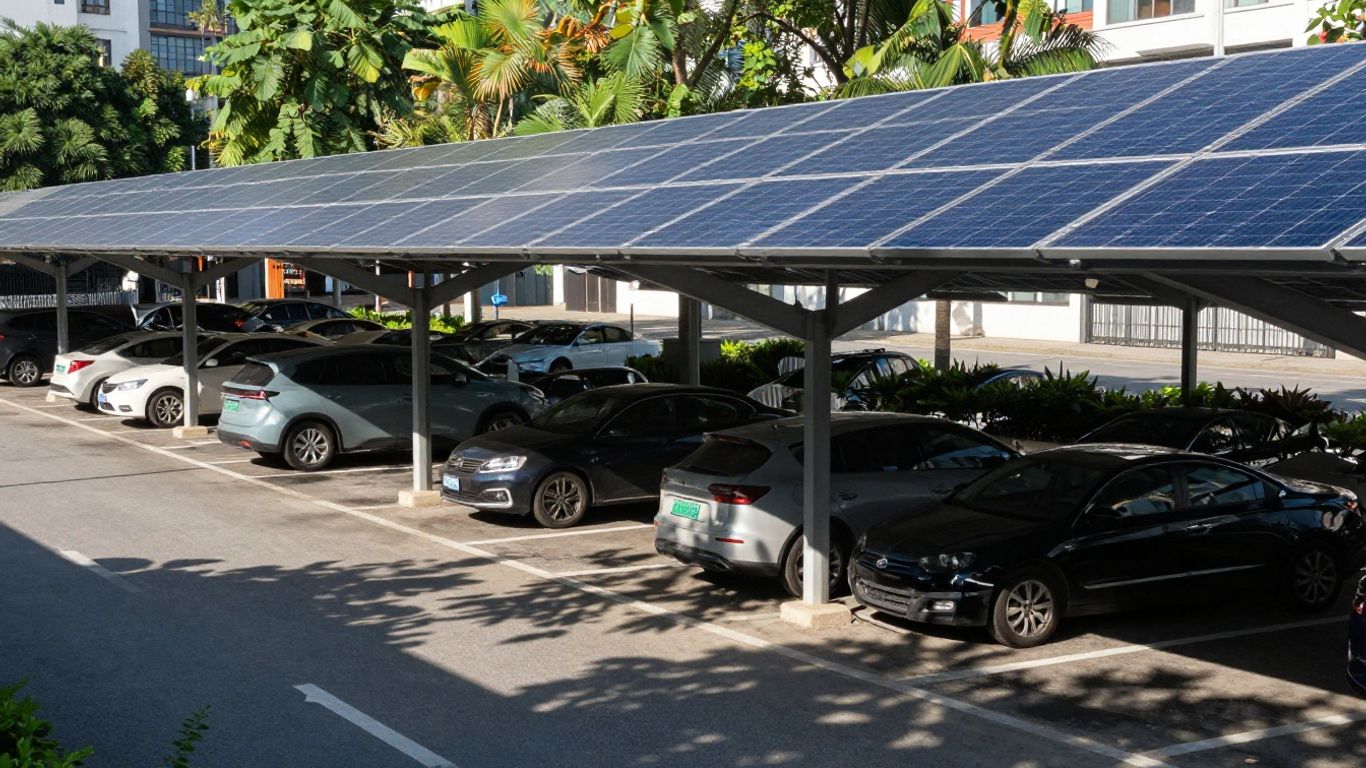
The installation of photovoltaic carports represents a significant initial investment. However, several strategies can turn this obligation into a profitable economic opportunity. These structures should be considered not only as elements of regulatory compliance but also as revenue-generating or cost-saving assets.
Selling the Produced Solar Electricity
One of the most direct ways to make your carports profitable is by selling the electricity produced. By feeding surplus energy into the public grid, you can benefit from guaranteed price sales contracts over a long period, often 20 years. This approach ensures predictable and stable income, contributing to the amortisation of the installation. For example, a 1500 m² car park can produce between 300,000 and 400,000 kWh annually, potentially generating up to €40,000 per year over the lifespan of the panels. It is important to accurately assess your site’s production potential to anticipate these revenues.
Self-Consumption of Generated Energy
Self-consumption involves directly using the electricity produced by your carports to power your own buildings or facilities. This solution allows for substantial savings on your electricity bills, as the energy consumed is produced on-site for free. This is a particularly attractive option for sites with regular and significant electricity consumption during the day. Energy thus self-consumed reduces your dependence on traditional energy suppliers and stabilises your operating costs.
Strategies for Combining Sales and Self-Consumption
To maximise profitability, a combined approach is often the most sensible. It allows you to benefit from both the savings achieved through self-consumption and the revenue generated by selling surplus unused electricity. This strategy adapts to varied consumption profiles, offering valuable flexibility. For instance, if your consumption fluctuates, you can self-consume energy when demand is present and sell the rest. This hybrid approach optimises the use of produced energy and ensures increased long-term profitability. It is also possible to engage a third-party investor who will cover the installation and operating costs in exchange for a share of the revenue or a preferential purchase price for the electricity produced.
Recent Legislative Simplifications and Developments
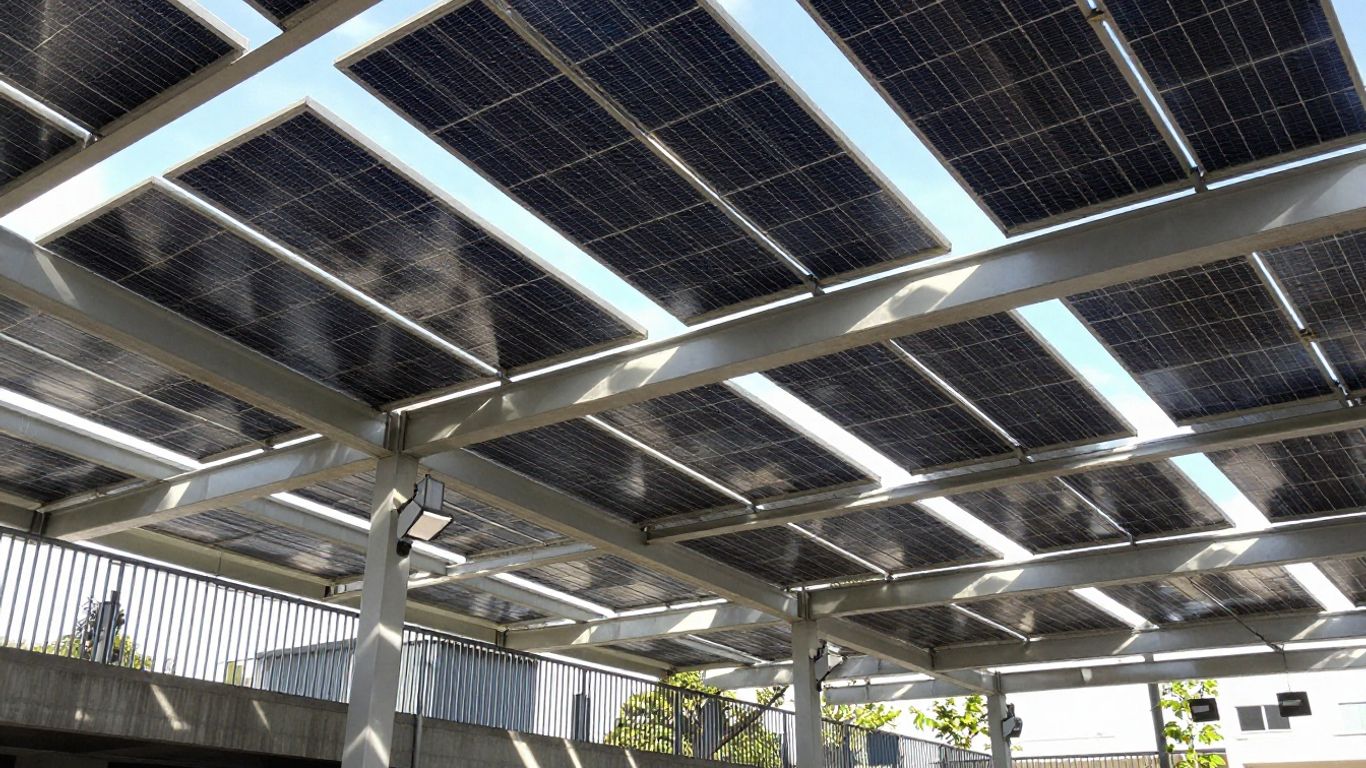
The regulatory framework for carports has undergone several adjustments aimed at facilitating their implementation while maintaining the objective of renewable energy development. These legislative changes offer greater flexibility to car park managers.
Impact of the DDADUE Law on Obligations
The DDADUE law (Provisions for Adaptation to European Union Law), introduced in April 2025, has brought significant changes. It has notably removed rainwater management rules for car parks under 500 m². Furthermore, the possibility of deferring photovoltaic installations on roofs to carports has been withdrawn. Another notable modification is the repeal of shading or rainwater management obligations upon renewal of certain contracts (concessions, service contracts, commercial leases). Responsibility for enforcing these obligations now clearly rests with the car park owner.
Clarifications Provided by the Huwart Law
The Huwart law, adopted in May 2025, has transformed the initial solarisation obligation into a more mixed shading obligation. For outdoor car parks over 1,500 m², the 50% coverage can now consist of 35% photovoltaic carports and 65% green structures. This represents actual solar coverage of approximately 17.5%. This relaxed approach takes into account landscape constraints and already-treed sites. The compliance deadlines for car parks over 1,500 m² remain in 2026 and 2028, with a possibility of postponement until January 2030 under certain conditions, particularly related to the supply of high-performance solar panels. Local urban plans can no longer oppose carport projects, thus strengthening the legal certainty of projects. The penalties provided for by the APER law remain unchanged.
Proposals for Relaxing Obligations
Recent legislative proposals aim to further relax these obligations. The National Assembly has thus adopted an amendment that substitutes the strict solarisation obligation with an obligation for shading, which can be met by solarisation, planting trees with a large canopy, or a combination of both. This amendment, approved by the Senate in June 2025, guarantees a minimum of 35% photovoltaic in case of a mix, unless half of the surface area is fully treed. Car parks with a surface area between 1,500 and 10,000 m² benefit from a calendar postponement until 1 January 2030 for the installation of photovoltaic panels, while those over 10,000 m² have until 1 January 2028. These developments aim to better reconcile renewable energy production with on-the-ground realities and local constraints, while maintaining the overall objective of solar energy development. It is recommended to consult the ministerial guide for the latest clarifications.
Rainwater Management and Soil Permeability
Cumulative Obligations for New Car Parks
For new car parks, the law imposes a dual requirement: the installation of solar carports and the implementation of rainwater management systems. These two obligations are cumulative and must be met over a minimum surface area of half the total car park area. Therefore, it is not an alternative, but a combination of measures aimed at improving the environmental impact of parking areas. The objective is twofold: firstly, to promote renewable energy production and, secondly, to improve water management, particularly through infiltration or evaporation. Compliance with both aspects is therefore essential for any new construction or major renovation.
Adaptation of Rules for Existing Car Parks
Existing car parks are not exempt from these concerns. Although the rules may be adapted, the spirit of the law remains. For these sites, it is possible to increase the density of existing vegetation to achieve shading and water management objectives. The idea is to ensure that the planted trees already provide sufficient shade over more than half of the surface area. Local regulations, such as those in Local Urban Plans (PLU), may also impose specific rules for rainwater management, supplementing or clarifying national obligations. It is therefore advisable to refer to local urban planning documents for a complete understanding of the applicable requirements.
Ministerial Guides for Car Park Development
To assist managers in implementing these obligations, ministerial guides have been published. These documents provide guidance and concrete examples of developments that meet the solarisation and rainwater management requirements. They detail, in particular, the methods for calculating the relevant surface areas and propose suitable technical solutions. It is important to note that some versions of these guides may not incorporate the most recent legislative developments, such as those from the DDADUE or Huwart laws. Therefore, it is recommended to consult the most up-to-date versions and stay informed of any clarifications or modifications made by the legislator. These resources are a valuable aid for planning and carrying out compliant and sustainable developments, taking into account soil permeability and rainwater management Ministerial Guide on Car Park Development.
Rainwater management in car parks aims to reduce runoff and promote infiltration or evaporation, thereby contributing to groundwater recharge and flood mitigation. The integration of these systems is a key component of sustainable car park development.
Rainwater management is extremely important for keeping our soils healthy. When it rains, water needs to be able to soak into the ground to avoid causing problems. This is where we talk about soil permeability. If water can’t pass through, it can carry away soil and cause floods. We can help nature by choosing materials that let water pass through, like gravel or special paving stones. Want to learn more about how to make your spaces more ecological and help water flow properly? Visit our website to discover our solutions!
In Summary: A Process to Anticipate
So, we’ve covered the obligations regarding carports. It’s no small matter, and we understand it can raise quite a few questions. The law is evolving, deadlines are approaching, and it’s clear that staying informed is the first step. Whether for new installations or adapting existing car parks, there are solutions. Considering greening in addition to photovoltaics is an interesting avenue for balancing constraints. And if you ever feel a bit lost in all of this, don’t hesitate to seek advice. The important thing is to get started in advance to avoid unpleasant surprises and penalties. It’s a project that requires a bit of preparation, but which, in the end, can bring benefits, both for the environment and for the management of your site.
Frequently Asked Questions
What is the car park solarisation obligation?
It’s a law that requires owners of large outdoor car parks to install structures that produce solar energy, such as photovoltaic panels. The aim is to produce clean electricity while creating shade for cars.
What size of car park is covered by this law?
Generally, outdoor car parks over 1500 square metres are concerned. This is roughly equivalent to a car park for 80 to 130 cars, including access roads.
When must this obligation be met?
New car parks must already comply. For existing car parks, the deadlines vary: some must be equipped by July 2026, and others by 2028 at the latest, depending on their size and management method.
Can I use trees to shade my car park?
Yes, the law allows the use of trees or other plants to create shade. However, a portion of the surface must be covered by solar panels. Generally, half of the car park must be shaded, with at least 17.5% covered by solar panels.
Are there cases where I am not required to install these carports?
Yes, there are exceptions. For example, if the car park is in a heritage-protected area, or if there are significant technical or economic constraints proven by a study. In such cases, a special request must be made.
What happens if I don’t comply with this law?
If you do not comply with the obligation, you risk a fine. The amount depends on the size of the car park: up to €20,000 per year for smaller car parks, and up to €40,000 per year for very large car parks. These fines continue as long as the car park is not compliant.
How can I make money from these solar carports?
You can sell the electricity produced by the solar panels to an energy supplier. Another option is to use this electricity for your own needs (self-consumption), which reduces your bills. You can also combine both methods.
Can this obligation be shared with other car parks?
Yes, if you have several car parks close to each other, you can agree to distribute the obligation among them. This requires formalising an agreement that explains how it will be done technically.

Journaliste spécialisée en transition énergétique et consultante RSE. À 42 ans, Claire combine une formation en journalisme (Master Sciences Po) et un diplôme d’ingénierie environnementale (École des Mines / INSA). Après 10 ans dans la presse économique et 7 ans en cabinet de conseil RSE, elle écrit pour aider les décideurs B2B à comprendre les réglementations, les enjeux climatiques et les innovations énergétiques.