Key takeaways
A domestic wind turbine can produce a portion of a home’s electricity, but its suitability depends primarily on the wind, terrain, and administrative procedures. The project therefore warrants a comprehensive study rather than a decision based solely on advertised power output.
- The height of the mast largely determines urban planning formalities.
- Consistent, unobstructed wind is more important than a flattering theoretical average.
- The budget includes equipment, connection, maintenance, and end-of-life disposal.
- Self-consumption should generally be compared with a solar solution suited to the site.
- A feasibility study and multiple quotes reduce the risk of errors.
Understanding different types of domestic wind turbines
Before discussing profitability, it’s essential to distinguish between technologies and possible uses. A domestic wind turbine converts the kinetic energy of the wind into electricity, with variable production depending on weather conditions. The choice of model should be consistent with the terrain, the household’s needs, and the intended connection method.
Horizontal or vertical wind turbine: what are the differences?
Horizontal-axis wind turbines are the most recognisable: their blades rotate to face the wind and generally require appropriate orientation. Vertical-axis models can accommodate more varied wind directions and sometimes integrate more easily into confined spaces. However, this difference alone does not guarantee better production, as efficiency also depends on height, turbulence, and actual wind speed.
A horizontal installation is often sought on open terrain, while a vertical solution may be considered when the environment imposes more constraints. In both cases, commercial claims should be compared with measured data and an understandable power curve.
What power is needed to cover a household’s needs?
Rated power indicates the machine’s maximum capacity under given conditions, not the electricity produced continuously. A household with low daytime consumption will not have the same needs as a house heated by electricity, equipped with a heat pump, or an electric vehicle. Sizing must therefore start from consumption history and the household’s hourly profile.
It is also important to distinguish between installed power and annual energy produced. A small, well-placed turbine can be more suitable than a more powerful unit exposed to weak or turbulent winds. The realistic objective is to estimate annual production and then determine what portion can be consumed directly.
Self-consumption, selling surplus, or total injection
Self-consumption involves using electricity produced on-site at the moment it is generated. When production exceeds immediate needs, the surplus can optionally be stored, sold, or injected depending on the contract, connection, and applicable regulations. Total injection, on the other hand, involves selling all electricity produced and consuming electricity from the grid separately.
The choice depends on the electricity tariff, contractual conditions, the ability to shift certain uses, and the cost of potential storage. A monthly simulation is more informative than a simple annual calculation, as it reveals periods of actual simultaneous production and consumption.
The main components of an installation
An installation typically includes the wind turbine, mast, foundations or fixing system, charge controller, inverter, and electrical protection. Batteries can be added in some projects, particularly when the grid is absent or when autonomy is a priority. Earthing, grounding, and safety devices must be treated with the same seriousness as the turbine itself.
Technical documentation should specify wind ranges, operating conditions, warranties, and maintenance operations. An offer that details each item allows for a more reliable comparison of solutions than an overall price that is difficult to interpret.
What the law says about installing a domestic wind turbine
In France, the rules applicable to a domestic wind turbine depend notably on its height, location, and local context. The mast, nacelle, and blades may be taken into account when assessing the project, according to applicable urban planning rules. A check with the local town hall remains essential before any order, as the local urban plan and easements may add constraints.
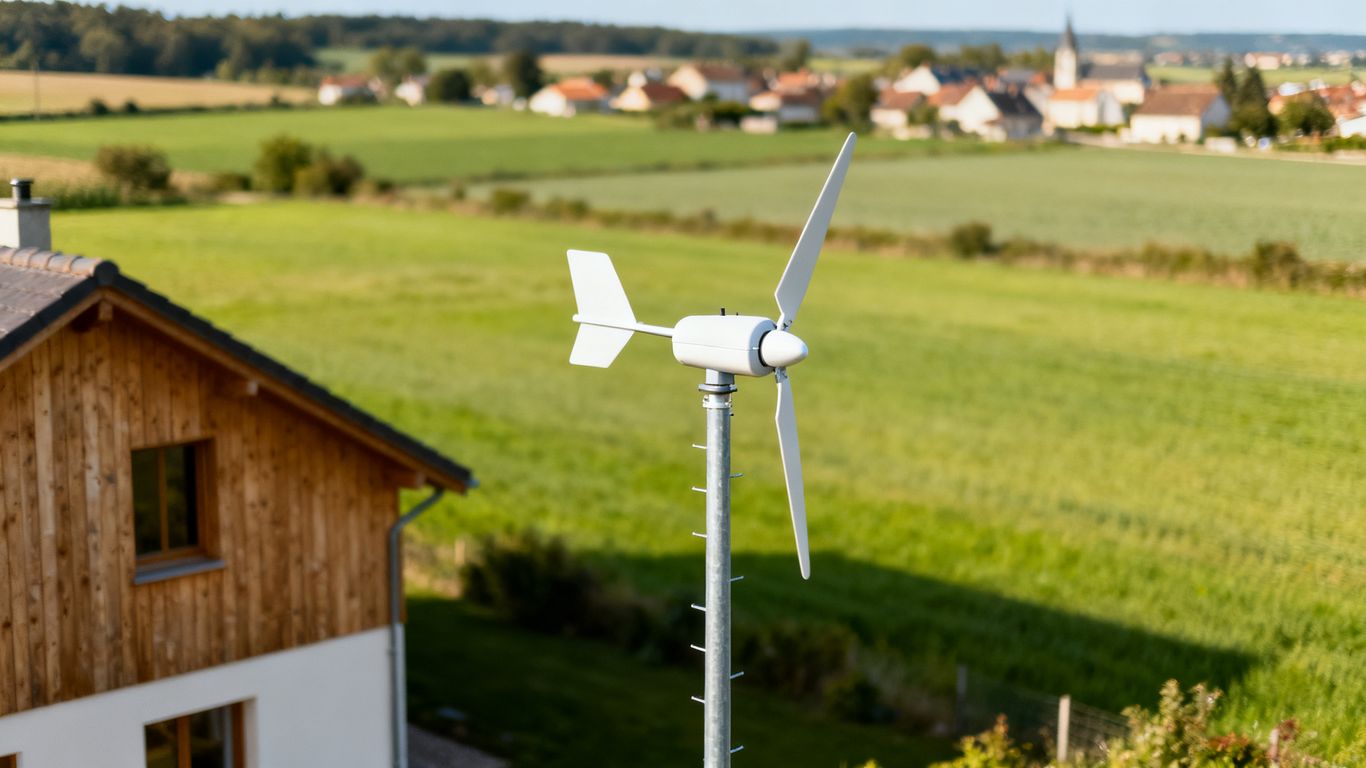
The procedures are not limited to obtaining a permit. Connection rules, neighbourly relations, heritage protection, and site conditions must also be examined. To supplement this initial reading, a guide dedicated to the installation of a domestic wind turbine can help organise the questions to ask professionals.
Urban planning rules according to turbine height
Height is the first threshold to examine. In practice, a wind turbine reaching or exceeding 12 metres generally requires a building permit, while a lower project may require a prior declaration or exemption depending on its location. This presentation must be confirmed by the urban planning department, especially if the land is in a protected area.
The calculation of height and the exact nature of the structure must be verified in the technical file. It should not be assumed that a small blade diameter automatically exempts from all formalities: the location and local rules can alter the analysis.
When is a building permit required?
A building permit is generally required when the wind turbine reaches or exceeds 12 metres in height. The file describes the location, external appearance, access, and integration of the project into its environment. The processing time and required documents must be anticipated in the overall schedule.
Even below this threshold, a formality may still be necessary depending on the municipality, zone, or installation characteristics. It is preferable to obtain a written response from the town hall before signing a quote that includes irreversible work.
Additional declarations and authorisations to consider
Depending on the project, a prior declaration, a connection request, or discussions with the network operator may be added to the permit. An easement, a specific access route, or earthworks may also require separate checks. The professional must provide a list of the procedures included in their scope and those remaining the owner’s responsibility.
The file must also specify who provides the plans, who submits the applications, and who bears the corresponding costs. This clarification prevents a forgotten authorisation from delaying the construction or compromising the installation’s insurance.
Constraints related to neighbours, heritage, and protected areas
The proximity of dwellings, views, noise, and risks associated with falling objects can lead to objections from neighbours. In a listed site, near a historic monument, or in a regulated natural area, the opinion of other services may be required. The project must therefore be studied at the plot level, but also in its immediate environment.
A transparent presentation of the operation, distances, and safety measures facilitates dialogue. It does not replace any authorisation but allows for earlier resolution of foreseeable objections and avoids a poorly accepted investment.
Assessing the wind potential of your land
Wind is the variable that most directly conditions production. A general map can guide an initial search, but it does not describe the turbulence created by a house, hedge, or nearby relief. The assessment must therefore combine local data, site observation, and technical analysis.
A favourable site is not necessarily one where the wind appears strong on an isolated day. Consistency, measurement height, and the possibility of installing the mast in a clear area are equally important. This phase often allows for the rapid elimination of unsuitable plots.
Why wind speed and consistency are crucial
The power available in the wind increases significantly with its speed. A moderate decrease in average speed can therefore substantially reduce annual production. Sporadic gusts are not enough: the equipment must operate in a wind regime that is exploitable over a significant duration.
It is also necessary to examine the distribution of winds by season and direction. A site that is only windy in winter will not meet a household’s needs in the same way as a site with a more uniform regime throughout the year.
How to interpret local meteorological data
Data from a nearby weather station is useful for establishing an initial trend, but it is not always directly transferable to a plot. Altitude, distance, exposure, and measurement height must be compared. A reputable installer must explain the assumptions made and their influence on the estimated production.
An on-site measurement campaign may be relevant for a significant or uncertain project. The results should be presented with conservative, median, and favourable scenarios, rather than a single value that would give a false sense of precision.
The influence of terrain, buildings, and obstacles
An obstacle slows down the wind and creates a turbulence zone downstream. Buildings, trees, ridges, and hedges must be mapped, taking into account their height and potential changes. Future planting or a neighbouring construction can permanently alter flow conditions.
The mast must generally extend sufficiently above nearby obstacles to reach a more consistent flow, subject to planning and safety regulations. The decision cannot therefore be based on a photograph taken from the garden: it requires a three-dimensional reading of the site.
Safety distances and anticipated nuisances
The safety distance must be defined based on the height, rotor diameter, terrain type, and technical recommendations. The consequences of a fall, an exceptional projection, or a maintenance intervention must be anticipated. Noise, vibrations, and visual impact must also be examined with neighbours.
The site study must specifically check:
- the presence of nearby occupied dwellings or buildings;
- boundary lines and access required for machinery;
- power lines, underground networks, and other infrastructure;
- risks related to extreme winds and ice throw, depending on the region.
This check does not replace local regulations but provides a concrete basis for discussing the installation. It also helps to quantify work that is sometimes absent from initial commercial estimates.
Estimating the cost and profitability of the project
The cost of a domestic wind turbine varies depending on the power, mast height, foundations, connection, and terrain complexity. Online estimates should be considered as rough guides, as two plots can lead to very different site costs. Profitability then depends on the energy actually produced and valued, not just the purchase price.
To establish a serious calculation, the initial investment must be compared with electricity savings, potential revenue, and recurring expenses. The **real financial return** must be examined over several scenarios, with a conservative production assumption. A documented simulation is preferable to a promise of a quick return.
What budget to plan for equipment and installation?
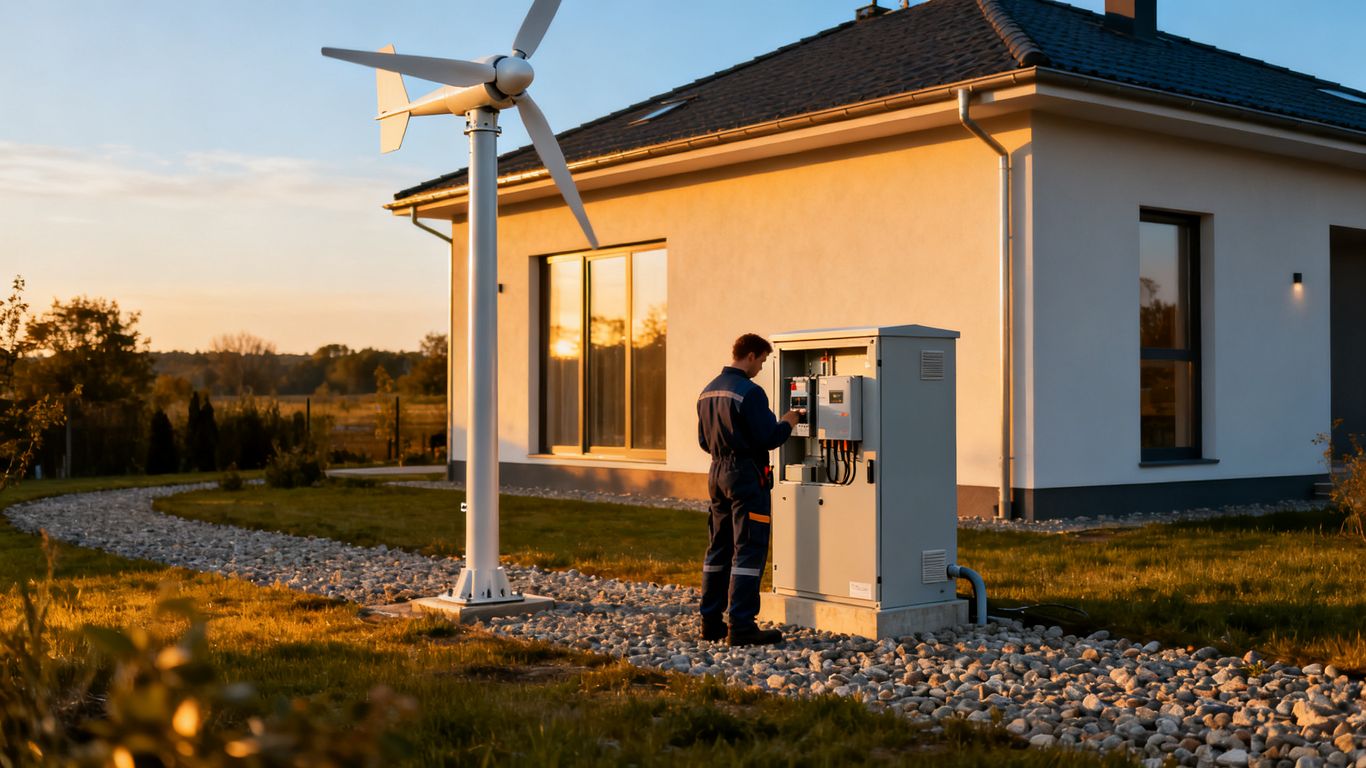
The quote should distinguish between the turbine, mast, foundations, transport, installation, electrical protection, inverter, and connection. Earthworks, site access, and crane hire can represent a significant portion of the total. Batteries, when considered, should be costed separately.
A useful comparison is between offers that cover the same scope. A lower price may simply exclude the soil study, administrative procedures, commissioning, or network work, shifting the expense rather than reducing it.
What expenses to include over the equipment’s lifespan?
Future expenses include inspections, wear parts, travel, repairs, and potentially the replacement of the inverter or batteries. Appropriate insurance and site restoration at the end of operation must also be planned for. These items should be included in the calculation from the outset.
The warranty does not necessarily cover all interventions or labour. Requesting precise conditions, parts availability, and after-sales service arrangements provides a better assessment of the total cost of ownership.
How to calculate electricity savings produced?
The calculation begins with an annual production estimate, adjusted for electrical losses and downtime. It is then necessary to distinguish between directly consumed electricity, any valued surplus, and energy that cannot be used. The value of each kilowatt-hour therefore depends on the household’s consumption profile.
A simulation table can make the assumptions clearer:
| Element analysed | Conservative scenario | Central scenario | Favourable scenario |
|---|---|---|---|
| Estimated annual production | low | intermediate | high |
| Portion consumed on-site | limited | average | significant |
| Savings on grid purchase | low | intermediate | high |
| Payback period | long | variable | shorter |
After comparison, the owner should select the scenario that remains acceptable even if production is lower than expected. This approach avoids confusing theoretical power with actual observed savings.
What grants and purchase conditions may apply?
Grants, potential tax exemptions, and purchase conditions depend on the location, the nature of the installation, and the regulations in force at the time of application. They should not be included in the calculation without an official source and verification of eligibility criteria. The connection and purchase contract may also impose specific procedures or costs.
It is prudent to request confirmation from the relevant authorities and the network operator. A commercial offer that presents a grant as a certainty before the application is processed should be viewed with caution.
In what cases is a domestic wind turbine worthwhile?
A domestic wind turbine is most relevant when several conditions are met: an exposed site, consumption compatible with production periods, a favourable regulatory framework, and a controlled connection cost. It is not a universal solution for all homes. The key question is whether the site allows for consistent and valuable production.
The comparison with other renewable sources should be made based on equivalent needs. The objective is to select the solution that offers the best balance between production, constraints, investment, and maintenance, rather than the one with the highest advertised rated power.
Situations favourable to self-consumption
Self-consumption is more advantageous when electrical uses coincide with windy periods. An occupied home, equipped with programmable appliances or a control system, can use a larger portion of its production. Storage can improve this match but also increases investment and maintenance operations.
The analysis must include the household’s actual habits. Shifting certain uses can improve the self-consumption rate, without transforming an inconsistent wind resource into a constant supply.
The benefit of an isolated or poorly connected site
On an isolated site, wind power can contribute to local production with storage and a backup solution. The benefit must then be compared with the cost of a grid extension or other equipment necessary for autonomy. Continuity of supply, rather than just accounting profitability, can become the main criterion.
In this context, sizing must account for periods of low wind. An autonomous installation generally requires a clearly defined strategy for storage, priority management, and backup before construction.
When solar photovoltaic may be more relevant
Solar photovoltaic can be simpler to install when the roof or land benefits from good exposure and formalities are lighter. It can also be more suited to the consumption profile of a home that produces mainly during the day. The comparison should focus on annual production, seasonality, footprint, and total cost.
This alternative does not mean wind power is useless. In some locations, the two sources can be complementary, but this combination must be justified by local data and not by a theoretical addition of power ratings.
Cases where the project is likely to be unprofitable
The project becomes fragile when the wind is weak, very turbulent, or impossible to exploit at the necessary height. Numerous obstacles, heritage constraints, and costly connections can also significantly reduce its appeal. Aggressive sales pitches are another warning sign that warrants an independent analysis; an article on pitfalls to avoid usefully reminds us of this point.
Profitability announced without detailed assumptions should be treated with caution. If the calculation does not specify annual production, self-consumption rate, or maintenance costs, it does not allow for an informed decision.
Preparing and securing your domestic wind turbine project
A solid project is built in stages, with verifiable documents and explicit assumptions. The first expense should not be the purchase of the machine, but the assessment of technical, regulatory, and economic feasibility. This method reduces the risk of discovering a site or neighbourly constraint too late.
The final quote must be clear, comparable, and adapted to the site. It must also specify each party’s responsibilities, from the study to commissioning and dismantling. A methodical decision protects the budget better than an offer presented as urgent.
Conduct a feasibility study before any purchase
The study should gather wind data, a site plan, obstacles, urban planning rules, connection details, and consumption profile. It should result in a production estimate and a list of procedures. If any of these elements are missing, the project remains difficult to evaluate.
It is useful to request several scenarios and to keep the assumptions used. The owner can then compare quotes without unintentionally changing the calculation method from one contact to another.
Choose an installer and check their references
The installer must be able to present comparable installations in terms of power, height, and environment. Insurance, qualifications, warranties, and after-sales service conditions must be verified before signing. References are only valid if they correspond to truly comparable installations.
The contract must specify the schedule, the procedures covered, the commissioning tests, and the acceptance terms. To address a technical question or seek guidance, it is possible to contact a specialised contact person before selecting an offer.
Compare actual performance rather than advertised power
Rated power is not sufficient to compare two machines. The power curve, cut-in speed, measurement conditions, noise level, and expected annual production on the site must be examined. Performance guarantees must be verifiable and specify liability limits.
A serious presentation distinguishes measured results from projections. It also indicates losses, downtime, and the weather conditions used. This transparency is more useful than an isolated figure highlighted in a brochure.
Anticipate maintenance, noise, and dismantling
Maintenance must be planned from the design stage, with safe access to the mast and components. Noise and vibrations must be clearly communicated, especially when dwellings are nearby. Dismantling must finally be contractually planned, with site restoration and the management of removed equipment.
These issues are not secondary: they can alter the total cost and the project’s acceptability. Addressing them beforehand gives the owner a more complete view of the installation over its entire lifespan.
Making the right choice
A domestic wind turbine can meet a specific need on a truly windy site, but it requires a more detailed analysis than a simple comparison of power ratings. Height, authorisations, nuisances, measured production, and future costs must be studied together. When the wind or the project’s economics are uncertain, an honest comparison with photovoltaics often helps to better guide the decision.
Frequently asked questions
Is a domestic wind turbine allowed everywhere?
No. Height, the local urban plan, easements, heritage, and protected areas can limit or regulate the project. The town hall must be consulted before any order.
Above what height is a building permit generally required?
A wind turbine reaching or generally exceeding 12 metres requires a building permit. Rules may vary depending on the local context, hence the need to confirm the applicable regime with the urban planning department.
Can a small wind turbine power an entire house?
It can cover part of the needs, but rarely constantly. Production depends on the wind, sizing, losses, and the household’s consumption profile.
How do I know if my land is windy enough?
Local meteorological data must be cross-referenced with an analysis of obstacles, terrain, and installation height. For a significant project, on-site measurements can supplement this initial assessment.
Does the turbine produce electricity when the wind is weak?
Each model has an operating range and a cut-in speed. Low or no production is possible when the wind is below the specified threshold or when safety conditions require the machine to stop.
Can the electricity produced be resold?
Resale or injection of surplus may be possible depending on the connection, contract, and current regulations. Conditions must be verified with the relevant authorities and operators.
What maintenance should be planned?
Inspections, electrical checks, and replacement of certain parts may be necessary. The schedule depends on the technology, wind conditions, and the manufacturer’s or installer’s specifications.

Thibault Mouillefarine est responsable éditorial de Solencia, une plateforme dédiée à la compréhension, à la qualification et à l’accélération des projets photovoltaïques professionnels. Fondateur de Millennium Digital, agence spécialisée en stratégie digitale B2B, il accompagne les entreprises dans la transformation de sujets complexes en parcours de décision clairs et orientés résultats. Les contenus publiés sur Solencia s’appuient sur des sources publiques et institutionnelles : textes réglementaires, documentation Enedis, données CRE, informations EDF OA, ressources ADEME et publications officielles liées à l’énergie.