Want to install a standalone solar system at home? That’s a great idea for becoming more energy independent. But, to successfully connect a solar panel to a 12V battery, you need to follow a few important steps. This guide will explain everything you need to know, from preparation to installation, including best practices to ensure your system works well and lasts a long time. We’ll look together at how to do this simply, without any hassle.
Key Points
- A standalone solar system uses a panel to capture energy, a battery to store it, and a regulator to manage everything.
- Before you start, make sure you have all the necessary components and the right tools for a smooth installation.
- Safety is paramount: always respect polarities and take precautions to avoid short circuits.
- To make your installation last, remember to clean the panels regularly and manage your energy consumption well.
- If you have any doubts, don’t hesitate to ask for help from a professional to ensure a correct and safe installation.
Understanding how a standalone solar system works
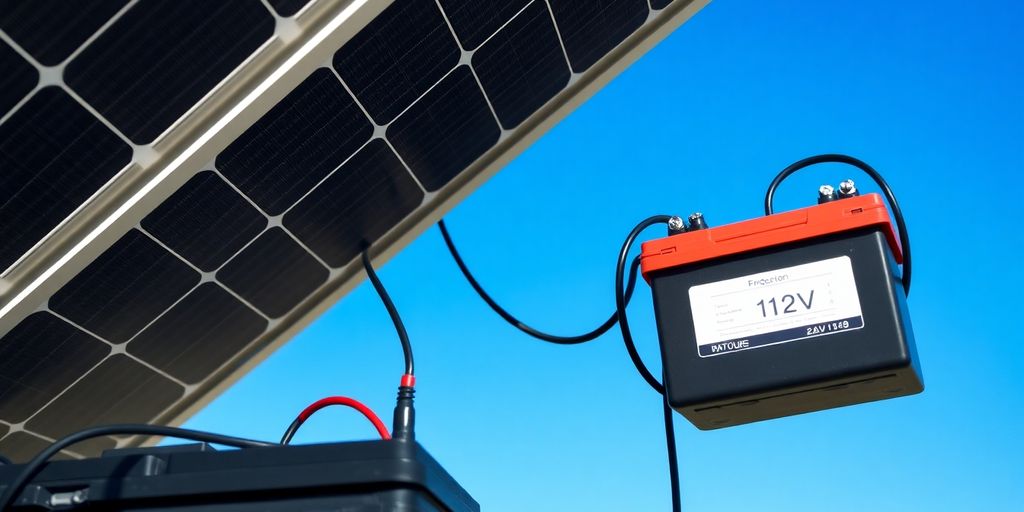
A standalone solar system is a bit like having your own little power plant at home. The idea is to capture the sun’s energy, store it, and use it when you need it. It’s particularly practical for isolated locations, camper vans, or simply to reduce your dependence on the conventional electricity grid. But how exactly does it work?
Role of the photovoltaic panel in electricity production
The photovoltaic panel is the heart of the system. It’s made up of cells that convert sunlight into electricity. Imagine each cell as a little worker who gets to work as soon as the sun shines. The more sun there is, the more electricity they produce. This electricity is then sent to the rest of the system. The photovoltaic solar panel is therefore essential for energy production.
Importance of battery storage for energy restitution
The sun doesn’t shine 24/7, and that’s where the battery comes in. It’s used to store the electricity produced by the panel during the day, so you can use it at night or when the weather is cloudy. It’s a bit like an energy reserve. Without a battery, you could only use electricity when the sun is shining. It’s important to choose a battery that suits your needs, taking into account its capacity and lifespan. A high-performance standalone solar system requires a quality battery.
Function of the charge regulator in system management
The charge regulator is the conductor of the system. It ensures that the battery is charged correctly, without being overcharged or excessively discharged. It also protects the battery against short circuits and overvoltages. It’s an essential element for the longevity of your battery and the safety of your installation. Without it, your battery could be damaged quickly. The regulator makes the voltage of the solar panel compatible with that of the battery, depending on the amount of sunshine and the state of charge of the battery. It regulates and protects the system. The charge regulator optimises the production of electricity and the lifespan of the battery.
In summary, a standalone solar system works thanks to the combination of three key elements: the photovoltaic panel that produces electricity, the battery that stores it, and the charge regulator that manages everything. It’s a simple but effective system that allows you to produce and use your own energy, in an ecological and economical way.
Preparing your installation: kit contents and necessary tools
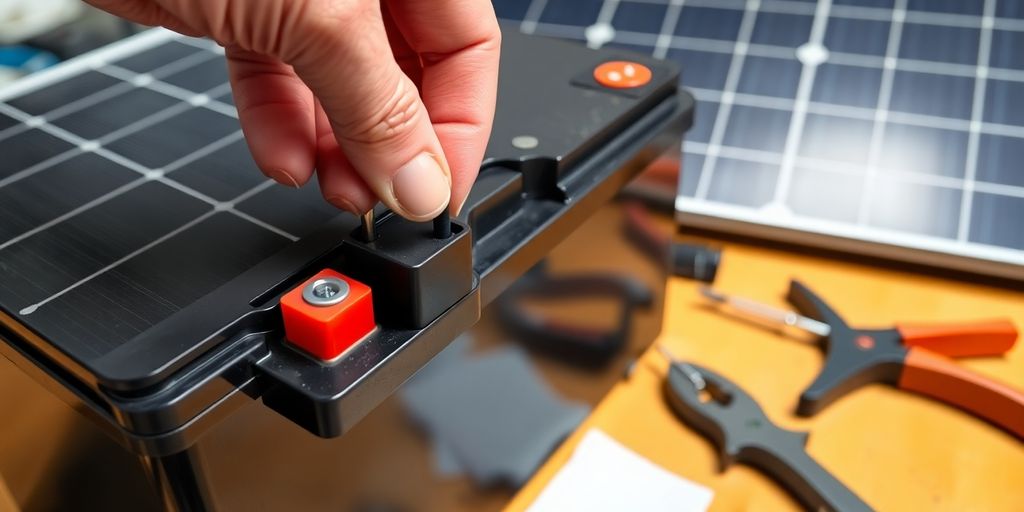
Before embarking on the adventure of installing your solar kit, thorough preparation is essential. It’s imperative to check that you have all the necessary elements and the right tools to carry out this task. A well-prepared installation guarantees a high-performance and durable system.
Inventory of essential components of the solar kit
A 12V standalone solar kit is generally made up of several key elements. Make sure each one is present before you start. Here is a non-exhaustive list:
- A photovoltaic solar panel, which captures solar energy and transforms it into electricity. It’s important to check the power of the solar panel and its technical characteristics.
- A charge regulator, which manages the flow of electricity between the solar panel and the battery, thus avoiding overcharging or excessive discharging of the latter.
- A 12V slow-discharge battery, which stores the energy produced by the solar panel for later use. The battery capacity must be adapted to your energy needs.
- Electrical cables and connectors, necessary to connect the various components together. Check the cable section and the compatibility of the connectors.
- A user manual, which guides you step by step through the installation and use of the kit. Take the time to read it carefully.
It’s essential to check the integrity of each component as soon as you receive the kit. Any apparent damage must be reported immediately to the supplier.
List of essential tools for assembly
To assemble and connect the various elements of your solar kit, you’ll need a number of tools. Here is a list of the most commonly used tools:
- A Phillips screwdriver and a flat screwdriver, for tightening screws and terminals.
- Wire strippers, for preparing the ends of electrical cables.
- A crimping tool, for attaching lugs to cables.
- An adjustable spanner or open-ended spanners of different sizes, for tightening nuts and bolts.
- A multimeter, for checking voltage and electrical current.
- A cutter or knife, for cutting cables and sheaths.
- Insulating tape, for protecting electrical connections.
It’s recommended to use quality tools to guarantee the safety and reliability of your installation. Don’t hesitate to invest in professional equipment if you plan to carry out other solar installations in the future. A well-installed solar kit is a durable solar kit.
Tips for protecting and handling equipment
Handling solar equipment requires certain precautions to avoid damage and accidents. It’s imperative to respect the following safety instructions:
- Wear insulating gloves when handling electrical cables and connectors.
- Avoid working in the rain or in a humid environment.
- Protect the solar panel from shocks and scratches during transport and installation.
- Never short-circuit the battery or solar panel.
- Consult a professional if you have any doubts about the installation procedure. A poorly executed installation of photovoltaic panels can be dangerous.
By following these simple tips, you’ll minimise the risks and ensure a safe and efficient installation of your solar kit.
Operating instructions to optimise performance and longevity
To guarantee optimum performance and prolong the lifespan of your solar installation, it’s imperative to carefully follow the following operating instructions. Rigorous management and regular maintenance are the keys to a high-performance and durable installation.
Managing available energy and switching off appliances
The energy you can use depends on the power of the solar panel, not the capacity of the battery. It’s therefore essential to manage your energy consumption effectively. Here are a few recommendations:
- Systematically switch off appliances when you’re not using them. Even on standby, some appliances consume energy.
- Give preference to low-energy appliances, such as LED bulbs.
- Regularly monitor the state of charge of the battery to avoid deep discharges, which can reduce its lifespan. A Battery Management System can be very useful.
Regular maintenance of photovoltaic panels
Regular maintenance of photovoltaic panels is essential to maintain their optimum performance. Dust, leaves and other dirt can reduce the amount of sunlight reaching the photovoltaic cells. Here are the steps to follow:
- Clean the panels regularly with clean water and a soft sponge. Avoid abrasive products that could damage the surface of the panels.
- Regularly check the condition of the panel fixings and tighten them if necessary.
- Inspect cables and connectors for any signs of damage or corrosion.
Precautions concerning cables and the battery
The safety and longevity of your installation also depend on the correct handling of cables and the battery. Here are a few precautions to take:
- Make sure the cables are properly secured and protected against the weather and mechanical damage.
- Check the condition of the battery regularly and replace it if necessary. A battery at the end of its life can affect the performance of the entire system.
- Never use the battery to start a vehicle. This could damage the battery and invalidate the warranty.
It’s crucial to monitor your solar system regularly, especially at the beginning, to fully understand its performance and adapt your consumption accordingly. In the event of excessive battery discharge, it’s imperative to recharge it immediately to avoid irreversible damage. Remember to properly size your electric car solar panel.
By following these instructions, you’ll maximise the performance of your solar installation and prolong its lifespan. Remember that a well-maintained installation is a high-performance and durable installation. For a 200Ah battery, make sure you have the adequate solar wattage.
Detailed assembly guide: component connection steps
Fixing the charge regulator
The first step is to securely fix the charge regulator. Choose an indoor location, close to the batteries, to minimise cabling losses. Make sure the location is dry and well ventilated. The regulator must be fixed to a flat, stable surface, using screws adapted to the material of the support. It’s important to check that the regulator is securely fixed to avoid any future damage or malfunction.
Secure connection of the 12V battery
Connecting the battery is a crucial step. Before you start, make sure the charge regulator is switched off. First connect the positive (+) cable from the regulator to the positive (+) terminal of the battery. Then connect the negative (-) cable from the regulator to the negative (-) terminal of the battery. It’s imperative to respect the polarities to avoid damaging the battery or the regulator. Use crimped lugs to ensure a reliable and durable connection. Protect the end of the bare cable during connections to avoid short circuits. For a successful installation, it’s important to choose your outdoor air conditioning unit carefully.
Connecting the solar panel to the regulator
Once the battery is connected, you can connect the solar panel to the regulator. Open the electrical box at the back of the panel. Connect the solar panel cables to the corresponding terminals on the regulator, scrupulously respecting the polarities (+ and -). Make sure the connections are tight to avoid current loss. It’s recommended to check the voltage of the solar panel before connecting it to the regulator.
It’s essential to follow these steps precisely to guarantee the correct operation and safety of your solar installation. If in doubt, don’t hesitate to consult a professional. A correct installation is the key to efficient and sustainable solar energy production. To connect appliances, you must first connect the regulator to the solar panels.
Connecting 12V appliances and testing operation
Connecting appliances to the regulator output
Once your solar system is correctly installed, the next step is to connect your 12V appliances. This may include lighting, small electronic devices or other devices designed to operate with this voltage. It’s important to refer to the documentation for your charge regulator to identify the dedicated 12V output terminals. Generally, these terminals are clearly indicated and may even be differentiated by a symbol representing a light bulb or a battery. Make sure you respect the polarity when connecting, by connecting the positive (+) wire of the appliance to the positive terminal of the regulator and the negative (-) wire to the negative terminal. Reversing the polarity can damage the appliance or the regulator.
Before connecting anything, check that the charge regulator is correctly configured for your battery voltage. Incorrect configuration can lead to overcharging or excessive discharging of the battery, thus reducing its lifespan.
Checking the system’s indicator lights
After connecting your appliances, it’s crucial to check the indicator lights on your solar system. Most charge regulators are equipped with LEDs that provide information on the battery’s state of charge, the solar panel’s energy production and the overall operation of the system. For example, a green LED may indicate that the battery is fully charged, while a red LED may indicate a problem with overcharging or excessive discharging. Consult your regulator’s manual to understand the meaning of each indicator light. If you notice any anomalies, such as a flashing or extinguished LED, it’s important to identify the cause of the problem before continuing to use the system. This could indicate a short circuit, a bad connection or a problem with the solar panel or battery. A careful check of the indicator lights can help you detect problems quickly and avoid more serious damage.
Testing the regulator’s 12V output
The last step is to test the regulator’s 12V output to make sure it’s working properly. You can use a multimeter to measure the voltage at the regulator’s output. The voltage should be around 12V, but it may vary slightly depending on the battery’s state of charge and the solar panel’s energy production. If the voltage is significantly below 12V, this may indicate a problem with the regulator, the battery or the connections. Check that all connections are tight and that there is no corrosion on the terminals. If the problem persists, it may be necessary to replace the regulator or battery. Once you’ve confirmed that the 12V output is working properly, you can start using your 12V appliances safely. Remember to regularly monitor the indicator lights and check the battery voltage to ensure that the system is operating optimally. For a successful installation, consult this assembly guide for solar kits.
Here is a sample troubleshooting table:
| Problem | Possible Cause | Solution |
Commissioning the solar kit and initial precautions
Commissioning your solar kit is an important step that requires special attention to ensure optimum operation and a long lifespan for your installation. It’s essential to follow the manufacturer’s instructions scrupulously and take certain initial precautions.
Optimising the location of the solar panel
The location of the solar panel is a determining factor for electricity production. It’s imperative to choose a location that is well exposed to the sun, without any shade from trees, buildings or other obstacles. A south-facing orientation, with an inclination of around 30° to the horizontal, is generally ideal for maximising the capture of solar energy. Think about the amount of sunshine throughout the year, as the position of the sun varies according to the seasons. A poor location can considerably reduce the performance of your La Rochelle solar panel.
Protecting the panel during installation
During installation, it’s crucial to protect the solar panel from shocks and scratches. Before making any electrical connections, it’s recommended to cover the panel with an opaque cover. This prevents electricity production during handling and prevents the risk of short circuits. Handle the panel with care and avoid placing it directly on hard surfaces. Make sure the surface is clean and stable. Adequate protection guarantees the integrity of the panel and its long-term performance.
System start-up procedure
The system must be started up in a specific order to avoid damaging the components. Here are the steps to follow:
- Check that all connections are correctly made and that the polarities are respected. A polarity error can cause irreversible damage to the battery or charge regulator.
- Make sure the battery is fully charged before first use. This optimises its lifespan and storage capacity. If the battery is not fully charged, allow it to charge for several hours before connecting any appliances.
- Connect the battery to the charge regulator. This step is crucial to avoid overvoltages. Use cables of the appropriate section to minimise energy loss and guarantee a secure connection. Connecting a solar panel requires caution.
- Then connect the solar panel to the charge regulator. Check that the voltage of the solar panel is compatible with the input voltage of the regulator.
- Start the system according to the manufacturer’s instructions. Monitor the indicator lights on the charge regulator to make sure the system is working properly. If you notice any anomalies, stop the system immediately and check the connections.
It’s strongly recommended to consult a qualified professional to commission your solar kit, especially if you have no experience with electricity. An incorrect installation can lead to safety risks and reduce the lifespan of your system.
By following these recommendations, you’ll maximise the performance and durability of your solar installation. Remember that safety is paramount and that it’s best to call on an expert in photovoltaic projects if in doubt.
Safety and best practices during connection
Safety is paramount when connecting a solar panel to a 12V battery. An incorrect installation can lead to material damage or even injury. It’s therefore essential to scrupulously follow the safety instructions and adopt best practices.
Preventing short circuits and material damage
A short circuit can seriously damage your equipment and present a fire hazard. To avoid this, it’s imperative to take certain precautions:
- Always work with the power off: Disconnect all components before starting the connection.
- Insulate the cables: Make sure all cables are properly insulated and that there are no bare wires.
- Use fuses: Install protective fuses adapted to your installation. These fuses will cut the circuit in the event of an overload or short circuit.
It’s recommended to wear insulating gloves and safety glasses when handling electrical components.
Importance of respecting polarities
Respecting polarities is fundamental for the correct operation and safety of your solar installation. Reversing the polarities can irreparably damage the battery, charge regulator and connected appliances.
Here are a few points to check:
- Clearly identify the polarities: Locate the positive (+) and negative (-) terminals on each component.
- Use different coloured cables: Generally, red is used for positive and black for negative. This makes identification easier and reduces the risk of error.
- Check with a multimeter: Before connecting anything, check the polarity and the presence of voltage using a multimeter.
Recommendations for first use of the battery
The first use of the battery is a crucial step to guarantee its longevity and correct operation. Here are a few recommendations to follow:
- Initial full charge: Fully charge the battery before using it for the first time. This optimises its capacity and lifespan. Batteries must be recharged to at least 80% before being used again.
- Monitor the voltage: Regularly monitor the battery voltage during the first few uses to make sure it’s charging and discharging correctly. If the voltage is below < 9V for a 12V battery bank, then they are in deep discharge.
- Avoid deep discharges: Deep discharges can damage the battery. Avoid discharging it completely, especially during the first few uses. The low cut-off voltage threshold must therefore be set to 11.2 V.
It’s imperative to consult the battery manufacturer’s instructions to find out the specific recommendations for your model. If in doubt, it’s always best to call on a qualified professional to carry out the connection. Don’t hesitate to consult a qualified electrician for a safe installation. For a durable installation, it’s important to choose appropriate solar cabling techniques. Also make sure you use a suitable charge regulator to protect your battery.
Key components of a 12V standalone solar kit
A 12V standalone solar kit is a set of elements designed to produce and store electricity from solar energy. These kits are particularly useful in isolated locations, camper vans, or for applications requiring an electrical power supply independent of the grid.
Photovoltaic solar panel and its connectors
The solar panel is the heart of the system. It converts sunlight into electricity thanks to the photovoltaic effect. The power of the panel, expressed in watts (W), determines the amount of electricity it can produce. Make sure you choose a panel adapted to your energy needs. The connectors, often of the MC4 type, make it easy to connect the panel to the rest of the system. It’s important to fully understand the photovoltaic future perspectives and innovations to optimise your installation.
PWM LCD solar regulator with USB socket
The charge regulator is an essential component for protecting the battery. It controls the flow of electricity from the solar panel to the battery, thus avoiding overcharging and deep discharging, which can damage the battery. A PWM (Pulse Width Modulation) regulator is a common and economical option. The LCD screen displays useful information on the state of the system, such as battery voltage and charging current. The USB socket can be used to power small electronic devices. Solencia photovoltaic projects offers a range of regulators to suit your needs.
Sealed slow-discharge battery and protective box
The battery is the energy storage element produced by the solar panel. A slow-discharge battery is specially designed to withstand frequent charge and discharge cycles, unlike car starter batteries. The amp-hour (Ah) of the battery determines its storage capacity. A protective box is strongly recommended to protect the battery from the weather, shocks and short circuits. For ecological agriculture, the advantages of photovoltaic greenhouses cultivate crops are undeniable.
It’s crucial to choose quality components that are adapted to your needs to guarantee the performance and durability of your standalone solar installation. Particular attention must be paid to the compatibility of the various elements with each other.
Options and accessories for a complete installation
Of course, a 12V standalone solar kit is an excellent starting point, but for a truly complete and high-performance installation, there are several options and accessories to consider. These elements can optimise the performance of your system and prolong its lifespan.
Mounting structure for the solar panel
The mounting structure is an essential element for correctly installing your solar panel. It allows you to orient it optimally in relation to the sun, thus maximising electricity production. There are different types of structures, adapted to roofs, floors or walls. The choice will depend on your situation and the location of your panel. A good structure ensures the stability of the panel in the face of the elements and facilitates its maintenance. Remember to check the compatibility of the structure with the dimensions and weight of your solar panel.
Inverter for converting 12Vdc to 230Vac
If you want to power appliances operating at 230Vac (like most household appliances), a 12V to 230V inverter is essential. This appliance converts the direct current (12Vdc) produced by your battery into alternating current (230Vac). Choose an inverter adapted to the total power of the appliances you want to power simultaneously. There are inverters of different powers and technologies (pure or modified sine wave). A pure sine wave inverter is recommended for sensitive appliances such as computers or televisions.
Integrated protection circuit breakers
Safety is paramount in any electrical installation. Adding protection circuit breakers is strongly recommended to protect your solar system against overloads and short circuits. These devices automatically cut the current in the event of a problem, thus preventing damage to your equipment and preventing the risk of fire. Place a circuit breaker between the solar panel and the charge regulator, and another between the battery and the inverter (if you’re using one). Choose circuit breakers adapted to the voltage and intensity of your installation.
Remember to consult a professional if you have any doubts about the choice or installation of these accessories. A correct installation is essential to guarantee the safety and performance of your solar system.
Tips for a successful and durable installation
To guarantee a high-performance and durable solar installation, several aspects must be taken into account. From checking the polarity to consulting a professional, each step is important to ensure the correct operation and longevity of your system.
Checking polarity and voltage
Before making any connections, it’s imperative to check the polarity of the cables. Reversing them can irreparably damage the charge regulator or battery. Use a multimeter to make sure the voltage conforms to the system specifications. Respecting polarities is a crucial step for the safety and correct operation of the installation.
Importance of neat and protected wiring
Poor wiring can lead to significant energy losses and increase the risk of short circuits. Here are a few recommendations for optimum wiring:
- Use cables of a section adapted to the power of the system.
- Protect cables from the weather and UV rays with appropriate sheaths or conduits.
- Securely fix the cables to avoid chafing and excessive tension.
- Avoid loose connections by using quality connectors and tightening them correctly.
Neat and protected wiring is essential to minimise energy loss and ensure the safety of the installation. It also helps to prolong the lifespan of the components.
Consult