To fully understand the APER law as it applies to car parks, here are the essential points to remember. These measures aim to integrate more renewable energy and improve the environment of our parking spaces.
Key Points to Remember
- The APER law applies to outdoor car parks larger than 1500 m² (or different thresholds in overseas territories).
- Existing car parks must comply gradually, with deadlines depending on their size.
- New car parks or those undergoing major renovation have more immediate obligations.
- A significant portion of the surface area must be shaded, ideally by canopies incorporating solar panels.
- Exemptions exist, but they require solid justification and a technical file.
Understanding the APER Law and its Application to Car Parks
Regulations concerning car parks have evolved in recent years, with several legislative texts aiming to make better use of artificialised surfaces and encourage the production of renewable energy. The APER law (Acceleration of Renewable Energy Production), enacted in 2023, plays a central role in this framework, extending obligations to existing car parks.
General Objectives of the APER Law
The main objective of the APER law is to significantly develop the production of renewable energy across France. For car parks, this translates into requirements for shading and the integration of energy production systems, such as photovoltaics. The aim is to transform these often underutilised spaces into assets for the energy transition, while also providing thermal comfort to users through shading.
Distinction Between the APER Law and Previous Regulations
Before the APER law, other texts such as the Climate and Resilience Law (2021) had already introduced obligations, particularly for new buildings and car parks. The APER law complements and extends these measures to existing car parks, which represent a significant portion of artificialised surfaces. The more recent Huwart law provides targeted flexibility, particularly when natural shading is already present or planned, without undermining the overall objectives.
The Central Role of the APER Law for Parking Surfaces
The APER law is now the reference text for the application of obligations to the majority of car parks, whether new or existing. It defines the surface area thresholds from which car park owners or managers are concerned, as well as specific obligations regarding shading and renewable energy production. Understanding its application is therefore essential for any entity managing significant outdoor parking spaces. Existing outdoor car parks larger than 1,500 m² in mainland France are particularly affected by this legislation APER law obliges car parks.
It is important to note that underground car parks are not affected by these provisions, as the APER law specifically targets outdoor parking facilities.
Identifying Car Parks Concerned by the APER Law
The APER law, aimed at accelerating renewable energy production, imposes new rules for the development of parking areas. It is therefore essential to correctly identify which car parks fall within the scope of this regulation. The objective is to transform these spaces, often underutilised, into energy-producing and more environmentally friendly locations.
Definition of Subject Outdoor Car Parks
The APER law primarily addresses outdoor car parks. This therefore excludes underground car parks, which cannot be equipped with photovoltaic canopies. Multi-storey car parks are also generally excluded from these specific shading and energy production obligations from above, although other regulations may apply to their construction or renovation.
Surface Area Thresholds Applicable in Metropolitan France
In metropolitan France, the size of the car park is the main criterion for determining its applicability to the APER law. The thresholds vary depending on whether the car park is existing or new.
- Existing Car Parks (in service as of 1 July 2023 or authorised before 11 March 2023):
- New Car Parks or those undergoing major renovation (modification of more than 50% of the surfacing):
Specific Thresholds for Overseas Territories
To take into account local specificities, the surface area thresholds are adjusted in certain overseas territories:
- Guadeloupe and Martinique: over 1,500 m².
- Réunion: over 1,000 m².
- French Guiana: over 2,500 m².
It is important to carefully check these thresholds for each territory concerned in order to anticipate regulatory obligations and best adapt your project.
Surface Area Criteria for the Application of the APER Law
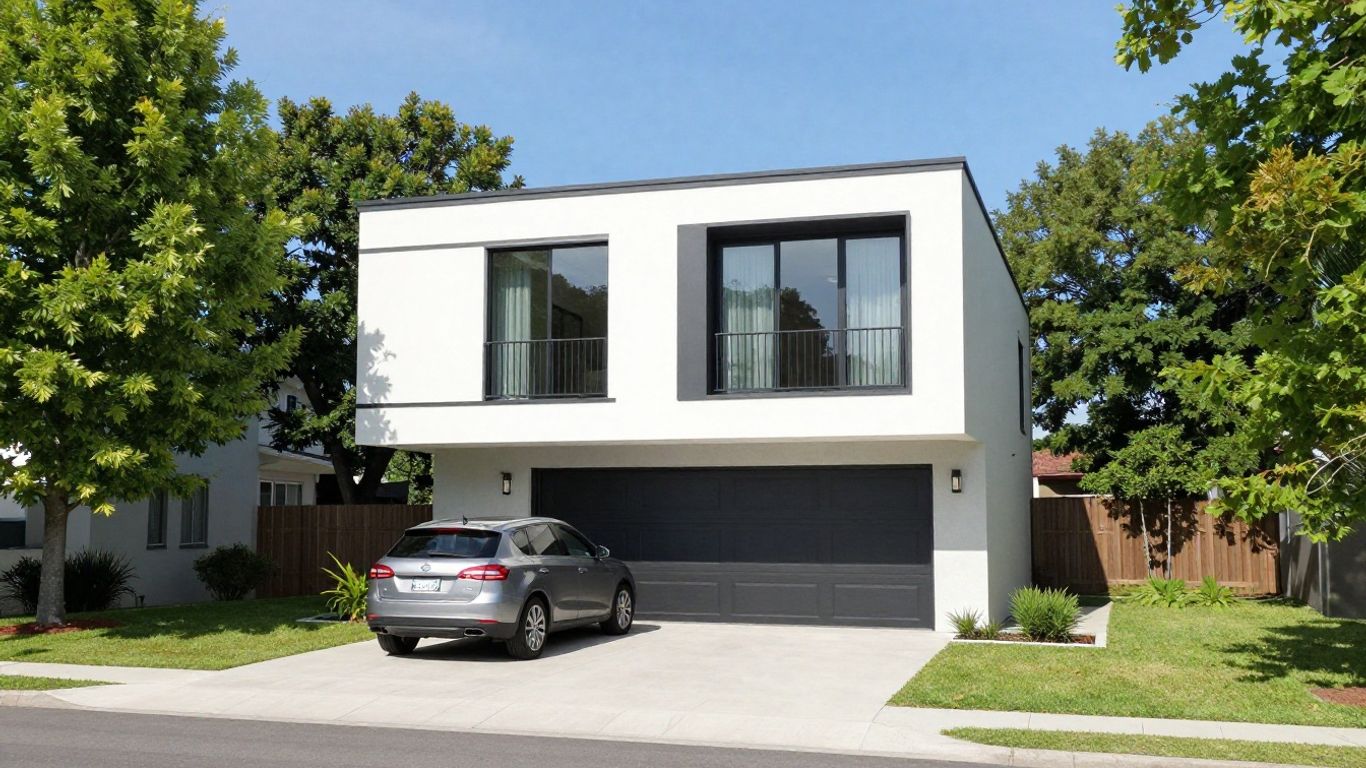
The APER law, aimed at accelerating the deployment of renewable energy, sets precise surface area thresholds to determine which car parks are subject to its obligations. It is therefore essential to understand these criteria to know if your facility needs to comply.
Minimum Surface Area for Existing Car Parks
For car parks already in service as of 1 July 2023, or whose authorisation was issued before 11 March 2023, the APER law generally applies from a surface area of 1,500 m². This threshold is valid for mainland France as well as for the departments of Guadeloupe and Martinique. It is important to note that the surface area taken into account for this calculation includes not only parking spaces but also circulation routes and internal pathways. However, certain specific areas such as loading bays or heavy goods vehicle routes may be excluded from this count.
Minimum Surface Area for New or Renovated Car Parks
The regime is slightly different for new car parks or those undergoing a so-called renovation
Specific Obligations for Existing Car Parks
Shading and Renewable Energy Production Requirements
For existing outdoor car parks exceeding 1,500 m², the APER law now imposes concrete measures to improve their environmental impact. One of the main obligations concerns shading: at least 50% of the total car park surface area must be shaded. This measure aims to reduce the urban heat island effect and improve user comfort. The idea is to favour solutions that provide vegetation cover or lightweight structures.
If canopies are chosen to fulfil this shading function, the APER law goes further. These structures must be fully equipped with renewable energy (RE) production systems. This means that canopies must, as far as possible, incorporate photovoltaic panels to produce electricity. This is a double benefit: shading and green energy production at the same time. It is important to distinguish these obligations from those that apply to new car parks, as the deadlines and procedures may differ. For car parks over 1,500 m², these works must therefore be anticipated. Consulting the surface area thresholds is an essential first step.
Compliance Deadlines According to Car Park Size
The APER law provides deadlines for existing car parks to comply, which vary depending on their size. For larger facilities, those exceeding 1,500 m², owners have a period to comply. It is crucial to be aware of these deadlines to avoid any penalties. Regulatory texts specify these deadlines, which are often linked to the construction completion date or specific dates set by decree. For example, for existing car parks, the obligation generally applies from 1 July 2023. It is therefore advisable to check the exact date that applies to your specific situation.
Flexibility Offered by the Huwart Law for Natural Shading
The APER law, while setting ambitious objectives, also recognises the diversity of situations and constraints. It provides a degree of flexibility, particularly regarding shading solutions. If the installation of photovoltaic canopies is not technically or economically feasible, other solutions can be considered. The focus is on natural shading, for example, through tree planting. The objective is to achieve the 50% shaded surface threshold, whether by artificial structures or vegetation. It is possible to combine these two approaches to achieve the desired result. The Huwart law, which preceded and influenced the APER law, had already introduced concepts of greening and landscape integration, and the APER law follows this continuity by offering alternatives for shading. Shading requirements are therefore adaptable under certain conditions.
It is important to note that car parks under 500 m² are generally not subject to these shading and renewable energy production obligations. The thresholds are therefore decisive in determining whether your car park is subject to the APER law.
Regulations Applicable to New and Renovated Car Parks
For car parks that are either newly constructed or undergoing major renovation, the APER law introduces specific rules, primarily governed by the French Construction and Housing Code. These provisions aim to integrate solutions favouring shading and renewable energy production from the design or rehabilitation stage.
Application of the Construction and Housing Code
New car parks, or those that have undergone a « major renovation » (defined as a modification of the ground surfacing over at least 50% of the surface area), are subject to specific obligations. These rules apply particularly when the car park is associated with a building whose surface area exceeds certain thresholds, or if it is an independent car park larger than 500 m² for new constructions.
- New Car Park Associated with a Building: If the building exceeds 500 m² (for commercial, industrial, craft, hangar, warehouse, public covered car parks) or 1,000 m² (for offices), and it has an outdoor car park larger than 500 m², the obligations apply.
- New Independent Car Park: Outdoor car parks open to the public and larger than 500 m² are directly concerned.
- Entry into Force Date: Obligations for new car parks associated with certain types of buildings came into effect on 1 January 2024, with other deadlines planned for 2025 depending on the nature and size of the buildings.
Conditions of Major Renovation Affecting Regulations
A renovation is considered « major » and triggers the application of the APER law if it involves modifying the ground surfacing over an area equal to or greater than 50% of the total car park surface area. This also includes the renewal of a concession, lease, or operating contract. It is important to correctly define what constitutes a major renovation to anticipate the necessary steps. The idea is that during works of such magnitude, it is more relevant to integrate the new requirements.
Attention must be paid to the definition of « major renovation » as it determines the application of the new rules. A simple refurbishment is not enough to trigger the obligations, but a substantial modification of the surfacing is.
Obligations Regarding Shading and Permeable Surfacing
For new or renovated car parks, two main requirements must be met over at least 50% of the total surface area:
- Improvement of Shading and Stormwater Management: Devices must be installed to create shade and improve soil permeability, such as drainage surfacing or vegetated areas. The objective is to reduce the urban heat island effect and better manage runoff water.
- Renewable Energy Production (RE): If shading is created by canopies (covered structures), these must be fully equipped with renewable energy production systems, typically photovoltaic panels. This accelerates the production of renewable energy for businesses.
It is possible to combine these two obligations on the same surface. For example, photovoltaic canopies can both provide shade and produce electricity. For new constructions, a mixed solution of trees and solar canopies can cover 50% of the surface, thus meeting the solarisation obligation.
Implementation Methods for Photovoltaic Canopies
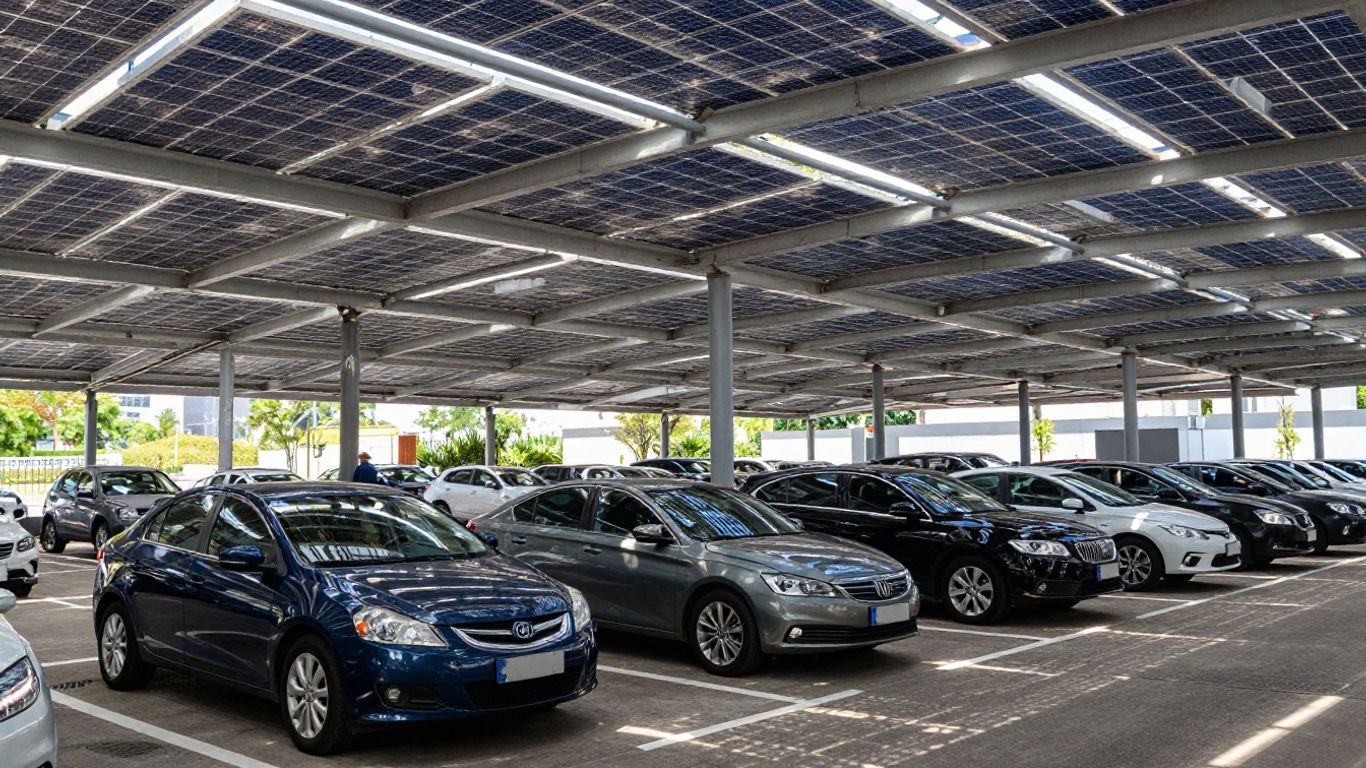
The installation of photovoltaic canopies in outdoor car parks is not just an option; it is a regulatory requirement for many sites. The general idea is to transform these often unused spaces into sources of renewable energy while providing protection from the sun. At least 50% of the total car park surface area must be covered by these canopies.
Percentage of Surface Area to be Covered by Canopies
The APER law sets clear objectives for car park coverage. It’s not just about placing a few panels here and there. The rule is strict: half of the car park’s surface area must be equipped. This includes the parking spaces themselves, but also the circulation routes within the car park, between the entrance and the exit. Green spaces or loading/unloading areas are generally not taken into account in this calculation.
Integration of Renewable Energy Production Systems
Once the surface area is defined, energy production must be integrated. The regulation states that the upper part of the canopies must be equipped with photovoltaic panels. The objective is to maximise green electricity production. It is even possible, under certain conditions, to include the roofs of adjacent buildings if the surface area of the canopies alone is not sufficient to reach the required threshold. Solar panels installed before 10 March 2023 can be taken into account if they are still functional and meet the current criteria.
Combination of Natural Shading and Solar Canopies
The APER law, in its amended version, offers some flexibility. It is not always necessary to cover 50% of the car park with purely artificial structures. A combined approach is possible. If your car park already benefits from significant natural shading due to the presence of trees, for example, this can be taken into account. The idea is to meet the overall objective of reducing the urban heat island effect and producing energy. The Huwart law, for instance, allows compliance by combining photovoltaic canopies and natural shading devices. However, it must be ensured that the combination of the two reaches the 50% coverage threshold.
The pooling of obligations between adjacent car parks is an interesting option for optimising installation costs and timelines. The important thing is that the total surface area covered by the canopies corresponds to the sum of the individual obligations of each car park.
Possible Exemptions to the APER Law
General Conditions for Requesting an Exemption
The APER law, while aiming to accelerate the deployment of renewable energy and green urban spaces, recognises that particular situations can make its application difficult, if not impossible. It is within this framework that exemptions can be granted. To benefit from them, it is essential to prepare a solid application file. This file must be submitted to the competent authority, generally the prefecture. It must include a non-technical summary clearly explaining the request, as well as an in-depth techno-economic study. This study, often carried out by a qualified company, such as those holding the RGE certification for photovoltaics, is essential to justify the request. It allows for an assessment of the feasibility and impact of legal obligations on the specific project. It is important to note that even if a Local Urban Plan (PLU) appears incompatible, the Huwart law explicitly allows for derogations from its rules for these projects, subject to the decision of the competent authority.
Technical and Environmental Reasons Justifying an Exemption
Several reasons can justify an exemption request. On a technical level, constraints related to soil type, insufficient sunlight for photovoltaics, safety imperatives, or operational difficulties can be invoked. From a heritage or environmental perspective, situations such as being located on classified or listed sites, strong landscape or architectural constraints, or the fact that natural shading exceeding 50% already exists, can be valid grounds. It is also possible to request an exemption if the car park is already covered by more than 50% by existing natural shading.
Economic Criteria for an Exemption Request
Economic aspects also play a role in granting exemptions. If compliance with the APER law results in additional costs that jeopardise the economic viability of the project over a 20-year period, an exemption may be considered. Similarly, an inability to secure initial financing can be an argument. These economic considerations aim to ensure that the energy transition does not become an insurmountable obstacle for certain projects, while maintaining a balance with environmental objectives. It is important to thoroughly document these financial aspects to support the request.
Specific Cases of Exemption
Beyond general grounds, the law provides for specific cases where an exemption may be granted. For example, if the site already has another means of renewable energy production that reaches a sufficient level of equivalence, this may justify an exemption from the solarisation obligations for car parks. Similarly, if the car park is intended to be removed or transformed in the medium term, this may be taken into account. Finally, as mentioned earlier, sufficient natural shading can exempt from certain obligations. These situations show a certain flexibility in the application of the law, recognising that not all configurations require the same measures.
Existence of Other Renewable Energy Production Means
If your site already benefits from installations producing renewable energy, such as geothermal energy or another form of solar energy not related to the car park, this can form a solid basis for an exemption request. The idea is not to impose a double constraint if the overall objective of renewable energy production is already met by other means. However, it must be possible to demonstrate that these existing installations have an impact equivalent to the obligations provided for by the APER law for car parks. The assessment of this equivalence will be at the heart of the application file.
Projects for the Removal or Transformation of the Car Park
Another case for exemption concerns future projects for substantial modification of the car park. If a decision has already been made and documented to remove the car park or radically transform it in the near future, it may be deemed disproportionate to require significant investment for its compliance with the APER law. The remaining lifespan of the car park and the nature of its transformation will be key elements in assessing this request. It is essential that these projects are clearly defined and planned.
Exemptions Related to Sufficient Natural Shading
One of the most direct exemptions concerns natural shading. If a car park is already covered by vegetation or other natural elements that provide sufficient shade, the obligation to install photovoltaic canopies may be waived. The APER law aims to reduce urban heat islands, and effective natural shading already achieves this objective. However, it must be possible to prove that this shading covers the required area and is sustainable. The objective is not to impose costly installations if the environmental benefit is already achieved through natural means. Experts can help to assess this shading.
Specific Cases of Exemption
Existence of Other Renewable Energy Production Means
In certain cases, it is possible to be exempt from the obligation to install photovoltaic canopies if you can prove that your site already has other renewable energy production facilities. The idea here is not to multiply devices if the objective of green energy production is already met elsewhere. However, these other means must be deemed equivalent in terms of production capacity. A certificate, often accompanied by a technical summary, is required to justify this situation to the competent authorities. It aims to show that the spirit of the law is respected, even if the form (specific canopy installation) is not strictly followed.
Projects for the Removal or Transformation of the Car Park
The APER law provides a degree of flexibility for car parks whose removal or transformation is already planned. If a concrete project for modification or disappearance of the car park is underway, and this is justified by urban planning permission or a formal commitment, installation obligations may be waived. Be aware that this exemption is not permanent; if work does not start within a specified timeframe, the obligations will be reinstated. Furthermore, if only part of the car park is affected by the transformation, the rules will apply to the remaining portion. It is therefore important to clearly define these projects to benefit from this exception for transformation projects.
Exemptions Related to Sufficient Natural Shading
Another situation allowing for an exemption concerns car parks that already benefit from significant natural shading. If more than 50% of the car park’s surface area is already shaded by trees or other natural elements, the obligation to install photovoltaic canopies may be waived. The objective is to avoid superfluous installations when the desired effect (reduction of the urban heat island) is already achieved. As with other cases, formal justification is required, proving that the natural shading threshold is indeed met.
Penalties for Non-Compliance with the APER Law
Amount of Potential Fines
Non-compliance with the obligations imposed by the APER law regarding car park solarisation can lead to significant financial penalties. These fines are designed to encourage compliance within the stipulated deadlines. For car parks with a surface area between 1,500 m² and 10,000 m², the fine can reach up to €20,000 per year. For larger infrastructures, exceeding 10,000 m², this amount can rise to €40,000 annually. It is important to note that these penalties apply recurrently as long as the situation is not rectified. Non-compliance with regulations can therefore quickly become costly, highlighting the importance of planning compliance as soon as possible.
Application of Penalties Until Compliance
The financial penalties provided for by the APER law are not a one-off punishment but rather a continuous mechanism. They are applied as long as the concerned car park has not met the legal requirements, whether it involves installing photovoltaic canopies, greening part of the surface, or a combination of both. The objective is to strongly encourage owners and managers to undertake the necessary works. The administration can identify non-compliance during inspections, thereby triggering the application of penalties. The duration of these penalties will therefore depend directly on the time it takes for the car park to become compliant with the law’s provisions.
Differentiation of Penalties According to Car Park Size
The APER law has introduced a tiered system of penalties based on the size of the parking areas concerned. This approach aims to adapt the severity of fines to the scale of the infrastructure and, potentially, to its capacity to bear the compliance costs. As mentioned earlier, larger car parks (over 10,000 m²) are subject to higher annual fines than those of intermediate size (between 1,500 m² and 10,000 m²). This distinction underscores the importance given to the transformation of the largest artificialised surfaces, which represent significant potential for renewable energy production and improvement of the living environment. It is therefore essential to correctly identify your car park’s category to anticipate the financial implications in case of non-compliance with obligations.
Responsibility for Compliance
Identification of the Legal Person Responsible for the Obligation
The APER law, aimed at accelerating the development of renewable energy and improving user comfort, imposes obligations concerning the installation of photovoltaic canopies or greening of car parks. It is therefore essential to know who is concretely responsible for this. The responsibility for compliance primarily lies with the owner of the car park or the person who has the right to use it. This can vary depending on the nature of the property and the contractual agreements in place. This is not a mere suggestion but a legal obligation that applies from certain surface areas.
Distinction Between Car Park Owner and Manager
In many cases, the owner of the land where the car park is located is not the same person who manages its day-to-day operations. The APER law distinguishes these roles. While the owner remains ultimately responsible, the manager, whether a private company, a local authority, or a management company, may have specific contractual obligations to carry out the necessary works. It is therefore important to carefully analyse concession or management contracts to determine the precise responsibilities of each party. For example, a public service concession contract may transfer the burden of compliance to the concessionaire, especially upon renewal of the contract. Outdoor car parks larger than 1,500 m² are particularly affected by these new rules [8bdb].
Implications for Lease or Concession Agreements
Existing lease or concession agreements can have a significant impact on compliance responsibility. If a contract is renewed or if major works are undertaken, the APER law may apply. It is therefore advisable to review these agreements to incorporate the new requirements. For example, if a car park is leased to a company, the lease agreement must specify who will bear the cost of installing canopies or greening. In the case of a concession, the terms of the contract are paramount. It is possible that the concessionaire will have to assume these costs, especially if the contract is renegotiated or expires. It should be noted that exemptions are possible under certain conditions, particularly if the works present significant technical or economic constraints [0fc6].
Here are the main points to consider:
- Contractual Analysis: Carefully examine the clauses of leases, concessions, or other management agreements.
- Notification: Inform all stakeholders of the new legal obligations.
- Negotiation: Redefine responsibilities and costs associated with compliance if necessary.
- Timeline: Respect the deadlines set by the law, which vary according to the size of the car park (e.g., 1 January 2026 for the largest, 1 January 2028 for intermediate ones).
Clarity on responsibility is the first step towards successful compliance. Ignoring these obligations can lead to significant financial penalties.
Ensuring everything is in order is our profession. We help you understand and follow the rules so that your project is compliant. It’s an important step, but not complicated with our help. To learn more about how we can assist you, visit our website today!
Conclusion
The APER law is transforming our car parks into greener, energy-producing spaces. Whether you have an existing car park or are building a new one, it is important to understand these new rules. The goal is to make our cities more sustainable. Do not hesitate to seek information from the competent authorities to adapt your situation. It’s a small effort for a great environmental benefit.
Frequently Asked Questions
Does the APER law apply to underground car parks?
No, not at all. The APER law focuses on car parks that are outdoors and well-exposed to the sun. Underground or multi-storey car parks, where it is difficult to install solar panels, are not concerned by these rules.
My car park is 1200 m². Do I have to install solar panels?
For mainland France, the APER law applies to outdoor car parks larger than 1500 m². So, if your car park is 1200 m², you are not directly concerned by this obligation for now. But be careful, if you undertake major works, this could change things.
What is a ‘major renovation’ for a car park?
A major renovation is when a large part of the car park is redone, more than half of its surface area. If you redo the surfacing or other major works, this can trigger the APER law’s obligations, even if the car park already existed.
Do I have to cover my entire car park with solar panels?
No, you don’t have to cover everything. The law requires that at least half of the car park’s surface area be shaded. If you use solar panels to create this shade, a portion must produce energy. But there are solutions to combine natural shading and panels.
I already have a lot of trees in my car park. Am I safe?
That’s good news! If the trees in your car park already cover at least half of the surface area, you might be exempt from the obligation to install solar canopies. You just need to be able to prove it, often with a study or photos.
Who decides if I can get an exemption?
To obtain an exemption, you must submit an official request, often to the prefecture. You need to present a solid file explaining why you cannot comply with the law, for example, for technical or safety reasons, or because it would be too expensive and jeopardise your business.
What happens if I don’t comply with the APER law?
If you do not comply with the law, you risk fines. The amount can vary, but it can be up to €20,000 per year. For very large car parks, the fine can even go up to €40,000 per year. And these fines continue as long as the car park is not compliant.
Who is responsible for bringing the car park into compliance?
Generally, the person or company managing the car park is responsible. It is not always the owner. If you rent a car park or have a concession, you need to check your contract carefully to know who must carry out the works.

Journaliste spécialisée en transition énergétique et consultante RSE. À 42 ans, Claire combine une formation en journalisme (Master Sciences Po) et un diplôme d’ingénierie environnementale (École des Mines / INSA). Après 10 ans dans la presse économique et 7 ans en cabinet de conseil RSE, elle écrit pour aider les décideurs B2B à comprendre les réglementations, les enjeux climatiques et les innovations énergétiques.