Installing photovoltaic panels is an interesting step towards reducing your energy bills and acting in favour of the environment. However, it is essential to fully understand the tax implications before proceeding. This article reviews property tax and photovoltaic panels, as well as other tax aspects to be aware of to optimise your solar project.
Key Takeaways
- Solar panels installed on the roof of a home are generally exempt from property tax. They are not considered a modification to the building that would increase its cadastral rental value.
- Ground-mounted photovoltaic installations can, however, have an impact on property tax as they are often assimilated to new constructions.
- Income from the sale of surplus electricity produced by installations of less than 3 kWp is generally exempt from income tax, but must still be declared.
- A reduced VAT rate (10%) applies to the installation of solar panels for homes over 2 years old, which reduces the initial cost.
- Financial aid, such as the self-consumption bonus, is available and can reduce the cost of your installation and improve its overall profitability.
Understanding the Impact of Photovoltaic Panels on Property Tax
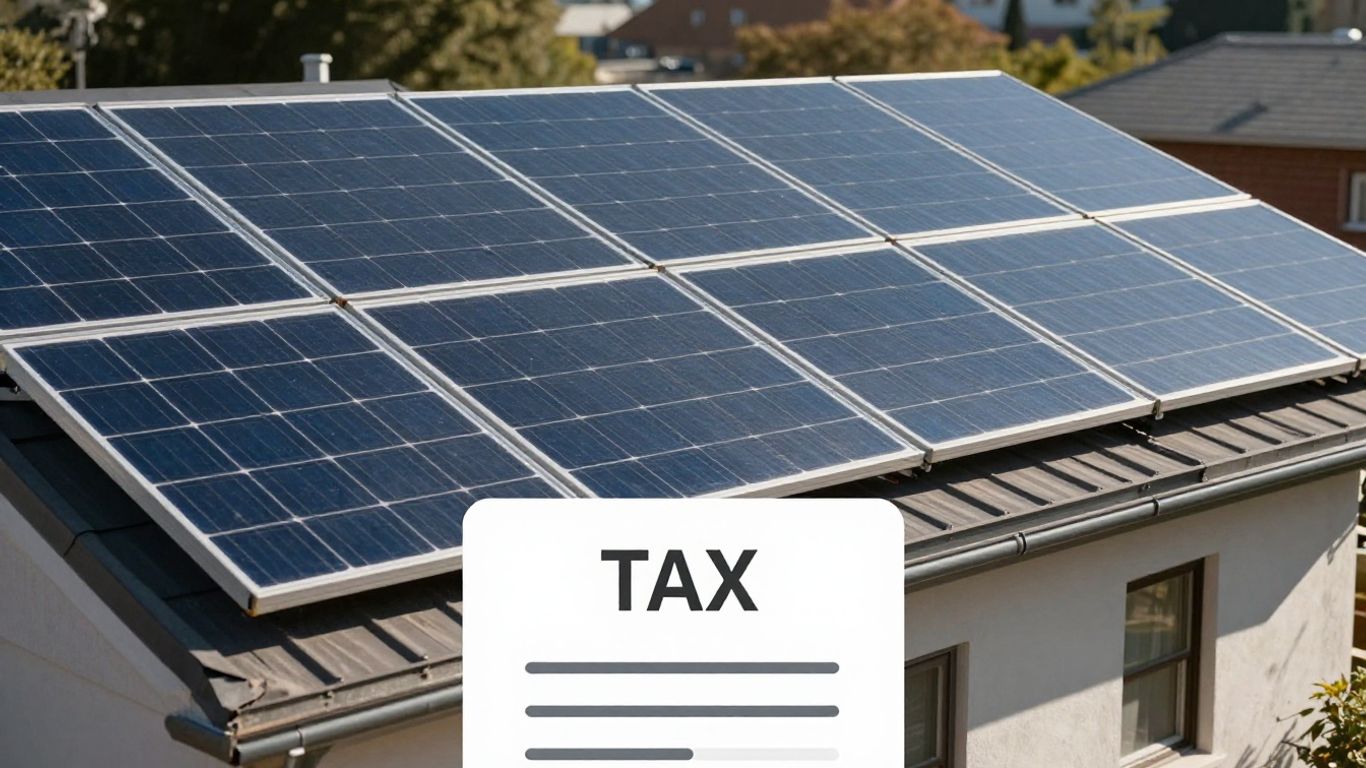
The installation of solar panels often raises questions about its impact on property tax. It is important to distinguish between different configurations to correctly understand the tax implications.
Roof-mounted Solar Panels and their Exemption from Property Tax
For photovoltaic installations fixed to the roof of a home, the good news is that they generally do not change the amount of your property tax. These systems are considered separable from the building’s structure. Consequently, they do not lead to an increase in the cadastral rental value of your property, which is the basis for calculating this local tax. This exemption is permanent and automatic. Therefore, you do not need to take any specific action with the tax authorities regarding property tax for this type of installation. This is a significant advantage that contributes to the overall profitability of your solar project.
Specifics of Ground-Mounted Photovoltaic Installations
The case of solar panels installed on the ground is different. Unlike roof-mounted installations, those installed directly on the land may be assimilated to new constructions. This distinction has a direct consequence: they may be taken into account in the calculation of the cadastral rental value of the land. This results in a potential increase in your property tax. Furthermore, these installations may also be subject to development tax, depending on local regulations. It is therefore essential to anticipate this tax impact before choosing the location for your ground-mounted panels.
Tax Exemption for Residential Installations Under 3 kWp
For residential installations with a power of 3 kilowatts-peak (kWp) or less, a tax exemption specifically applies to income from the sale of surplus electricity. Although this income is exempt from income tax, it must still be declared in your annual tax return, in the category of « exempt net income ». This step, although simple, is mandatory to remain compliant. The absence of any change to property tax for residential installations is a key point to remember for your project.
It is essential to understand these distinctions to assess all the tax implications of your photovoltaic project. Roof-mounted installations offer a clear tax advantage regarding property tax, while ground-mounted installations require increased vigilance.
Tax Regimes Applicable to Photovoltaic Electricity Income
Taxation of Income from Electricity Sales
As soon as a homeowner resells the electricity produced by their solar panels, they must consider the associated taxation. In France, the sale of photovoltaic electricity generated by a domestic installation can be either completely exempt or taxable, depending on the installed capacity and the amount of income. The most common scenario: a domestic installation where the owner sells their surplus to EDF OA or another buyer, which implies an annual declaration of this income, even if it is exempt.
Here are the general rules applied:
- If your sales income does not exceed a certain threshold, it may be tax-exempt (see below).
- Beyond this threshold, a portion becomes taxable, falling under non-professional industrial and commercial profits (BIC).
- Tax procedures vary depending on the category.
Exemption Conditions for Small Installations (< 3 kWp)
For residential installations with a total capacity of 3 kWp or less, the situation is straightforward: you will never pay tax on income from electricity sales under three main conditions:
- The installation is connected to the grid at a maximum of two points;
- The activity is not professional or related to a company;
- The amount from the sale of electricity does not exceed €305 per year.
If these criteria are met, your revenue from electricity sales will not be subject to any tax, as specified by current regulations on the tax exemption for small photovoltaic incomes. However, it is mandatory to declare them annually via form 2042C PRO, in the « exempt net income » section.
Opt for a low-power installation and non-professional management to avoid any taxation on your solar earnings.
The Micro-BIC Regime and the Simplified Real Regime for Solar Income
If your installation exceeds 3 kWp or if you generate annual income exceeding €305, taxation applies, and two main regimes are available:
- Micro-BIC:
- Applies below €70,000 in annual income.
- Benefits from a flat-rate allowance of 71%. Result: only 29% of your revenue is taxed.
- Easy to declare, this regime is suitable for individuals.
- Simplified Real Regime:
- Mandatory for revenues exceeding €70,000 per year.
- Allows deduction of all related expenses (purchase, installation, maintenance, etc.)
- More complex, it is mainly reserved for companies or owners of large-scale solar installations.
| Tax Regime | Applicable Threshold | Taxable Portion of Income | Possible Deductions |
|---|---|---|---|
| Micro-BIC | ≤ €70,000 / year | 29% | 71% flat-rate allowance |
| Simplified Real | > €70,000 / year | According to actual profit | All expenses |
Remember to keep all your contracts up to date and retain the tax certificates provided by your electricity buyer. Finally, even for small incomes, the annual declaration is mandatory, as reminded by the regulations on the taxation of photovoltaic income. This avoids any administrative errors and secures your procedures in case of an inspection.
Tax Advantages Related to the Acquisition of Solar Panels
Investing in photovoltaic solar panels is an ecological and economic step. Beyond the savings on your electricity bills and your contribution to the energy transition, the French tax framework offers several schemes to make this investment even more attractive. It is important to be aware of these aids to optimise your project.
Reduced VAT Rate for Solar Panel Installation
One of the first financial advantages concerns Value Added Tax (VAT). For residential installations with a power not exceeding 3 kilowatts-peak (kWp), the VAT rate applied is reduced. It is thus reduced from 20% to 10% for the purchase and installation of solar panels. This measure concerns the majority of households opting for self-consumption. For installations with a power exceeding this threshold, the standard VAT rate of 20% applies. It should be noted that from 1 October 2025, all residential installations under 9 kWp will benefit from a reduced VAT rate of 5.5%, a measure aimed at further encouraging the adoption of renewable energy [cd9b].
Self-Consumption Bonus and Other Financial Aid
To encourage the development of self-consumption, the State has implemented an investment bonus. This bonus is paid in a single instalment, calculated based on the installation’s power. It significantly reduces the initial cost of your solar project. In addition to this bonus, other aid schemes may exist at regional or local levels, although general schemes have evolved. It is advisable to consult the relevant authorities to find out about the aid available at the time of your project.
Exemption and Local Tax Reduction Schemes
Regarding local taxes, the situation is generally favourable. Solar panels installed on the roof of a home are not considered a permanent improvement to the building. Consequently, they do not lead to an increase in the cadastral rental value, which serves as the basis for calculating property tax. Thus, installing solar panels on your roof does not impact your property tax. However, it is essential that the installation complies with current standards, particularly through Consuel certification, to fully benefit from these advantages. Companies can also benefit from specific schemes, such as accelerated depreciation of equipment, thereby reducing their corporate tax.
Administrative Procedures and Tax Declarations for Solar Panels
Once your solar panels are installed, it is important to know what administrative and tax procedures to follow. Rest assured, in most cases, this remains quite simple, especially for residential installations.
Obligation to Declare Solar Income, Even if Exempt
It is essential to understand that even if the income from the sale of your photovoltaic electricity is tax-exempt (for installations of 3 kWp or less), you still have an obligation to declare it. This is done annually during your usual tax return. You will need to mention this income in the section dedicated to « exempt net income » on form 2042 C Pro. This is an administrative step that allows the tax authorities to keep a record of your production, even if it does not generate tax for you. Failure to declare, even for non-taxable amounts, could potentially cause problems in the future.
Specific Procedures for Ground-Mounted Installations
Ground-mounted photovoltaic installations, unlike those integrated into roofs, may require additional administrative procedures. If you are considering such an installation, it may be subject to a prior declaration of works at the town hall, especially if it alters the external appearance of your property or if it is large. It is therefore advisable to check with your town hall before starting the work. Furthermore, these installations may have a different impact on property tax, unlike roof panels which are generally exempt. Remember to check local regulations.
Importance of Consuel Certification for Compliance
Consuel certification (National Committee for the Safety of Electricity Users) is a key step to attest to the compliance of your electrical installation, including your solar panels. Although not directly a tax procedure, the Consuel certificate is often requested by financing bodies, electricity distributors (such as EDF OA for surplus sales), and may be required by the tax administration in case of an inspection. It guarantees that your installation complies with current safety standards, which is a mark of seriousness and longevity for your project. Without this certificate, you may encounter difficulties connecting your installation to the grid or benefiting from certain aid. It is therefore essential to ensure that your installer provides you with this document.
It is important to note that the declaration of solar income, even if exempt, must be made using form 2042 C Pro. This form should be attached to your main tax return. Income from electricity sales is considered non-professional industrial and commercial profits (BIC). For installations of 3 kWp or less, you will complete the specific boxes for exempt net income. For more powerful installations, income will be taxed according to the chosen regime (micro-BIC or simplified real).
Here is an overview of the items to declare:
- Income from electricity sales: Total amount received from the sale of your surplus or your entire production. The electricity buyer (often EDF OA) will provide you with an annual tax certificate.
- Installation power: Indicate the power of your installation (in kWp) to determine the applicable tax regime.
- Type of installation: Specify whether it is a roof-mounted or ground-mounted installation, as this may have different implications.
Don’t forget to keep all documents related to your installation and income, such as contracts, invoices, and tax certificates, as they may be requested. If you have chosen total self-consumption without selling surplus, no income declaration is necessary. This is an important point to consider during your installation project.
Optimising Your Photovoltaic Investment Through Taxation
Self-Consumption with or Without Storage: What is the Tax Impact?
Self-consumption is the idea of directly consuming the electricity your panels produce. This is already a good way to reduce your bills. If you add batteries to store energy, you can use it later, for example in the evening. From a tax perspective, self-consumption itself does not significantly change your taxes, especially for residential installations. The exemption of income for small installations (< 3 kWp) applies whether you consume all or part of your production. Batteries are considered equipment and have no direct impact on property tax. The main advantage remains the reduction in your electricity bill.
Choosing the Most Advantageous Electricity Resale Scheme
If you sell part of your production, the choice of tax regime is important. For small installations, the micro-BIC regime is often the simplest. It applies automatically if your sales income does not exceed a certain threshold. You then benefit from a flat-rate allowance for expenses. For larger projects, or if you have many expenses, the simplified real regime may be more advantageous. It allows you to deduct your actual expenses (maintenance, insurance, etc.) from your income, which can reduce your tax. You need to calculate what is most profitable for you.
| Tax Regime | Flat-Rate Allowance | Deduction of Actual Expenses |
|---|---|---|
| Micro-BIC | 71% (for electricity sales) | No |
| Simplified Real | No | Yes |
Anticipating Ancillary Costs such as Development Tax
For installations that are not on the roof, such as ground-mounted ones, you need to consider development tax. This is a local tax that applies to new constructions. Its amount depends on the surface area of your installation and the rates voted by your municipality and department. This is a cost not to be forgotten in your budget, especially if your project is large. It is therefore advisable to check with your town hall to find out the exact amount before proceeding. For roof-mounted installations, this tax is generally not applicable. Also, consider checking available aid to finance your project, such as the self-consumption bonus self-consumption bonus.
It is always best to obtain information from the tax authorities or a professional before finalising your project. Each situation is unique, and good anticipation helps avoid unpleasant surprises and maximise the benefits of your solar installation.
Specific Cases and Tax Particularities of Solar Installations
Beyond the general rules, certain situations deserve particular attention regarding the taxation of solar panels. It is not always a simple application of basic principles, and it is good to be aware of these nuances.
Impact of Solar Panels on Cadastral Rental Value
The cadastral rental value is the basis for calculating property tax. For installations fixed to the roof, the good news is that they are generally not taken into account in this assessment. This means that installing solar panels on your roof should not, in principle, increase your property tax. This is because they are considered removable elements, not permanently altering the building’s structure. However, it is always prudent to check with your local tax office, as local interpretations may sometimes exist, although rare for roof-mounted installations.
It is important to note that this non-taxation concerns solar panels fixed to the roof. Ground-mounted installations may be treated differently.
Tax Differences Between Roof-Mounted and Ground-Mounted Installations
The distinction between a roof-mounted installation and a ground-mounted installation is crucial from a tax perspective. While roof panels generally benefit from property tax exemption, ground-mounted installations may be treated differently. If the latter are considered new constructions or significant land improvements, they could potentially be subject to property tax, or even development tax. It is therefore essential to be well-informed about the tax status of your project before committing, especially if you are considering an installation that is not integrated into the roof. Administrative procedures for ground-mounted installations are also more complex, often involving building permits.
Potential Municipal Objections to Solar Installations
Although less common, it is possible that local regulations or municipal urban planning documents may have implications for your solar installation project. Some municipalities may have specific rules regarding landscape integration or the placement of panels, particularly in protected areas. These rules, while not directly fiscal, can influence the cost or feasibility of your project. It is therefore advisable to consult your town hall’s urban planning department before finalising your project. Local aid may also be available for energy renovations.
Here are a few points to consider:
- Declaration at the town hall: For ground-mounted installations, a building permit is often required.
- Urban planning rules: Check the Local Urban Plan (PLU) for any restrictions.
- Landscape integration: Some municipalities require harmonious integration of panels into the landscape.
It is always best to have a clear understanding of all potential constraints before starting work to avoid any unpleasant surprises.
Understanding the Taxation of Solar Panels: An Essential Guide
Property Tax and Photovoltaic Panels: A Key Relationship
The installation of solar panels on your roof often raises questions about their impact on property tax. The good news is that in most cases, your investment will not result in an increase in this local tax. Indeed, photovoltaic panels fixed to the roof are generally considered separable from the building’s structure. They are therefore not included in the calculation of the cadastral rental value, which serves as the basis for calculating property tax. This means that as long as your panels are installed on your roof, you should not see your property tax increase. However, it is important to ensure that the installation complies with current standards, sometimes validated by an organisation such as Consuel.
Income from Electricity Sales: Taxable or Not?
When you produce more electricity than you consume, the surplus can be sold. This income, even if it comes from a residential installation, may be subject to tax. However, there are significant exemption thresholds. For installations with a power of 3 kWp or less, income from electricity sales is generally exempt from income tax. However, the installation must be connected to the public grid and the activity must not be considered professional. Even if your income is exempt, it must be declared in your annual tax return, in the « exempt net income » category on form 2042 C PRO.
Aid and Exemptions to Reduce Your Tax Burden
Beyond the property tax exemption for roof-mounted installations and the income tax exemption for sales from low-power systems, other tax schemes can reduce your investment. The reduced VAT rate of 10% for the installation of solar panels on homes over two years old is a concrete example. Furthermore, aid such as the self-consumption bonus can reduce the initial cost of your project. It is therefore advisable to find out about the available aid to optimise your solar project.
Implications of Property Tax on Photovoltaic Installations
Permanent Property Tax Exemption for Roof-Mounted Panels
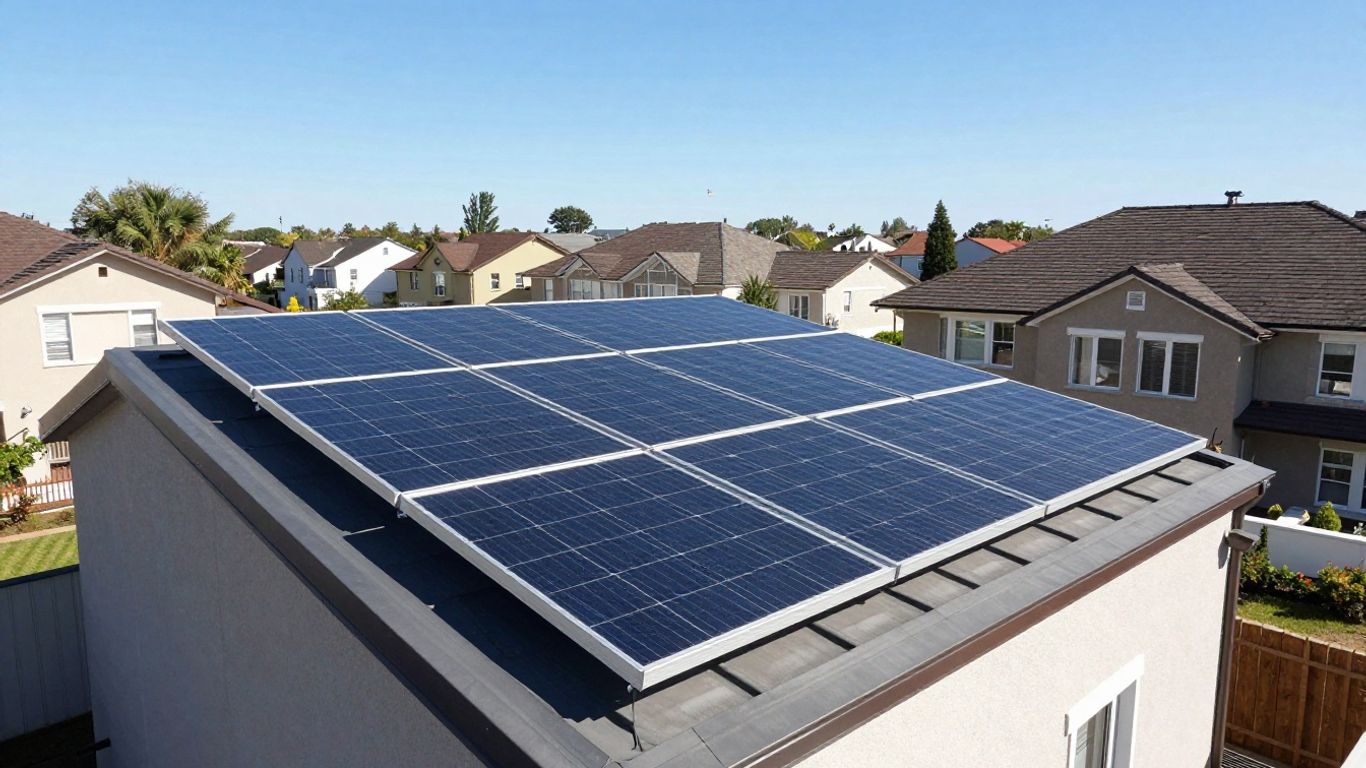
For solar installations fixed to the roof of your home, the good news is that they generally do not change your property tax. Indeed, these systems are considered separable from the building’s structure. This means they do not increase the cadastral rental value of your property, which is the basis for calculating this local tax. Therefore, you do not need to take any specific action with the tax authorities regarding property tax for these installations. This is a significant tax advantage that applies for the entire lifespan of your panels.
Potential Increase in Property Tax for Ground-Mounted Installations
Things get slightly more complicated when photovoltaic panels are installed on the ground. In this case, they may be assimilated to new constructions. This can lead to a revaluation of the cadastral rental value of the land on which they are installed, and by extension, an increase in your property tax. Furthermore, these ground-mounted installations may also be subject to development tax, another local tax to anticipate. It is therefore essential to be well-informed about local specifics and the Local Urban Plan (PLU) before proceeding with such an installation.
No Change to Property Tax for Residential Installations
It is important to distinguish between different configurations. For the majority of residential installations, particularly those with a power of less than 3 kWp and connected to the grid, property tax remains unchanged. Even if you sell part of the electricity produced, as long as the activity is not considered professional, property tax will not be affected. However, you must always declare this income, even if it is exempt, in the « exempt net income » category on your annual tax return. For more details on the procedures, you can consult the information relating to the declaration of solar income.
It is essential to understand that the taxation of photovoltaic panels depends heavily on their installation method and power. A roof-mounted installation is generally neutral for property tax, whereas a ground-mounted installation may incur additional costs. Getting informed in advance is key to avoiding any unpleasant surprises.
Here is a summary table of the tax implications:
| Type of Installation | Impact on Property Tax | Development Tax | Income Declaration | Notes |
|---|---|---|---|---|
| Roof-mounted panels (< 3 kWp) | No increase | Not applicable | Mandatory (exempt net income) | Permanent exemption |
| Ground-mounted panels | Potential increase | Applicable | Depends on power and regime | To be checked according to PLU |
| Roof-mounted panels (> 3 kWp) | No increase | Not applicable | Taxable (according to regime) | May require specific declaration |
Property tax may seem complicated when talking about solar installations. But don’t panic! We’ll explain simply how it works and what it means for you. Want to know if your solar project is affected?
To find out more and get personalised advice, visit our website today!
Conclusion: An Informed Approach for a Successful Solar Project
Installing photovoltaic panels is a bit like embarking on a new project. You think about it, you get informed, and you try to plan for everything. When it comes to property tax and taxes in general, we’ve seen that it can be quite advantageous. Most of the time, there are no unpleasant surprises with property tax, especially if the panels are on the roof. For income from electricity sales, it depends on the power, but often it’s exempt or just requires a small declaration. The important thing is not to remain in the dark. Take the time to fully understand the rules, talk to your installer or even the tax office if necessary. Good preparation avoids many hassles and allows you to fully enjoy the benefits of your solar installation, both for your wallet and for the planet.
Frequently Asked Questions
Do I have to pay more property tax if I install solar panels on my roof?
Good news! Generally, if your solar panels are installed on the roof of your house, it doesn’t change your property tax. It’s as if they were part of the roof; they don’t increase your home’s value for tax purposes.
What about if the solar panels are installed on the ground?
That’s a bit different. If the panels are placed on the ground, in your garden for example, it can be considered a new construction. In this case, your property tax may increase slightly, as it changes the value of your land.
Do I have to declare my solar panels to the tax authorities?
Yes, even if in most cases they don’t change your taxes, you are often required to declare your installation. It’s a formality so that the tax administration is aware, especially if you sell the electricity you produce.
If I sell the electricity produced by my panels, do I have to pay tax on it?
If your installation is less than 3 kilowatts-peak (kWp), which is the case for most homes, the money you earn from selling your electricity is generally not taxable. But be careful, you still need to declare it on your tax return.
Are there any grants for installing solar panels that reduce costs?
Absolutely! There are several grants to help you pay for the installation. For example, the VAT rate can be lower (10% instead of 20%), and there are sometimes bonuses paid by the state or other organisations to encourage the use of solar energy.
What is the self-consumption bonus?
This is a financial aid provided by the state for people who use the electricity produced by their own solar panels (this is called self-consumption). This bonus is paid over several years and depends on the size of your installation.
Can installing solar panels increase the value of my house?
Yes, having solar panels can make your house more attractive and potentially increase its value. It’s an interesting selling point because it shows that the house is modern, ecological, and that electricity bills will be lower.
What is the Consuel certificate and why is it important?
The Consuel certificate is an attestation that proves that your electrical installation, including solar panels, is properly done and complies with all safety regulations. It is proof of compliance that is often requested and is essential for your installation to function correctly and safely.

Journaliste spécialisée en transition énergétique et consultante RSE. À 42 ans, Claire combine une formation en journalisme (Master Sciences Po) et un diplôme d’ingénierie environnementale (École des Mines / INSA). Après 10 ans dans la presse économique et 7 ans en cabinet de conseil RSE, elle écrit pour aider les décideurs B2B à comprendre les réglementations, les enjeux climatiques et les innovations énergétiques.