Key points
A reversible air conditioner can cool a home in summer and heat it in winter, provided it is correctly sized and installed. The choice must take into account thermal comfort, noise, room layout, and overall budget.
- Determine the type of installation suited to the home’s layout.
- Size the power based on the surface area, insulation, and exposure.
- Check the noise levels of the indoor and outdoor units.
- Anticipate works, local regulations, and maintenance.
- Compare purchase cost, consumption, and duration of use.
Understanding how it works and the different models
Reversible air conditioning combines heating and cooling in a single system. It can meet very different needs depending on the number of rooms, the area to be treated, and the space available for equipment. Before comparing prices, it is therefore best to understand how it works and the existing configurations.
The principle of reversible air conditioning
Reversible air conditioning, also known as an air-to-air heat pump, transfers heat between the inside and outside of the home. In summer, it extracts heat from the indoor air to release it outside; in winter, the cycle reverses to draw heat from the outdoor air and distribute it inside. The system therefore does not directly produce heat like conventional heating: it moves it using a thermodynamic cycle.
This dual function explains its usefulness in homes that need to be cooled during hot spells while also benefiting from supplementary or main heating during the cold season. The principle of reversible air conditioning is thus linked to both the desired comfort and the actual performance of the building.
The difference between monosplit, multisplit, and ducted systems
A monosplit system connects one outdoor unit to a single indoor unit. It is generally suitable for one room or a main area. A multisplit system allows several indoor units to be connected to the same outdoor unit, while a ducted system distributes air through a network hidden in the loft, a false ceiling, or a technical space.
The choice depends less on commercial jargon than on air circulation and room usage. A room-by-room installation offers independent control, whereas a ducted solution is more discreet but requires more planning during installation.
The role of the indoor and outdoor units
The outdoor unit handles heat exchange with the ambient air and houses the main components of the refrigeration circuit. The indoor unit then diffuses the heated or cooled air into the room, with adjustable airflow and direction depending on the model.
The connection between the two units must be carefully considered. Its route, length, and integration into the building influence the aesthetics, installation complexity, and sometimes the overall performance.
Situations where this system is particularly suitable
Reversible air conditioning is particularly relevant when the home experiences hot summers, when several rooms need to be regulated, or when flexible heating is sought to complement another system. It can also be suitable for an office, an extension, or a room that is difficult to keep at a stable temperature.
However, it does not negate the need to examine insulation and actual needs. The operation of an air-to-air heat pump is more effective when the building envelope limits heat loss and temperature settings are reasonable.
Defining the essential selection criteria
The right equipment is not necessarily the most powerful or feature-rich. It must above all match the home’s layout, the local climate, and occupancy habits. A methodical decision avoids overpaying for an oversized unit or choosing a difficult-to-install solution.
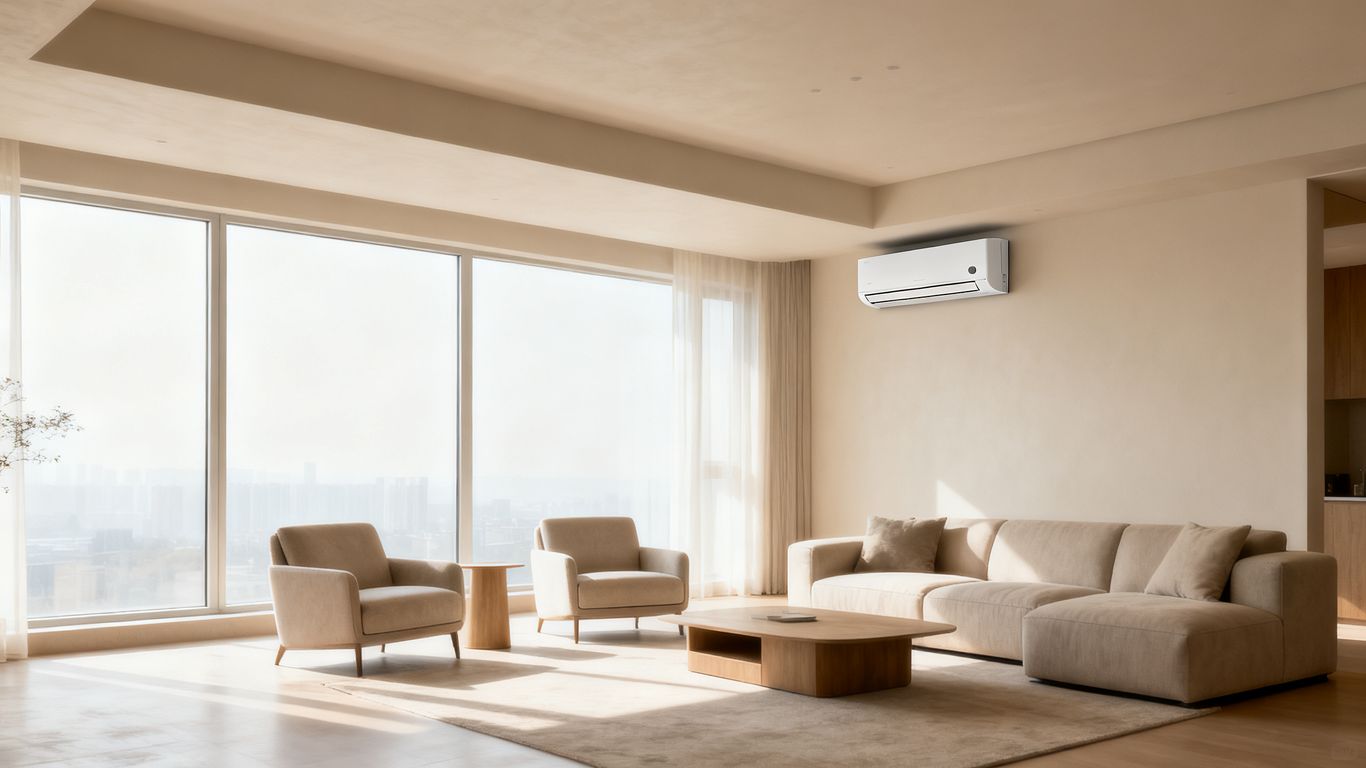
The surface area and layout of the rooms to be treated
The surface area provides an initial guide, but it is not sufficient to determine the power. A large open-plan room and several separate rooms do not require the same air distribution. Ceiling height, frequently closed doors, and the presence of a hallway also affect the expected outcome.
Therefore, a simple plan of the home should be drawn up, indicating the rooms concerned, their use, and their occupancy periods. This approach helps to choose between a single unit, multiple units, or a more discreet distribution network.
Insulation, exposure, and heat gains
A south-facing room, with large windows and occupied by several people, accumulates more heat than a shaded, sparsely glazed room. Electrical appliances, lighting, and cooking can also temporarily increase the thermal load.
Insulation plays a role in both directions: it limits heating needs in winter and slows down temperature rise in summer. An older home or one with significant drafts may require additional work before installation.
Energy efficiency and seasonal performance
Seasonal indicators allow us to go beyond the power stated on the technical sheet. SCOP indicates average heating efficiency, while SEER relates to cooling. It is best to read these in conjunction with the operating conditions and the climate of the area concerned.
An appliance that is efficient on paper may be poorly utilised if it is too large, poorly positioned, or used with excessive temperature differences. The analysis should therefore cover the entire project, not just an isolated value.
Useful everyday features
The available features should be assessed based on their actual usefulness. Some improve regulation, others facilitate use or maintenance, without being essential in all homes. The following criteria generally warrant checking before purchase:
- time programming and independent zone control;
- silent mode for rest periods;
- filtration and access to filters;
- presence detection or automatic airflow adjustment.
These options are only useful if they are easy to use. Clear controls and accessible maintenance are often more important than a long list of rarely used functions.
Calculating the required power
Sizing is the step that determines both comfort and consumption. An estimate based solely on surface area can provide an initial orientation, but it does not replace building analysis. The power must be sufficient to quickly reach the desired temperature without causing inappropriate operating cycles.
The main sizing parameters
The calculation takes into account the surface area, volume, insulation, exposure, glazing, climate zone, and number of occupants. For heating, reference outdoor temperatures and heat loss from the home are also important.
It is also necessary to determine whether the appliance should treat a specific room, a floor, or the entire home. This distinction avoids mechanically transferring a local need to a complete installation.
Order of magnitude by surface area
Ratios expressed in watts per square metre can be used to establish an initial range, but they remain indicative. A well-insulated, low-exposure room will not require the same power as a large, glazed living room under a poorly protected roof.
The number of units also matters. Several moderately powered units can distribute air better than a single very powerful unit placed in a high-traffic area. Manufacturer data and installer advice should supplement any general estimate.
Risks of insufficient or excessive power
An undersized unit will run at high load for extended periods and may struggle during heat or cold peaks. Comfort then becomes irregular, while noise and consumption can increase.
Conversely, excessive power leads to frequent starts and stops. It increases the purchase cost and does not guarantee better regulation. Correct sizing remains the best compromise between comfort, efficiency, and longevity.
Why a thermal study may be necessary
A thermal study becomes relevant when the home is large, poorly insulated, subject to high solar gain, or equipped with multiple zones. It is also useful for major renovations or projects where air conditioning is expected to provide a significant portion of the heating.
The aim is not to complicate the project, but to reduce uncertainty. A coherent analysis allows for scenario comparison, anticipation of installation limitations, and better estimation of future costs.
Assessing the noise level
Noise is often subtle during the day and becomes very noticeable at night. Therefore, the stated values must be examined, as well as the location of the units and the nature of the walls. Acoustic comfort results from all these parameters, not from a single figure.
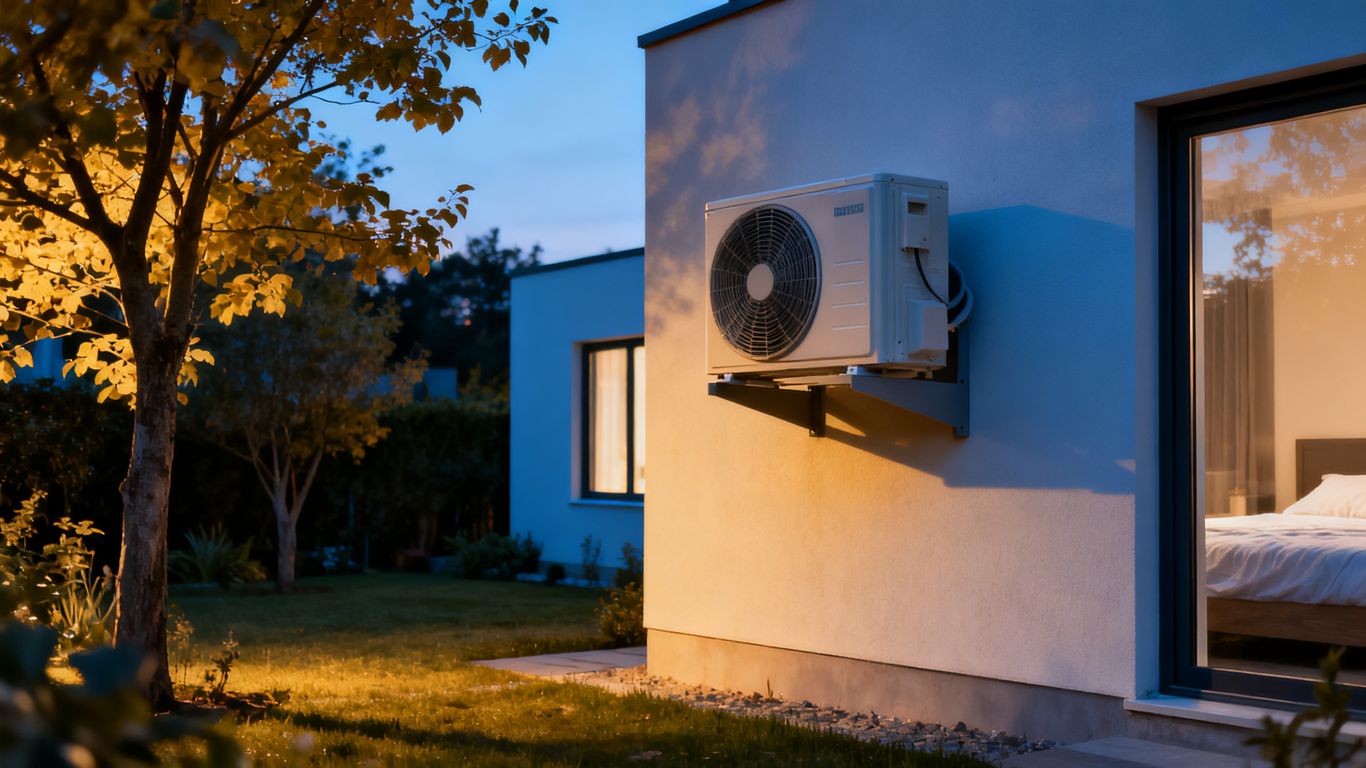
Decibels of indoor and outdoor units
Technical sheets generally distinguish between the sound pressure of the indoor unit and that of the outdoor unit. These values are measured under specific conditions and can vary depending on the fan speed, the selected mode, and the measurement distance.
It is advisable to compare values established using a similar method. The maximum level can be useful for assessing an unfavourable situation, while the level in silent mode provides a better indication of nighttime use.
The impact of location on acoustic comfort
An indoor unit placed above a bed, desk, or sofa will be more noticeable than an appliance installed in a circulation area. Vibrations can also be transmitted to a lightweight partition or poorly insulated structure.
Outdoors, a confined courtyard or a reverberating wall can amplify the perception of noise. Neighbours, nearby windows, and the distance from bedrooms must be considered from the project’s inception.
Values to favour for a bedroom or office
For a bedroom, priority is given to a discreet indoor unit operating at low speed, with stable ventilation and smooth regulation. In an office, background noise must be compatible with calls, concentration, and conversations.
It is prudent to consult detailed data rather than relying on a simple mention like « silent ». A demonstration, where possible, also provides concrete insight into the perception of airflow and vibrations.
Solutions to limit noise pollution
Choosing a suitable support, correctly tightening fixings, and installing anti-vibration mounts can limit vibrations. Regular maintenance also prevents a clogged filter or an unbalanced fan from degrading the noise level.
The position of the units remains crucial. Avoiding resonant corners, fragile supports, and airflow directed towards an occupied area often improves comfort without modifying the unit.
Comparing installation constraints
Reversible air conditioning is not just about installing two boxes. The routing of connections, condensate drainage, electrical supply, and visual integration must be planned. A preliminary technical visit can identify difficulties before ordering.
Choosing the location of the units
The indoor unit must be able to diffuse air without creating unpleasant drafts and remain accessible for filter cleaning. The outdoor unit needs sufficient airflow and a stable support, as far as possible from openings and resting areas.
The project must also preserve the appearance of the facades and limit the visibility of cables. A location convenient for the installer is not always the best for the occupants.
Length of refrigerant lines and associated works
The distance between the units affects the routing of the pipes and the amount of work required. Depending on the configuration, it may be necessary to drill through walls, create conduits, provide condensate drainage, or adapt the electrical circuit.
The permitted length and height differences must be checked in the documentation of the chosen model. The cost of installing air conditioning depends in particular on the number of units, drilling, and the complexity of the work.
Regulations applicable to the outdoor unit
Outdoor installation may be subject to co-ownership rules, urban planning constraints, or noise nuisance requirements. An authorisation may be necessary depending on the municipality, the building, and the visible modification of the facade.
Before starting work, it is therefore useful to consult the co-ownership regulations and the relevant authorities. This precaution reduces the risk of having to move the equipment after installation.
The importance of professional installation
The professional checks the sizing, the circuit’s tightness, the connections, and the overall operation. They can also explain the settings, maintenance procedures, and warranty conditions.
Careful installation contributes to the system’s performance and reliability. For complex projects, several detailed quotes allow for comparison not only of the price but also of the exact scope of the service.
Controlling costs and maintenance
The budget for reversible air conditioning includes the equipment, installation, commissioning, and running costs. The lowest purchase price is not necessarily the most economical over several years. A thorough comparison must include the home’s layout and frequency of use.
Purchase price according to the chosen configuration
A monosplit is generally simpler to acquire than a multisplit or a ducted system. The number of units, power, seasonal performance, and control features affect the final price.
Aesthetic choices and additional features can also impact the budget. The price of reversible air conditioning should therefore be examined for comparable configurations, always distinguishing between the equipment and the installation service.
Costs related to installation and commissioning
Works may include supports, drilling, conduits, condensate drainage, electrical supply, and surface repairs. A precise quote should itemise these elements separately to avoid unpleasant surprises.
Commissioning includes the checks necessary for the circuit to function correctly. It is preferable to verify that it is included in the offer and to keep the documents provided at the end of the work.
Electricity consumption for heating and cooling
Consumption depends on the power drawn, operating time, outdoor temperature, and the difference between the setpoint and the actual temperature. Correct insulation, moderate setpoints, and clean filters help to limit needs.
Seasonal efficiency is more representative than consumption observed over a single day. To compare different appliances, identical assumptions must be used, distinguishing between heating and cooling uses.
Maintenance, lifespan, and maintenance obligations
The indoor unit filters must be cleaned regularly according to the environment and frequency of use. Condensate drainage, the condition of the heat exchangers, and the appearance of unusual noises or odours should also be monitored.
Some installations containing a significant amount of refrigerant are subject to mandatory checks by a professional. Deadlines depend on the configuration and applicable regulations. Regular maintenance helps to maintain performance and detect anomalies earlier.
Preparing your project
Choosing reversible air conditioning requires bringing together several pieces of information: thermal needs, room layout, noise level, facade constraints, and operating budget. A sound decision is therefore not based on the stated power or the displayed price alone. To clarify options and obtain advice tailored to your home, you can contact a competent advisor before starting the work.
In brief
Reversible air conditioning can offer versatile comfort, but its success depends mainly on sizing, placement, and the quality of installation. By comparing seasonal performance, noise, works, and long-term maintenance, it becomes easier to choose an installation that is consistent with the home and actual usage.
Frequently asked questions
Can reversible air conditioning heat an entire home?
Yes, if the power, air distribution, and insulation are adequate. In some homes, it serves as the main heating; in others, it complements an existing system.
What is the difference between a monosplit and a multisplit?
A monosplit connects one indoor unit to one outdoor unit. A multisplit allows several indoor units to be connected to a single outdoor unit, with room-by-room control possible.
How do I choose the power of a reversible air conditioner?
Consider the surface area, volume, insulation, exposure, glazing, climate, and number of occupants. A more precise study is recommended when the home is large or complex.
Is reversible air conditioning noisy?
The noise level depends on the model, operating mode, and location. A well-chosen and correctly fixed unit can remain discreet, especially in reduced mode.
Where should the outdoor unit be installed?
It should be placed on a stable support, in a sufficiently ventilated area and away from windows or resting places. Co-ownership and urban planning regulations must also be checked.
What maintenance should be planned?
Filters should be cleaned regularly and condensate drainage monitored. Depending on the installation, professional inspection of the refrigeration circuit may be mandatory or recommended.
Does the price depend on the number of rooms?
Yes. The number of units, the length of the connections, the drilling, and the complexity of the routing directly influence the total cost, in addition to the price of the equipment.

Thibault Mouillefarine est responsable éditorial de Solencia, une plateforme dédiée à la compréhension, à la qualification et à l’accélération des projets photovoltaïques professionnels. Fondateur de Millennium Digital, agence spécialisée en stratégie digitale B2B, il accompagne les entreprises dans la transformation de sujets complexes en parcours de décision clairs et orientés résultats. Les contenus publiés sur Solencia s’appuient sur des sources publiques et institutionnelles : textes réglementaires, documentation Enedis, données CRE, informations EDF OA, ressources ADEME et publications officielles liées à l’énergie.