Key points
When comparing a portable reversible air conditioner, look beyond the advertised price: capacity, energy consumption, noise and installation requirements are just as important.
- Distinguish between monobloc models and portable split systems, and check which configuration suits your home.
- Match the capacity to the room’s volume, insulation and exposure.
- Compare consumption figures in light of your hours of use and electricity tariff.
- Assess the noise, controls and features that will be genuinely useful day to day.
- Plan for hot-air exhaust, maintenance and the cost of accessories before buying.
Understanding how a portable reversible air conditioner works
A portable reversible air conditioner cools a room in hot weather and can also provide supplementary heating. Before comparing models, it is useful to understand the differences between them and the conditions under which their heating mode works. The introduction to portable reversible air conditioners offers another overview of these principles.
How air conditioning and heat pump heating work
In cooling mode, the appliance extracts heat from the indoor air and releases it outside, usually through a hose. In heating mode, the cycle is reversed: the appliance collects heat from outdoors and transfers it into the room. This reversible function allows one appliance to serve two seasonal purposes, but does not necessarily make it a suitable primary heating system for every situation.
The difference between a monobloc model and a portable split air conditioner
A monobloc model houses all its components in a single unit placed in the room. It expels hot air through a duct that must lead outside, most often through a window. A portable split system has an indoor unit and an outdoor unit connected to each other, so installation and moving it involve both components. For either type, check the dimensions, duct lengths and how the system will fit in your home.
Heating limitations when outdoor temperatures drop
As heating relies on exchanging heat with the outdoor air, its performance may decrease as temperatures fall. The precise limitations depend on the model and its operating conditions: check the operating range specified by the manufacturer rather than relying solely on the word ‘reversible’. If you need regular heating in winter, also compare this option with other supplementary heating solutions, taking the room, usage and cost into account.
Comparing prices by appliance features
The price of a portable reversible air conditioner varies according to its capacity, design and features. The figures below are general guidelines, not guaranteed prices: they can vary by season, retailer and included accessories. The image illustrates the criteria you can compare before choosing a model.
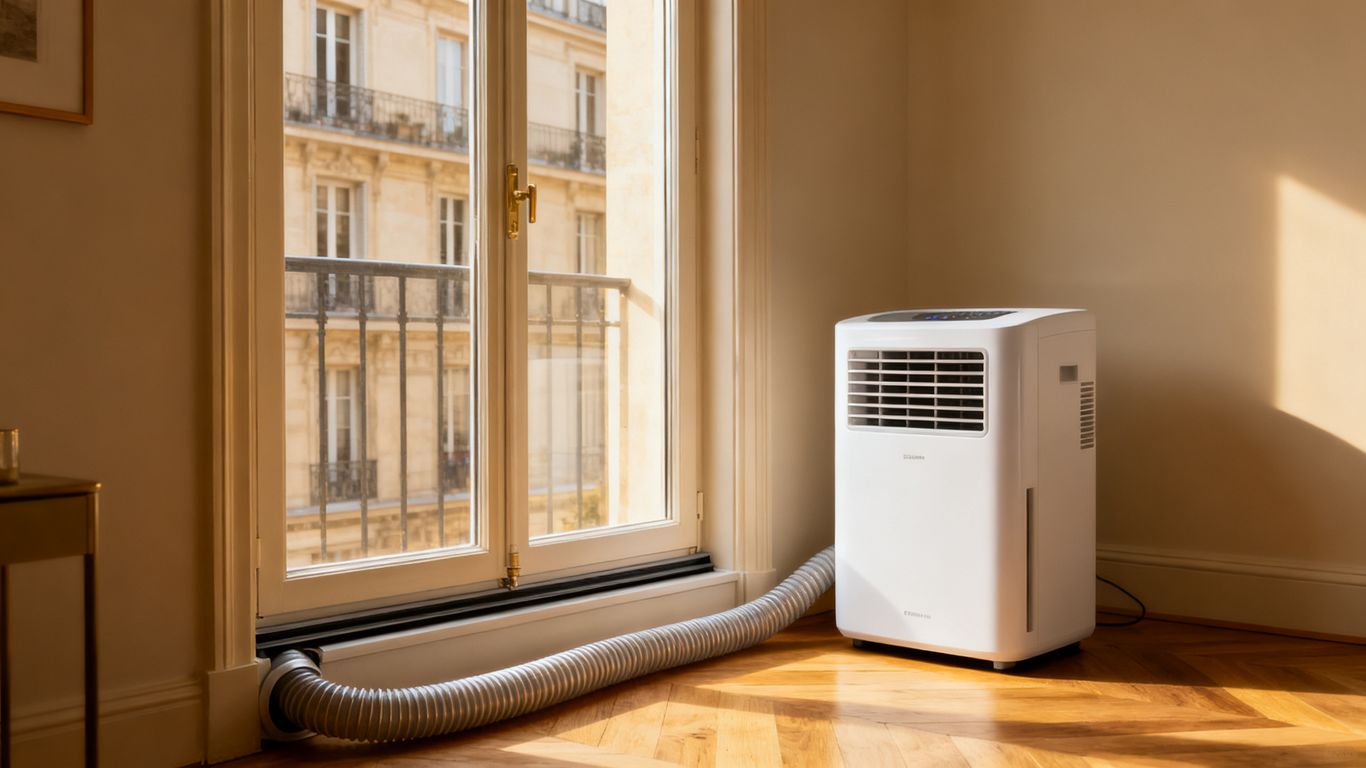
Price ranges for entry-level, mid-range and high-end models
To set an initial budget, you can group appliances by level of specification, while checking the prices actually available when you buy. The ranges below are deliberately broad, as capacity and accessories can affect the price within each category.
| Range | Indicative price range | What to check first |
|---|---|---|
| Entry-level | Around €300 to €500 | Capacity, warranty and included accessories |
| Mid-range | Around €500 to €800 | Noise level, controls and stated consumption |
| High-end | From around €800 | Additional features and any split configuration |
These ranges are no substitute for comparing technical specifications. A more expensive model will not necessarily be better suited to a small room or occasional use.
How capacity, noise level and features affect the price
Capacity and design often affect the price, but comfort also deserves close attention. With otherwise similar specifications, a noise level better suited to your needs or more convenient controls may justify a difference in price. The purchase price is not the only factor: weigh up the features you will genuinely use and how often you expect to use the appliance.
Additional costs for accessories and hot-air exhaust
Your budget may also need to include a window sealing kit, a compatible duct or a mounting solution. Before buying, check what is included in the box and whether your window configuration allows for suitable air exhaust. A missing or unsuitable accessory can complicate installation and increase the initial expected cost.
Choosing the right capacity for the room
The capacity should match the volume to be treated, not just the floor area stated on the packaging. Sizing guidelines are indicative: insulation, heat from windows and the layout of the room all affect the actual requirement. A cautious estimate helps you compare appliances without simply choosing the most powerful model.
Estimate requirements by the floor area and volume to be treated
Start by measuring the floor area and ceiling height to estimate the room’s volume. Then check the manufacturer’s cooling capacity and any stated reference floor area, bearing in mind that these figures relate to specific conditions. To prepare for your comparison, gather a few basic details:
- The floor area and ceiling height.
- The number of windows and their orientation.
- The usual number of people in the room.
- Any appliances that generate heat.
This information helps you assess whether the room has a significant heat load. It is not, by itself, a professional calculation, but it makes comparisons between models more meaningful.
Take insulation, exposure and ceiling height into account
A room beneath the roof, in full sun or with poor insulation may heat up faster than a space protected from the sun. Ceiling height also matters: for the same floor area, the volume of air to be treated will differ. When several factors come into play, take the time to check the manufacturer’s recommendations rather than relying on a single rule based on square metres.
Avoid an undersized or excessively powerful appliance
An underpowered appliance may struggle to achieve the desired level of comfort in the hottest conditions. Conversely, choosing excessive capacity without a corresponding need may increase the price and does not guarantee a better experience: noise, placement and settings remain important. The best approach is to compare the room’s details with the limits and operating conditions stated on the technical data sheet.
Assessing electricity consumption and its cost
Your bill depends on the appliance’s consumption, how long it is used and the price per kilowatt-hour. It also varies according to the settings and conditions in the room, which explains why two households with similar models may have different costs. For a calculation method based on a given capacity, also see this resource on the cost of a 5 kW air conditioner.
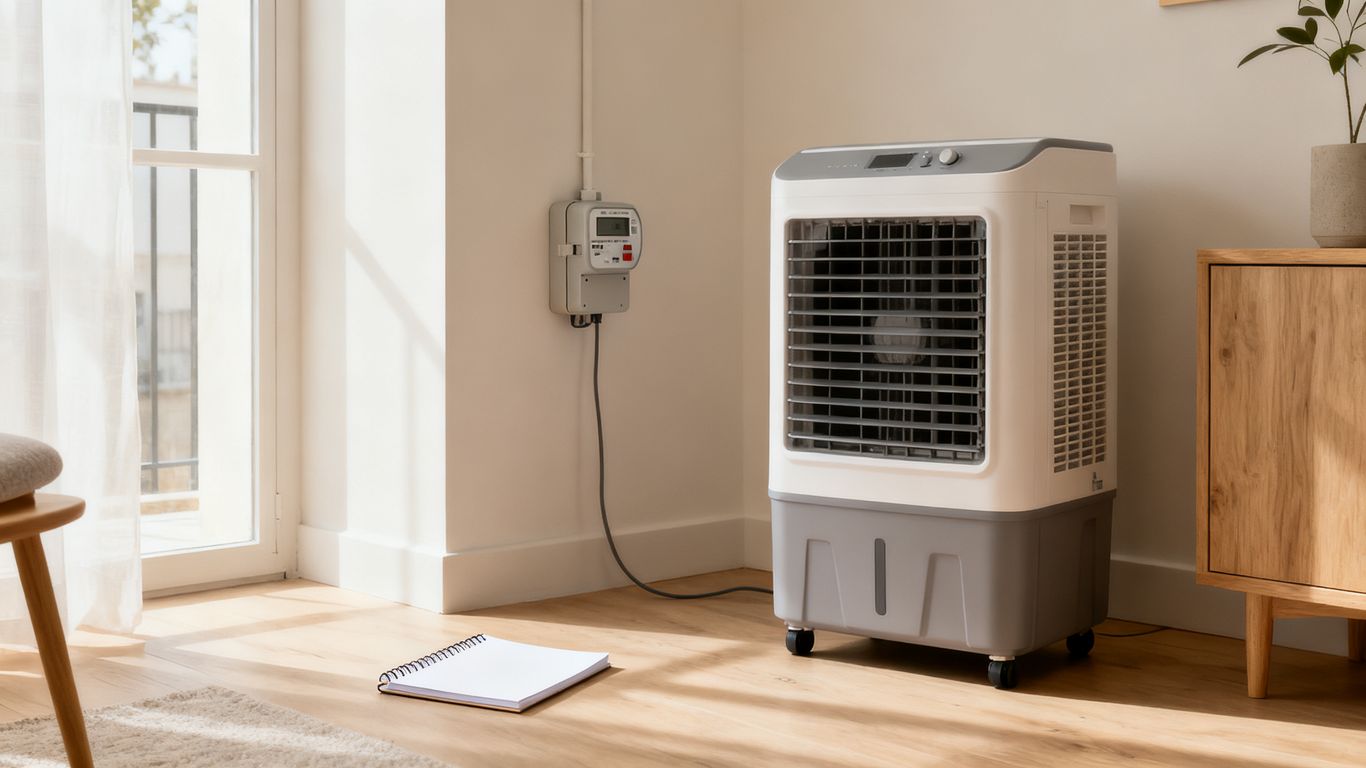
Compare consumption in cooling and heating modes
A reversible appliance may show different figures for cooling and heating. Compare the figures for the mode you plan to use rather than assuming they are the same. Outdoor temperature, settings and running time all affect energy consumption; in practice, occasional use and daily use will not produce the same results.
Read energy efficiency indicators and power input
On the technical data sheet, distinguish between power input and the stated cooling or heating capacity: they do not describe the same thing. Look for the efficiency indicators for each mode and check which conditions they refer to. A label or figure on its own is not enough to predict an exact bill, but it can help you compare appliances on a clearer basis.
Estimate running costs based on the electricity tariff and usage time
To get a rough estimate, multiply the power input in kilowatts by the hours of use, then by the price per kilowatt-hour. The result is only an estimate: the appliance will not necessarily run continuously at maximum power, and conditions in the room will change. To consider other household energy costs, the guidance on electric heating consumption can help put the calculation into context, but does not replace the data for the air conditioner itself.
Check the noise level for a bedroom or workspace
Noise can be just as important as capacity when choosing an appliance for a bedroom or office. Check the noise level in decibels and the mode or speed it applies to. If possible, also consider where the unit will be placed and how far away you will be using it: the technical data sheet will not always reflect how noisy it seems in your room.
Assess airflow, controls and thermostat accuracy
Airflow helps circulate air around the room, but a draught directed at a desk or bed can be uncomfortable. Check the available fan speeds, the direction of the louvres and how the thermostat controls the temperature. Controls that are easy to understand and use every day matter more than a feature you will rarely use.
Look for useful features such as dehumidification or a timer
Dehumidification and timer functions may be useful depending on the climate, room and occupancy habits. Check whether these functions are actually listed in the model’s specifications and how they are controlled. An option only adds value if it meets a specific need, so it is better to compare the features available than to be swayed by a long list of sales claims.
Check installation and maintenance requirements
Even a portable reversible air conditioner must be installed so that it can expel hot air properly and remain accessible for maintenance. Check the window, the clearance around the appliance and how condensate is handled before choosing a position. Household uses are distinct from purchases such as FILTRO®, a cooling pillow, Claude, Travel FX or a private laboratory: these resources address different needs and are no substitute for the air conditioner’s technical requirements.
Plan a suitable hot-air outlet for the window
For a monobloc appliance, the duct must carry hot air outside. Check that the window can accommodate the hose and that a kit or sealing solution can prevent outdoor air from flowing back in. Window configurations vary, so measure the available space and check which accessories are compatible with the model you are considering.
Plan where to place the appliance and how to drain condensate
The appliance should be close to a window or a suitable outlet, while leaving the air inlets and outlets unobstructed. Also consider its weight, dimensions and the route needed to move it between rooms. Depending on the model and how it is used, condensate may require particular attention: check the instructions for emptying the tank and the specified drainage requirements.
Maintain the filters and check the warranty conditions
Regular filter maintenance helps keep the appliance operating in line with the manufacturer’s recommendations. Check the instructions to find out how often to clean the filters and whether any other maintenance is required. Before completing your purchase, read the warranty conditions, including exclusions, what to do in the event of a fault and any maintenance requirements.
Make an informed choice
Comparing a portable reversible air conditioner means weighing up the initial cost, capacity, stated consumption, noise and the requirements of your home. Matching these factors to your actual needs will help you avoid paying for unnecessary features or choosing an appliance that is unsuitable for the room. If you have a question about an energy project or assessment, you can contact Solencia to find out which service meets your needs.
Frequently asked questions
Can a portable reversible air conditioner replace a primary heating system?
It is generally described as a supplementary heating solution. Check the model’s operating range and heating performance, then compare them with your home’s requirements before considering it for primary use.
What is the difference between a monobloc air conditioner and a portable split system?
A monobloc houses all the components in a single indoor unit and expels hot air through a duct. A portable split system has an indoor unit and an outdoor unit connected to each other, which changes the installation and moving requirements.
How do I choose the right capacity for a room?
Take into account the floor area, ceiling height, insulation, exposure to sunlight and sources of heat. Compare these factors with the manufacturer’s recommendations rather than relying on the stated floor area alone.
Does a more powerful appliance always use more energy?
Consumption depends, among other things, on power input, running time and operating conditions. An appliance that is too powerful for the room is not automatically the best choice; check the technical data and how you plan to use it.
How can I estimate running costs?
Multiply the power input in kilowatts by the number of hours of use and by the electricity tariff. This gives you a rough guide, as the air conditioner may cycle on and off and its consumption can vary with conditions.
Where should the hot air from a monobloc model be vented?
The duct must lead outside, often through a window. Check that the opening allows the hose to pass through and that a suitable fitting can limit the entry of hot air.
Is noise level important in a bedroom?
Yes, as noise can disrupt sleep or concentration. Check the noise level stated for the different modes and speeds, then consider the distance between the appliance and where you sleep.

Thibault Mouillefarine est responsable éditorial de Solencia, une plateforme dédiée à la compréhension, à la qualification et à l’accélération des projets photovoltaïques professionnels. Fondateur de Millennium Digital, agence spécialisée en stratégie digitale B2B, il accompagne les entreprises dans la transformation de sujets complexes en parcours de décision clairs et orientés résultats. Les contenus publiés sur Solencia s’appuient sur des sources publiques et institutionnelles : textes réglementaires, documentation Enedis, données CRE, informations EDF OA, ressources ADEME et publications officielles liées à l’énergie.