Solar canopies are transforming our car parks into power stations. It’s an idea that’s gaining traction, especially with new laws pushing for the installation of these on large commercial sites. Beyond the obligation, it’s a real opportunity to produce green energy. But how does it work, how much does it cost, and is it really profitable? Let’s take a closer look.
Key takeaways
- A solar canopy is a structure that covers parking spaces while producing electricity thanks to solar panels.
- The Climate and Resilience Law requires the installation of canopies on car parks larger than 1500 m² from 2026.
- The cost of a canopy varies, but it is generally between €1,000 and €2,000 per kWp, with economies of scale for large installations.
- Profitability depends on self-consumption, electricity resale, and available aid, with a return on investment often estimated between 8 and 15 years.
- Several financial aids exist, such as the self-consumption bonus and guaranteed feed-in tariffs, not to mention potential support from local authorities.
Understanding the Photovoltaic Solar Canopy
Definition and operating principle
A photovoltaic solar canopy, often called a solar carport, is a structure designed to cover spaces, typically car parks, while integrating solar panels on its roof. Its primary role is twofold: to provide shelter and produce green electricity. The principle is simple: sunlight hits the photovoltaic panels, which convert it into direct current electricity. This current is then converted into alternating current by an inverter to be consumed on-site or fed into the electrical grid. It’s a clever way to transform an often underutilised area into a source of renewable energy.
Different types of solar canopies
There are several types of canopies to suit various needs and configurations:
- Linear canopies: Ideal for large areas, they form continuous rows over multiple parking spaces.
- Single or double carports: More compact, they are suitable for one or two vehicles, perfect for small businesses or residences.
- Double-pitched (V-shaped) canopies: This design promotes water drainage and can optimise production by orienting panels east and west.
- Single-pitched canopies: A structure inclined in one direction, often simpler and more economical to install.
- Architectural canopies: Custom-designed, they can incorporate specific shapes to harmonise with the built environment.
Multiple benefits of the photovoltaic canopy
Installing a solar canopy offers numerous benefits. Firstly, it protects vehicles from adverse weather conditions (sun, rain, hail) and reduces interior temperature in summer. In terms of energy, it generates renewable electricity, thus helping to reduce carbon footprint and electricity bills. It’s also a way to add value to a space like a car park, transforming it into a productive area. Furthermore, it can integrate perfectly with electric vehicle charging, creating an interesting synergy for sustainable mobility. Finally, it contributes to improving the living environment by creating shaded areas and combating urban heat islands.
The photovoltaic canopy represents a versatile technical solution that combines protection, energy production, and space enhancement. Its deployment addresses growing environmental and economic challenges.
The regulatory framework for solar canopies
The implementation of photovoltaic canopies is not just a strategic decision for companies or local authorities; it is now governed by precise legal obligations. The Climate and Resilience Law, enacted in August 2021, marked a turning point by introducing requirements for the solarisation of car parks.
The obligation stemming from the Climate and Resilience Law
Article 101 of this law, integrated into the Urban Planning Code, stipulates that outdoor car parks of certain dimensions must incorporate renewable energy production systems. In practical terms, this means that the managers of affected car parks must equip a portion of their surface area with photovoltaic canopies. The objective is to transform these often underutilised spaces into sources of green energy.
Affected areas and exemption criteria
The regulatory framework, clarified by subsequent decrees, clearly defines the application thresholds. The obligation applies to outdoor car parks with a surface area exceeding 1,500 square metres. It is important to note that the surface area taken into account includes parking spaces and circulation routes, but excludes green spaces or storage areas. Exemption criteria exist, allowing for derogation from this obligation in specific cases, for example, if the installation presents insurmountable technical or safety constraints. The APER Law (Acceleration of Renewable Energy Production) has also clarified these obligations, particularly for buildings over 500 m² associated with an outdoor car park over 500 m², requiring shading over 50% of the car park’s surface.
Pooling of obligations and potential penalties
For owners or managers with multiple sites, the law provides for the possibility of pooling obligations. This allows the required objectives to be met across all their car parks, even if each individual site does not directly meet the criteria. However, non-compliance with these obligations can lead to financial penalties. Decree No. 2024-1023 of 13 November 2024 provides clarifications on these arrangements, particularly concerning the effective dates and application conditions for existing car parks or those for which planning applications were submitted after a certain date. It is therefore essential to stay informed of legislative developments to ensure the compliance of your installation with the Climate and Resilience Law.
The regulations are evolving to encourage the integration of photovoltaics on already built-upon surfaces, such as car parks. This is an initiative aimed at reconciling energy needs with environmental preservation and improving the living environment.
Cost of a solar canopy installation
Cost estimate per kilowatt-peak (kWp)
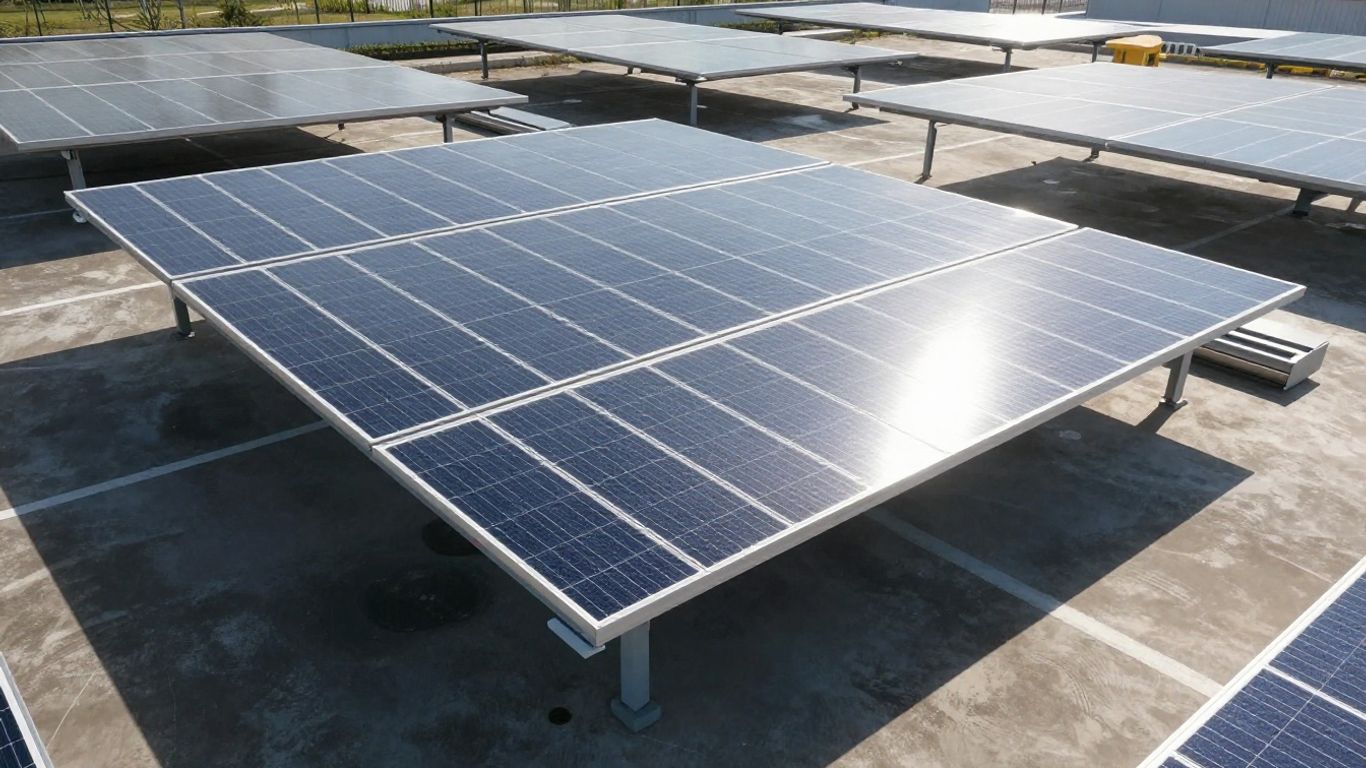
The cost of a photovoltaic solar canopy is often measured in euros per kilowatt-peak (kWp). This unit allows for price comparison between different installations, regardless of their total size. Generally, for a car park canopy installation, the cost falls within the range of €1,000 to €2,000 per kWp installed. It is important to note that this price generally includes the supporting structure, solar panels, inverters, cabling, as well as installation and associated administrative procedures. Large installations, thanks to economies of scale, can see their cost per kWp decrease, sometimes down to €900/kWp following competitive tenders.
Cost variations according to surface area and power
The surface area covered by the canopy and the total installed power are determining factors in the overall cost. The larger the area and the higher the power, the higher the total cost, but the cost per square metre or per kWp tends to decrease. For example, a 100 kWp installation over 1,000 m² could cost between €120,000 and €140,000, which is a cost per kWp of €1,200 to €1,400. For a 1,000 kWp installation covering 10,000 m², the total cost could range from €1.1 to €1.3 million, maintaining a similar, or even slightly lower, cost per kWp thanks to economies of scale.
Here is an estimated cost breakdown by power output:
| Power (kWp) | Estimated surface area (m²) | Estimated cost (€) | Cost per kWp (€) |
|---|---|---|---|
| 10 | 100 | 16,000 – 20,000 | 1,600 – 2,000 |
| 100 | 1,000 | 120,000 – 140,000 | 1,200 – 1,400 |
| 500 | 5,000 | 550,000 – 650,000 | 1,100 – 1,300 |
| 1,000 | 10,000 | 1,100,000 – 1,300,000 | 1,100 – 1,300 |
Note: The m²/kWp ratio is based on 400-500 Wp modules.
Factors influencing the price of a canopy
Several elements can affect the price of a solar canopy installation. The complexity of the structure, the type of foundations required depending on the soil, and specific technical constraints of the site (such as wind or snow resistance) are important factors. The choice of equipment also plays a role: high-efficiency photovoltaic modules, specific mounting systems, or the addition of energy storage solutions (batteries) will increase the initial cost. Furthermore, site costs, including labour, lifting equipment, safety measures, and cleaning, must be taken into account. Preliminary technical studies, such as a structural survey or a soil study, can also represent an additional budget, ranging from €1,000 to €5,000 depending on the complexity.
The cost of a photovoltaic canopy is a sum of several components: materials (panels, inverters, structure), installation, administrative procedures, and potentially site-specific technical studies. It is therefore essential to obtain detailed quotes to fully understand the breakdown of these costs.
Connection costs to the electrical grid, which can vary, must also be considered. For high-power installations, the addition of a transformer or the construction of a technical room may be necessary, impacting the final budget. Geographical location can also influence prices, with costs sometimes being higher in certain regions. Obtaining multiple quotes for your solar car park project is therefore a key step in comparing offers and ensuring a fair price.
Profitability and return on investment
Calculating the profitability of a canopy
Evaluating the profitability of a photovoltaic solar canopy involves looking beyond the simple installation cost. It requires considering the revenue generated by electricity production and the savings achieved. Generally, the investment cost for a canopy is around €1,200 per kilowatt-peak (kWp). Given that 1 kWp can produce approximately 1,200 kWh per year, the potential annual revenue can reach around €102 per kWp, before deducting operating and maintenance costs. A careful analysis of financial flows over the installation’s lifespan is therefore essential.
Equipment lifespan and investment sustainability
Photovoltaic modules are designed to last. Their average lifespan is 25 years, but it is not uncommon for them to continue producing electricity satisfactorily for 30 or even 40 years. This longevity provides a certain sustainability to the investment. Although the canopy structure may require a longer depreciation period than the panels themselves, the overall lifespan of the installation ensures a potentially very attractive long-term return on investment. It is important to take this longevity into account when evaluating the project’s financial viability to better understand profitability.
Comparison between self-consumption and total resale
Two main economic models are available for valorising the electricity produced by your canopy: self-consumption and total resale. Self-consumption allows you to reduce your electricity bills by directly consuming the energy produced, offering immediate savings and stable energy costs. Total resale, on the other hand, involves selling all production to the grid, generating direct income. The choice between these two options, or a combination of both (selling surplus), will depend on your energy needs, current feed-in tariffs, and your financial strategy. Each model offers specific advantages in terms of return on investment.
Here is a simplified comparison of the two approaches:
- Self-consumption:
- Direct reduction of electricity costs.
- Increased energy independence.
- Less direct revenue, but substantial savings.
- Total resale:
- Regular financial income guaranteed by purchase agreements.
- Less direct savings on the electricity bill.
- Dependence on fixed feed-in tariffs.
The choice of economic model must be carefully considered based on the objectives of the company or local authority. It is often wise to conduct a pre-feasibility study to determine the most advantageous strategy.
Financial aid and available subsidies
The self-consumption bonus
To encourage the installation of solar panels, a self-consumption bonus is offered. It is aimed at installations with a power output of 100 kWp or less. This bonus is paid over a period of five years. Its amount depends on the size of your solar project. For example, for an installation up to 3 kWp, the bonus is €0.08 per Watt-peak (Wp). For installations between 36 and 100 kWp, this amount is €0.16/Wp. It is important to note that this aid is available without income conditions, making it accessible for a wide range of projects. You can find more details on eligibility criteria and exact amounts on dedicated websites for solar installation aid in 2026.
Feed-in tariffs for electricity produced
If your solar canopy feeds surplus electricity produced into the public grid, you can benefit from guaranteed feed-in tariffs. These tariffs are set by the Energy Regulatory Commission (CRE) and vary depending on the power of your installation and whether you sell all your production or only the surplus. For example, for a 36 kWp installation, the feed-in tariff for total resale is 10.49 c€/kWh, while for selling surplus, it is 6.17 c€/kWh. It should be noted that from the end of 2025, installations between 100 and 500 kWp can no longer benefit from the fixed feed-in tariff from the open access point and must go through simplified tenders, except for non-interconnected areas.
Support from local authorities
In addition to national aid, local authorities (regions, departments, municipalities) may offer additional support schemes. This aid can take various forms: direct subsidies, zero-interest loans, local tax exemptions, or technical support. It is therefore advisable to inquire with your local council, departmental, or regional council to find out about specific schemes in your area. This local aid can sometimes advantageously complement national bonuses and feed-in tariffs, thereby optimising the overall profitability of your solar canopy project.
Technical design and sizing
The importance of a preliminary feasibility study
Before laying the first stone, a thorough analysis is essential. This preliminary study, often carried out by a specialised engineering firm, identifies all technical and financial aspects of the project. It assesses the soil’s load-bearing capacity, constraints related to the Local Urban Plan (PLU), the site’s sunlight exposure to optimise panel orientation and tilt, and, of course, the feasibility of connecting to the electrical grid. Ignoring this step risks costly surprises later on. A soil study, for example, is fundamental in determining the most suitable type of foundations, especially if the ground has particular characteristics. Similarly, checking local planning regulations helps avoid unforeseen administrative blockages. A good feasibility study can cost between €1,000 and €2,500, but it is an investment that protects the project’s overall budget.
Structural sizing constraints
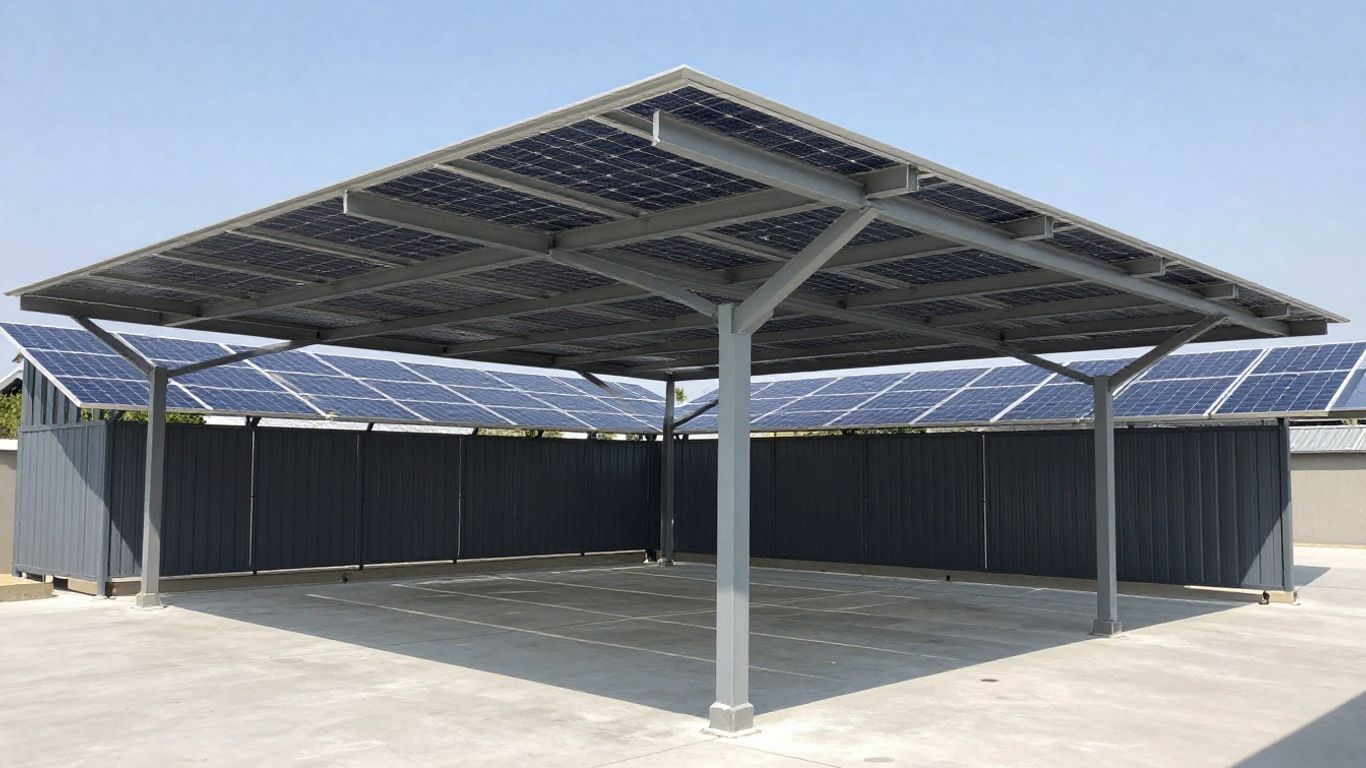
The canopy structure must be designed to withstand natural forces. Calculations must be based on current standards, such as Eurocodes, to ensure safety. Wind loads are often the determining factor, which can reach considerable speeds depending on the region. The weight of snow in winter, which can be very significant in mountainous areas, must also be considered. The height under the canopy is also a point not to be overlooked; a minimum height of 2.50 metres is generally required, but 3 metres is preferable for utility vehicles. The spacing between posts, which can vary from 5 to 7 metres, directly influences the cost of the structure. A well-thought-out design allows for covering multiple parking spaces per bay, thus optimising space and cost.
Optimising photovoltaic sizing
Once the structure is defined, the photovoltaic power to be installed must be determined. For a standard parking space, the aim is generally between 1.5 and 2 kWp. This translates to installing 3 to 4 solar panels, depending on their individual power (often between 400 and 500 Wp). The tilt angle of the panels is another key parameter: a slight slope, between 5° and 15°, is often recommended. It facilitates rainwater drainage and reduces soiling, while maintaining good production. Although a south-facing orientation is ideal, south-east or south-west orientations remain very efficient, with a production loss often less than 10%. It is important to note that sizing is more logically done in peak power (kWp) than in surface area, as revenues are directly linked to installed power. The cost per Watt-peak (€/Wp) is a key indicator for comparing installer quotes. For example, for a 2500 m² car park, covering 50% of its surface area (i.e., 1250 m²), an installation of around 90 kWp can be considered, capable of producing around 108,000 kWh per year in the south of France. Galvanised steel structures are the most common due to their good value for money and durability, but aluminium or glued laminated timber are also interesting options depending on the budget and desired aesthetics. The waterproofing of the system is a critical point not to be overlooked, requiring a well-designed gutter and downpipe system from the outset. For large installations, administrative procedures, such as building permits, and potentially an environmental impact study [4d8f] must also be planned.
Key steps for installing a canopy
The installation of a photovoltaic solar canopy is a project that requires rigorous planning and adherence to several administrative and technical steps. To successfully complete this type of installation, it is essential to follow a structured process to ensure the compliance, safety, and performance of the entire system.
Administrative procedures and authorisations
First and foremost, it is imperative to ascertain the necessary authorisations. Depending on the size of the installation and the project’s location, a building permit or a prior declaration of works may be required. These procedures are carried out with the local council of the municipality concerned. It is also necessary to verify the project’s compliance with the Local Urban Plan (PLU) and ensure that there are no specific easements that could hinder the installation. A preliminary feasibility study is a crucial step in anticipating these administrative and technical constraints.
Connection to the electrical grid
Once authorisations are obtained and the structure is installed, connecting the installation to the public electrical grid is a major technical step. This operation is generally entrusted to the distribution network operator (Enedis in France). A connection request must be submitted, providing the technical specifications of the installation. The network operator will assess feasibility and propose a quote for the connection works. The power of the installation and the configuration of the local grid will influence the complexity and cost of this step. It is important to allow sufficient time for this procedure, which can sometimes take several months.
Selecting a qualified installer
Choosing the right professional is crucial for the success of your project. It is recommended to use RGE (Reconnu Garant de l’Environnement – Recognised Environmental Guarantor) certified companies, particularly to benefit from financial aid. A qualified installer will be able to carry out an in-depth technical study, propose a solution tailored to your needs, and guarantee an installation in compliance with safety standards. Request multiple detailed quotes to compare offers, warranties, and intervention times. Do not hesitate to consult the company’s previous projects and gather customer reviews. The quality of the installation will directly impact the performance and longevity of your solar canopy.
Application areas for solar canopies
Company car parks and industrial sites
Solar canopies are particularly relevant for company car parks and industrial sites. These vast parking areas, often underutilised, become spaces for renewable energy production. The Climate and Resilience Law now imposes requirements on car parks larger than 1,500 m², obliging them to cover a significant portion of their surface with photovoltaic systems. This transforms these areas into environmental and economic assets. Installing canopies on these sites not only ensures compliance with regulations but also offers appreciable comfort to employees and visitors thanks to the shade provided, thus reducing vehicle temperatures. Furthermore, the electricity produced can be used for self-consumption, powering the site’s energy needs, or resold, generating additional revenue. It is an effective way to add value to existing space while contributing to the energy transition. Companies can thus improve their brand image and reduce their carbon footprint. Solar canopies for car parks are therefore a win-win solution.
Agricultural and wine-growing operations
The agricultural sector, whether farms or vineyards, represents another promising application area for solar canopies. These structures can be installed over storage areas for equipment, farmyards, or even over certain sensitive crops requiring partial shading. They allow for the production of green electricity while protecting equipment or harvests from bad weather and excessive sun. Self-consumption of this energy can significantly reduce operating costs, particularly for water pumping, lighting, or machinery operation. Integrating solar panels onto existing or new structures allows for the valorisation of agricultural land without encroaching on arable land. This approach is part of a sustainable development and energy autonomy strategy for the agricultural world.
Public buildings and local authorities
Public buildings and local authorities have a key role to play in the adoption of renewable energies, and solar canopies fit perfectly into this dynamic. Car parks at town halls, schools, hospitals, sports centres, or administrative buildings can be equipped with these structures. Beyond the regulatory obligation for large car parks, these installations allow local authorities to set an example in terms of ecological transition. The electricity produced can power public buildings themselves, thereby reducing local authorities’ energy expenditure, or be made available to citizens through collective self-consumption schemes. The shade provided on public car parks improves user comfort, which is particularly appreciated during heatwaves. Solarhona offers solutions tailored to the specific needs of local authorities, contributing to both local energy production and the improvement of the living environment.
Installing solar canopies on already built-upon spaces like car parks is a key strategy for accelerating the deployment of renewable energies without consuming new land. It addresses multiple challenges: electricity production, reduction of heat islands, vehicle protection, and regulatory compliance.
Solar canopies are super practical! They protect from the sun and produce electricity at the same time. They can be installed anywhere: over car parks, schoolyards, or even over certain crops. It’s a smart way to use space and save energy. Want to know how it works for you? Visit our website to learn more!
Conclusion: A solar future for our car parks
In summary, photovoltaic canopies represent much more than just a trend. They are establishing themselves as a concrete and advantageous solution, meeting both environmental imperatives and practical needs. Between vehicle protection, green energy production, and space valorisation, the benefits are numerous. Regulations are evolving to encourage their deployment, making this investment increasingly relevant. Although initial costs may seem significant, long-term profitability, supported by aid and the lifespan of the installations, makes it a serious option for many stakeholders, from businesses to local authorities. It’s time to consider our car parks in a new light: that of renewable energy production.
Frequently Asked Questions
What exactly is a solar canopy?
A solar canopy is like a large, special roof for car parks. It’s designed to shelter cars from the sun and rain, but it also has solar panels on top to generate clean electricity. It’s a structure that provides protection and produces energy at the same time.
Why does the law require the installation of these canopies?
The law wants us to use more clean energy to protect the planet. Since car parks are large, often sunny areas, the law requires solar panels to be installed there to produce green electricity. It’s a way to transform surfaces that heat up the ground into energy production sites.
How much does it cost to install a solar canopy, approximately?
The price can vary quite a bit. For each square metre covered, it can cost between €110 and €160, roughly. If we look at the power of the panels, it’s around €1,000 to €2,000 for each unit of power (called kWp). The larger the installation, the less it costs per unit.
Is it worth investing in a solar canopy?
Yes, it can be very profitable! Generally, you get your money back in 8 to 15 years, and canopies can last over 30 years. If you use the electricity produced for yourself (self-consumption), you save money on your bill straight away. Otherwise, you can also sell the electricity produced.
What aid can be obtained to finance a solar canopy?
There are several types of aid. There’s a bonus for those who use the electricity they produce themselves (self-consumption). You can also sell the electricity produced at a government-set price for 20 years. Sometimes, regions or local councils also offer additional aid.
How long does it take to install a canopy?
First, you need to handle the paperwork and get authorisations, which can take 6 months to a year. Then, the construction work itself usually takes between 2 and 6 months, depending on the size of the car park. The work can be done in stages so that cars can still park.
What is the lifespan of solar panels and the structure?
The metal structures of canopies are robust and can last 30 to 40 years. Solar panels produce electricity for 25 to 30 years, and they are often guaranteed to produce at least 80% of their initial capacity after 25 years. The device that converts the current (the inverter) may need to be replaced once during this period.
Can a canopy be installed in any car park?
The law mainly applies to large car parks over 1500 m². There are a few cases where you can be exempt, for example, if the car park is already very green or if there are specific technical reasons. For smaller car parks, you can also install them, but it’s not mandatory.

Journaliste spécialisée en transition énergétique et consultante RSE. À 42 ans, Claire combine une formation en journalisme (Master Sciences Po) et un diplôme d’ingénierie environnementale (École des Mines / INSA). Après 10 ans dans la presse économique et 7 ans en cabinet de conseil RSE, elle écrit pour aider les décideurs B2B à comprendre les réglementations, les enjeux climatiques et les innovations énergétiques.