Key points
Effective cleaning starts with observation: the condition of the modules, their surroundings and access conditions matter just as much as the cleaning itself. If you are unsure about safety or a stubborn deposit, it is better to stop than risk damaging the installation.
- Clean when persistent deposits or a drop in output make it necessary.
- Check the manufacturer’s instructions and work on cool modules.
- Use clean water, a soft brush and low-pressure rinsing.
- Avoid household cleaning products, dry scrubbing and dangerous access.
- Call in a professional if deposits or the roof pose a risk.
Why and how often to clean a solar panel
An exposed panel can accumulate dust, pollen, leaves or bird droppings, but not every mark calls for immediate action. Rain can wash away some particles, but may not remove deposits that adhere to the glass. The right frequency therefore depends mainly on what is around the installation and what its condition and output indicate. For further practical guidance, also see these tips for cleaning panels.
Identify dirt that could reduce output
Inspect the modules from a safe place and look for deposits that remain visible after rain: accumulated dust, pollen, mud marks, bird droppings or stuck leaves. A single mark does not necessarily indicate a significant problem, but extensive or persistent dirt deserves more attention. Bear in mind that shading, the weather or an electrical fault could also explain a drop in output. Cleaning is therefore just one possibility among others.
Distinguish surface dust from stubborn deposits
A light, even film behaves differently from dried bird droppings or a sticky deposit. The former may sometimes be washed away by sufficient rain, while localised dirt may remain. To avoid unnecessary scrubbing, check how extensive the marks are and where they are located. If they do not come off with a gentle rinse, wet them and let the water soften them rather than trying to remove them dry.
Adjust cleaning frequency to the surroundings and weather
Dust, pollen, nearby trees or birds can cause deposits to build up more frequently. After a particularly dusty spell or leaf fall, a visual check can help you decide whether to act. There is no single schedule that suits every roof: the climate, tilt and manufacturer’s instructions all matter. A guide on when to clean panels also offers guidance on assessing frequency.
Check output before deciding whether to act
If output seems to be falling, compare it with your usual readings, taking account of changes in sunshine and season. A persistent difference, with no obvious change in the weather, is a reason to investigate the cause rather than immediately assume the panels are dirty. This approach avoids unnecessary cleaning and can help identify another problem. For installations designed for particular conditions, Integra’s commercial solar design services illustrate the importance of adapting a project to its context, without making assumptions about the cause of a drop in output.
Assess the risks before you start
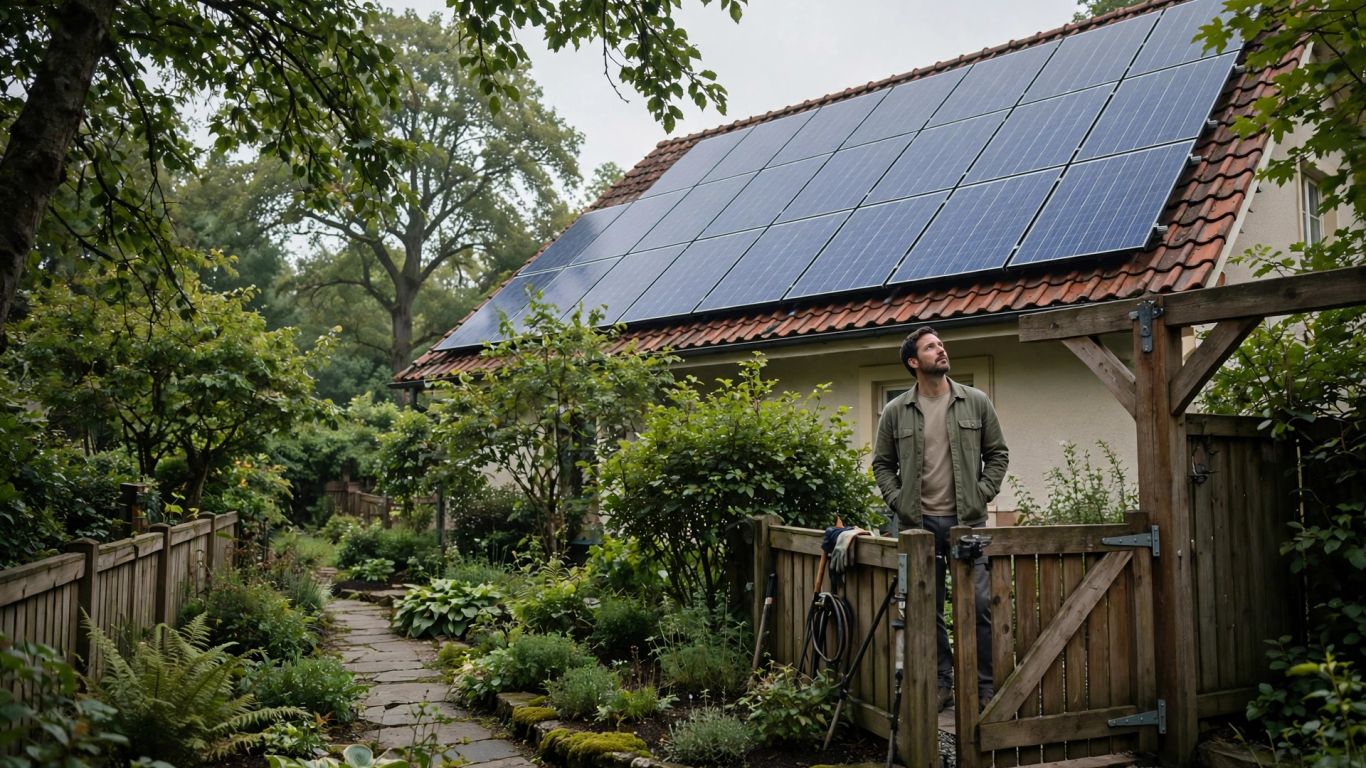
Cleaning should not turn routine maintenance into a dangerous job. Before getting your equipment out, check the recommendations for your modules, the weather and whether you can work from a stable position. A high, slippery or fragile roof changes the decision completely: in such cases, the work may need to be carried out by a suitably equipped professional. Safety comes before any potential benefit from cleaning straight away.
Check the manufacturer’s instructions
The instructions supplied with the modules are the first point of reference for maintenance precautions, products to avoid and actions to steer clear of. They may vary depending on the materials and design of the installation, so do not rely solely on a method you have read elsewhere. If the document is no longer available, ask the installer or manufacturer for advice before using an unusual product or tool. The requirements for the building and roof should also be taken into account, as this guide to rooftop installation requirements points out.
Choose a time when the modules are cool
Choose a cool time, for example early in the morning or when the panels are in the shade. Cold water on a very hot surface can cause a sudden temperature change, while direct sunshine speeds up drying and can leave marks. Waiting for the modules to cool is a simple precaution, even though the work must still comply with the manufacturer’s instructions. Cleaning is never so urgent that it justifies working in poor conditions.
Do not climb on the panels or an unsafe roof
Never walk on the modules: their surface is not designed as a walkway and concentrated pressure can damage them. A roof may also be fragile, sloping or slippery, even if it looks accessible from the ground. Companies working on commercial sites must also factor these risks into their procedures, with measures suited to site rules and environmental compliance practices. These guidelines do not replace a safety assessment for each job.
Do not clean in windy, icy or stormy weather
Wind can throw someone off balance, move a pole or make it harder to control the water. Ice makes surfaces more slippery, and an approaching storm means outdoor work should be postponed. In practice, a quick check before starting can prevent you from getting into a situation that is worsening. If conditions are unsuitable, simply wait for a safer spell of weather.
Choose equipment suitable for the modules
Gentle maintenance generally does not require complex equipment. The safest choice is to use clean, non-abrasive accessories that are suitable for the installation and comply with its instructions. Do not improvise with equipment designed to strip or clean another type of surface. For these recommendations alongside other maintenance tasks, you can consult this page on solar panel maintenance.
Use clean water with low mineral content or demineralised water
Use clean water, ideally with low mineral content or demineralised water if this is recommended for your modules. Water with a high mineral content can leave marks as it dries, especially when the surface dries quickly. You do not need to add a product for an effective rinse. The choice between demineralised water and detergent is also discussed in this guide to water and cleaning products.
Use a soft brush or a non-abrasive sponge
A soft-bristled brush or a clean, non-abrasive sponge can be used to treat a mark after wetting it. Check that no grains of sand or debris are trapped in the fibres, as they could scratch the glass as you work. Do not press hard, and stop if the dirt does not come off. The aim is to remove the deposits without scrubbing, not to polish the surface.
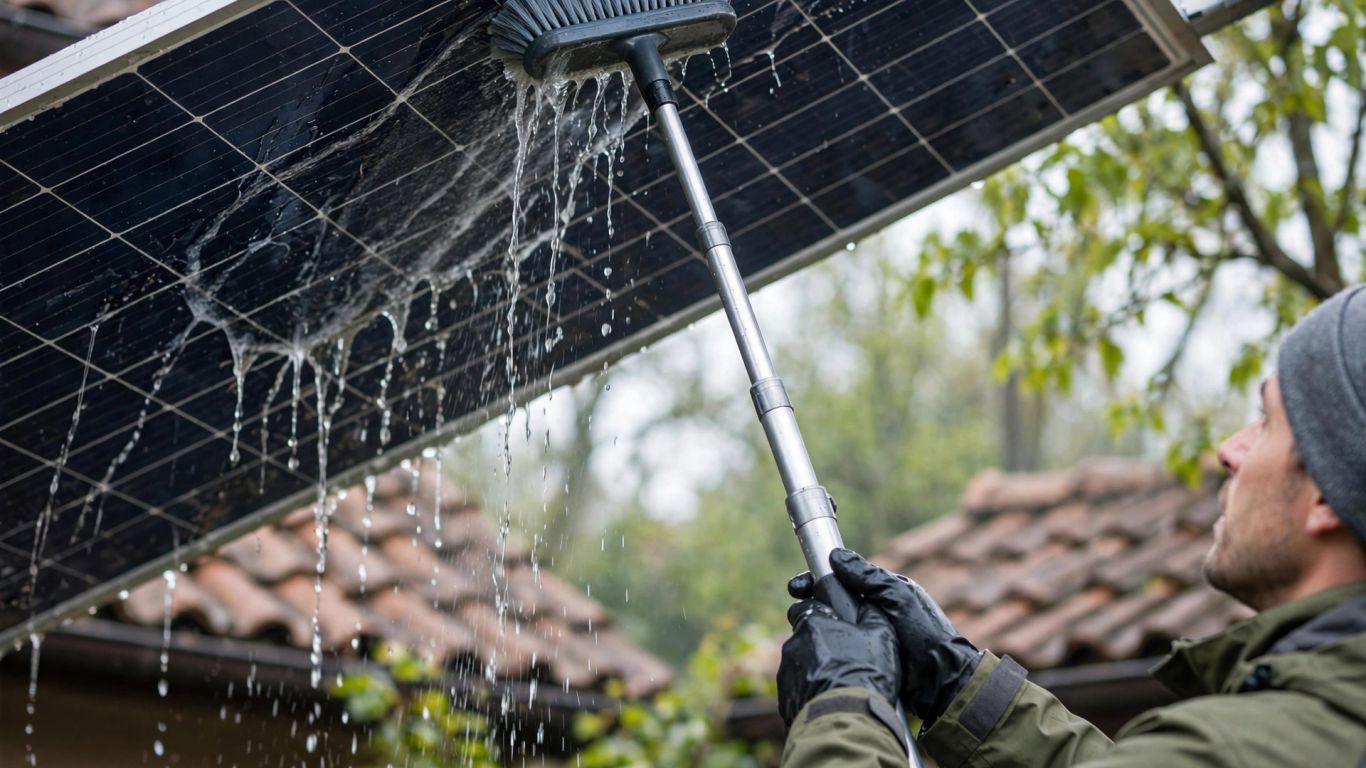
Use a telescopic pole to work from the ground
When the modules can be reached from the ground, a suitable pole may allow you to access them without climbing onto the roof. Choose a stable accessory that works with a soft brush and is easy enough to handle to control your movements. However, a long pole does not automatically make the job safe: avoid power lines, obstacles and any unstable position. If access is still difficult, do not try to compensate by leaning out or working from a poorly positioned ladder.
Avoid pressure washers and metal tools
A powerful jet can put unsuitable pressure on the modules, their seals or nearby components. Scrapers, blades and wire brushes can scratch the glass and are not suitable for photovoltaic panels. The same caution applies to accessories whose material or condition is uncertain. Moderate rinsing and gentle manual cleaning are sufficient for ordinary dirt.
Clean solar panels without damaging them
Once you have assessed the risks and prepared your equipment, work slowly and do not try to clean the entire roof in one go. Rinsing and cleaning small areas at a time help you stay in control. Gentle contact matters more than the force applied. If a mark does not come off easily, wet it again or stop the job.
Remove loose debris without dry scrubbing
Start by inspecting the debris and remove only what can be cleared without scraping. Dry scrubbing can drag abrasive particles across the glass, particularly when dust or sand has settled on it. If something is stuck, wet the area and let the water work for a few moments. It is better to make several gentle passes than to scrub with a tool.
Rinse gently with water, without a powerful jet
A gentle rinse loosens loose particles before you use a brush or sponge. Direct the water without excessive pressure and avoid concentrated jets on seals or connections. A cautious approach limits uncontrolled splashing and lets you check the surface condition gradually. For a simple sequence, proceed as follows:
- Check that the modules are cool and that access is safe.
- Wet the surface with clean water at low pressure.
- Use a soft accessory only on persistent deposits.
- Rinse again and check the result without scrubbing.
This approach starts with the least abrasive action and lets you stop as soon as the dirt has been removed. It does not replace the manufacturer’s instructions, which take precedence if they are more restrictive.
Clean small areas at a time with a gentle touch
Divide the surface into manageable areas rather than wetting the whole installation at once. Use the brush or sponge without pressing, then rinse before the water dries if conditions are likely to leave marks. This method also helps you spot a crack, an unusual deposit or an area that does not react like the others. If you notice an irregularity, stop cleaning instead of treating it as ordinary dirt.
Allow to dry naturally or use a soft squeegee
Natural drying is suitable when the water used will not leave residue and the weather is favourable. If a squeegee is needed, choose a clean, soft model suitable for the surface and use it without excessive pressure. Avoid sudden movements and accessories with worn edges. A final visual check is usually sufficient: there is no need to keep going until the surface looks perfectly uniform if it is clean.
Deal carefully with particular types of dirt
Some marks require more patience than a layer of dust. In such cases, the first step is to soften them with water, then assess whether they can be removed without force. Do not try to save time by using a stripping product or a rigid tool. The following guidance can help you distinguish straightforward situations from those that call for outside help.
Remove bird droppings after wetting them
Wet the bird droppings and let the water work before trying to remove them with a sponge or soft brush. A dry mark can be hard and may scratch the glass if rubbed straight away. Rinse again rather than scraping, and wear gloves if you need to handle it. If the deposit does not come off without effort, stop and ask for advice.
Clear leaves and branches without scraping the glass
Remove accessible leaves by hand or with a soft accessory, without dragging them across the surface. Do not pull at a branch trapped under a component or near a cable without checking: it could dislodge a part or damage a connection. Take particular care with debris that has built up along the edge of the modules. If removing it means climbing onto a dangerous roof, leave the task to a professional.
Avoid harsh products on greasy or sticky marks
Solvents, abrasive powders, household detergents and products not intended for modules may leave residue or damage the materials. A greasy mark does not automatically justify using a stronger product. Start with water and a soft tool, then check the manufacturer’s recommendations. If the mark persists, it is better to get appropriate advice than to keep trying different things.
Call in a professional for deposits in hard-to-reach places
A deposit near the ridge, behind an obstacle or on a hard-to-reach part of the roof can make cleaning dangerous. Access must be assessed separately from how difficult the dirt appears to be to remove. Home renovation work also involves specific decisions about the condition of the property and the choice of contractors; this renovation planning guide is about a different subject, but serves as a reminder of the value of organising work methodically. For work at height, contact a qualified professional.
Avoid common mistakes and know when to delegate
Damage is not caused only by using the wrong tool: an excessively hot surface, too much pressure or ignoring an irregularity can also cause problems. Before and after cleaning, inspect the modules without touching electrical components. If you spot a fault, do not try to repair it during maintenance. Clean glass and correct electrical operation are two separate matters.
Do not clean a hot module with cold water
The difference between the temperature of the module and the water can cause thermal shock. Instead, choose a cool time and postpone the job if the panels have been strongly heated by the sun. Waiting also reduces the risk of the water drying too quickly and leaving marks. There is no advantage to working at the hottest time of day.
Do not apply detergent, wax or household cleaning products
Household cleaning products can leave a film, alter the appearance of the surface or be incompatible with the materials. Wax has no place in routine cleaning, nor does detergent chosen without checking the manufacturer’s recommendations. To remove ordinary dirt, use water and a soft accessory. Do not add a product as a matter of course.
Look out for cracks, leaks and damaged cables
While inspecting the modules, look for a crack, a displaced component, a mark that could indicate a leak or a visibly damaged cable. Do not touch a cable or try to dismantle a module. If you spot a fault, stop cleaning and have the installation assessed by a qualified professional. A page on common solar panel faults can help you recognise types of fault, but does not replace an on-site diagnosis.
Ask a professional to do the work if access is risky
A steep roof, unstable support or hard-to-reach area are all good reasons to delegate the job. A professional can assess the working conditions and use appropriate equipment, although this does not mean that cleaning is necessarily required. If you would like a particular situation assessed, you can also get in touch to discuss your enquiry. In all cases, safety comes before immediate maintenance.
Key takeaways
Solar panel cleaning should be a measured task: inspect first, choose a gentle method and only proceed when conditions are safe. Clean water, non-abrasive accessories and following the manufacturer’s instructions can prevent many unnecessary actions; if you find a fault or access is risky, stop and call in a professional.
Ask for tailored advice
To discuss your situation and be directed to the right person, contact Solencia via its contact page.
Frequently asked questions
How often should a solar panel be cleaned?
There is no universal frequency: take account of visible dirt, the surroundings, the weather and the manufacturer’s recommendations. Regular checks help you decide whether cleaning is really necessary.
Is rain enough to clean solar panels?
It can wash away some dust, but certain deposits, such as bird droppings or sticky marks, may remain. Inspect the modules from a safe place before deciding whether to act.
When is the best time to clean the modules?
Choose a time when they are cool, for example early in the morning or when they are in the shade. Avoid full sunshine, ice, strong winds and storms.
Can you use a pressure washer?
It is best to avoid one, as a powerful jet could damage parts of the installation. A gentle rinse with clean water is safer.
Should you use a special cleaning product?
For routine maintenance, water and a soft accessory are often sufficient. Only use a product if it is explicitly compatible with the modules and recommended by their manufacturer.
How do you remove dried bird droppings?
Wet them, let the water work, then gently try to remove them with a sponge or soft brush. Do not scrape the glass while it is dry, and do not force it if the mark persists.
When should you call in a professional?
Delegate the job if the roof is hard to access, safety conditions are inadequate or you notice a crack, a leak or a damaged cable. These situations go beyond simply cleaning the surface.

Thibault Mouillefarine est responsable éditorial de Solencia, une plateforme dédiée à la compréhension, à la qualification et à l’accélération des projets photovoltaïques professionnels. Fondateur de Millennium Digital, agence spécialisée en stratégie digitale B2B, il accompagne les entreprises dans la transformation de sujets complexes en parcours de décision clairs et orientés résultats. Les contenus publiés sur Solencia s’appuient sur des sources publiques et institutionnelles : textes réglementaires, documentation Enedis, données CRE, informations EDF OA, ressources ADEME et publications officielles liées à l’énergie.