With the evolution of regulations and the need to reduce carbon footprints, solar carports are becoming an essential solution for businesses. Beyond legal obligations, this approach offers considerable economic and environmental benefits. This article explores the key aspects for understanding and implementing a solar carport project.
Key Takeaways
- The APER law mandates the installation of photovoltaic canopies on car parks exceeding 1500 m², with varying deadlines depending on management and surface area.
- A solar carport helps reduce energy costs through self-consumption, generates income by selling electricity, and enhances land value.
- The sizing and design of a solar canopy require an analysis of solar potential, energy needs, and a rigorous structural study.
- The profitability of a solar carport is measured by its return on investment (ROI), typically between 6 and 10 years, with a lifespan of 25 to 30 years for the installations.
- Several valuation methods exist, including direct self-consumption, electricity resale, or hybrid approaches, tailored to each company’s strategy.
Understanding the Legal Obligation for Solar Carports
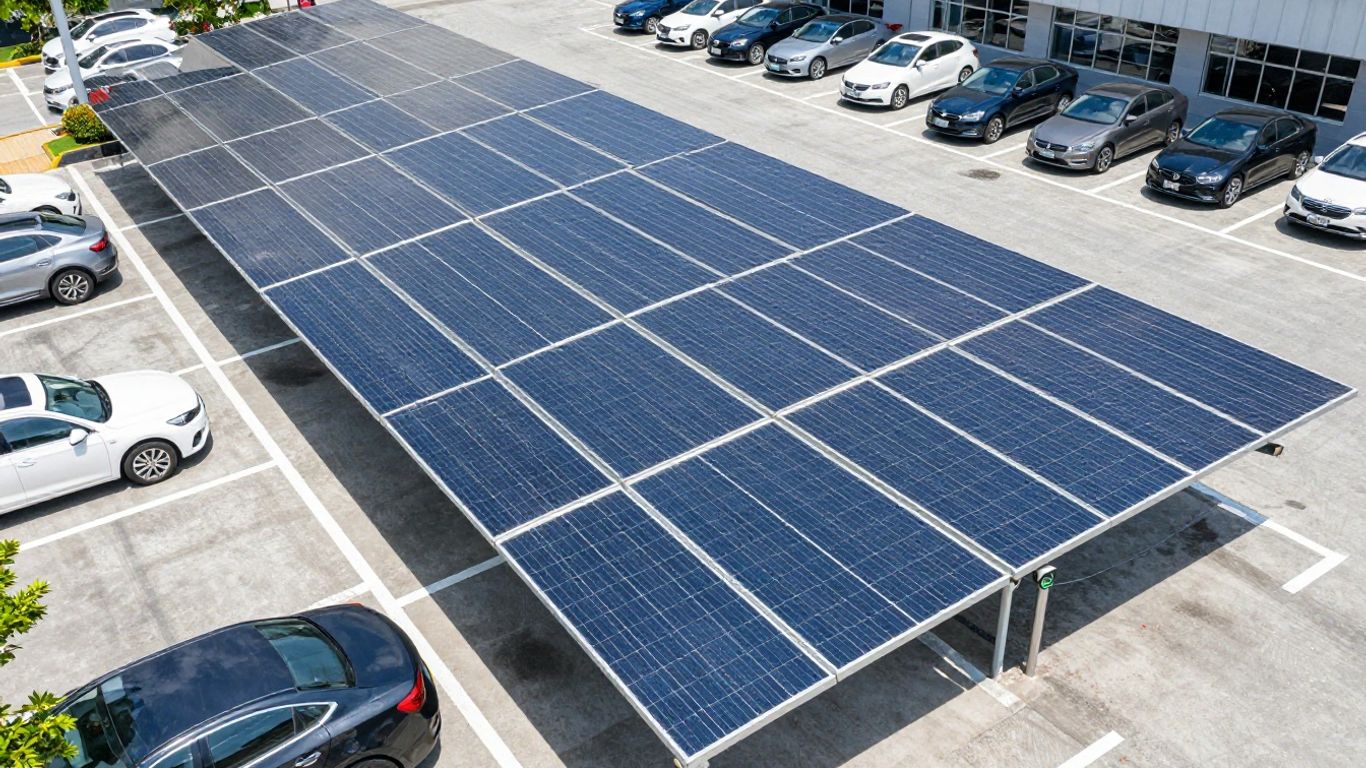
The law of 10 March 2023, often referred to as the APER law (Acceleration of Renewable Energy Production), has introduced new requirements for businesses regarding the development of their car parks. It is no longer a mere option but a legal obligation for many sites. The objective is clear: to transform these often underutilised spaces into green energy production sites. This regulation aims to significantly increase the share of renewable energy in our energy mix.
The APER Law and its Implications for Business Car Parks
The APER law mandates the installation of photovoltaic canopies on outdoor car parks of a certain size. For businesses, this means this constraint must now be integrated into their land management. The idea is to cover part of the car park’s surface with solar panels, thereby contributing to renewable electricity production. It is important to note that the law specifies how to calculate the relevant surface area: it includes parking spaces and traffic lanes, but excludes green spaces or areas designated for hazardous materials. This obligation applies to both new and existing car parks, according to defined schedules.
Compliance Deadlines Based on Car Park Size and Management
The deadlines for compliance vary depending on several criteria, notably the size of the car park and its management method (concession, public service delegation, or direct management). Here is an overview of the main milestones:
- New car parks over 1500 m²: The obligation applies from their construction.
- Concession or public service delegation car parks over 1500 m²: Compliance is required from 1 July 2026 for contracts concluded or renewed before this date.
- Directly managed car parks over 10,000 m²: The deadline is set for 1 July 2026.
- Directly managed car parks between 1500 m² and 10,000 m²: Compliance is expected by 1 July 2028.
It is also possible to pool obligations across several adjacent car parks, subject to a formal agreement. Furthermore, the law now recognises greening as a complementary shading solution, allowing it to cover part of the obligation, thereby reducing the minimum proportion of photovoltaic panels to 17.5% of the total car park area.
The APER law, supplemented by its implementing decree, clarifies the procedures for installing solar canopies on car parks. It aims to accelerate the deployment of renewable energy by transforming artificialised areas into green electricity production plants.
Financial Penalties for Non-Compliance
Failure to comply with these new rules can have significant financial consequences. Fines are provided for companies that do not comply within the stipulated deadlines. The amount of these penalties depends on the size of the car park:
- For car parks over 10,000 m²: An annual fine of €40,000 may be imposed.
- For car parks between 1500 m² and less than 10,000 m²: The fine amounts to €20,000 per year.
These financial penalties underscore the importance for businesses to take this legal obligation seriously and to anticipate the necessary steps for installing photovoltaic canopies. It is therefore advisable to consult specialists to explore the most suitable solutions for your situation and ensure your installation complies.
Benefits of a Solar Carport for Your Business
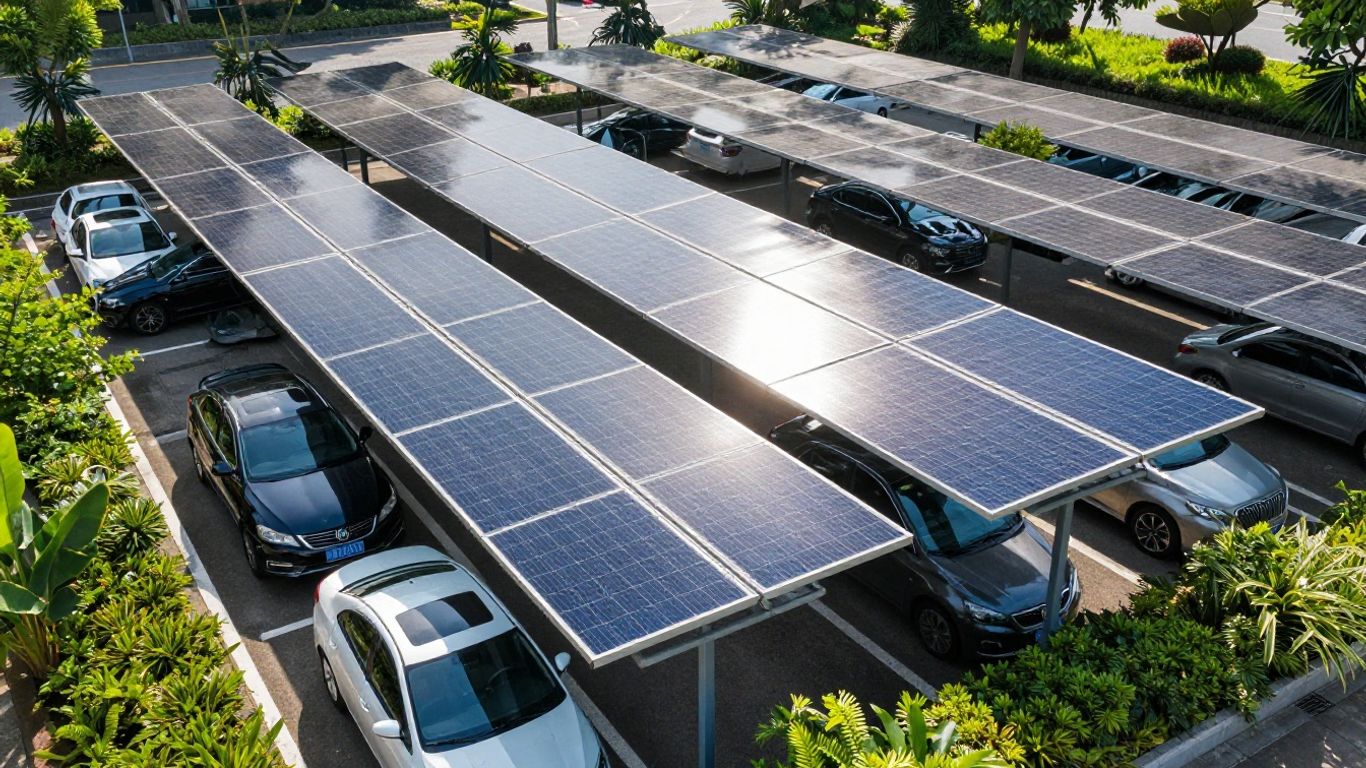
Installing solar panels on your car park is much more than just an ecological step. It is an intelligent strategy that brings tangible benefits to your business.
Significant Reduction in Energy Bills Through Self-Consumption
One of the primary advantages of a solar carport is its ability to reduce your electricity expenses. By producing your own energy, you decrease your dependence on traditional suppliers and price fluctuations. The electricity generated by the canopies can directly power your buildings, equipment, or even electric vehicle charging stations. This self-consumption allows for greater control over your operational costs.
Generation of Additional Income Through Electricity Resale
Beyond self-consumption, any surplus electricity you produce can be sold back to the grid. Electricity sales contracts exist, thus transforming your car park into a source of additional revenue. This dual valuation of the energy produced optimises the profitability of your solar project.
Enhancement of Land Value and Improved User Comfort
Photovoltaic canopies transform an often underutilised space into a productive infrastructure. They offer valuable protection for parked vehicles, shielding them from sun, rain, or hail. This improves the comfort for employees and visitors, making your site more pleasant. Furthermore, the installation of canopies can be a strong signal of your environmental commitment, enhancing your brand image.
Contribution to the Energy Transition and Carbon Footprint Reduction
By adopting solar for your car parks, you actively participate in the energy transition. You produce clean, renewable energy, thereby reducing your company’s carbon footprint. It is a concrete way to address current and future climate challenges, while anticipating regulatory changes that drive the decarbonisation of economic activities. This is a step that aligns with a sustainable vision for your development. Transforming your car park into a solar power plant is an opportunity not to be missed.
Sizing and Design of a Photovoltaic Canopy
Analysis of Solar Potential and Site Energy Needs
Before considering the physical structure, we must first look at what the sun offers and what the company needs. It’s a bit like planning a trip: you check the weather and pack your bags accordingly. For a solar canopy, this means assessing the average sunshine in the car park’s location. This data, often available from meteorological databases, tells us how much solar energy we can reasonably expect to capture over a year. We also need to consider the available space, of course, but also any shading from surrounding buildings or trees. All of this influences the number of panels we can install and their orientation.
In parallel, we need to tally the company’s electricity consumption. What does it need? When? Can the solar production cover part of this demand? The idea is to match supply (solar energy produced) with demand (company needs). Sometimes, simulation tools can be used to get a more precise idea of the expected production. This is a key step to ensure the installation will be truly useful and profitable. Specialised software can be used to assist with this calculation, such as LisePV, which helps determine the optimal panel power based on the surface area.
Sizing Canopies Based on Surface Area and Technical Constraints
Once we have an idea of the solar potential and needs, we move on to the size of the installation. The car park’s surface area is obviously the main factor. How many parking spaces need to be covered? What is the total available area for installing the structures? We also need to consider technical constraints. Are there local planning regulations that limit the height of structures? Are passages for vehicles or specific traffic lanes required? The structure must be designed to integrate as seamlessly as possible into the existing environment.
There are several types of canopies, each with its advantages:
- Canopies on posts: Very flexible, they can be installed independently and adapt to different configurations.
- Lean-to canopies: Attached to an existing building, they optimise space when the car park is close to a structure.
- Roof canopies: If the car park has a flat roof, this is an option to maximise production.
- Bioclimatic canopies: They combine solar panels with thermal regulation elements for increased comfort.
The choice will depend on the site’s configuration, budget, and objectives. We also need to consider how the panels will be fixed and the space required between them to prevent mutual shading. It’s a balance to be struck between the number of panels and the efficiency of each.
Structural Study to Ensure the Solidity of Installations
Installing solar panels on a car park means building a structure that must withstand the weather for years. It’s not just about placing panels, but designing a solid framework. This involves considering the weight of the panels, as well as the forces exerted by wind and snow. Construction standards, such as Eurocodes, are there to guide us. They define the calculations needed to ensure everything will hold up, even in extreme weather conditions.
The structural study will determine the type of materials to be used (steel, wood), the cross-section of posts and beams, and the nature of the foundations. For example, a very windy area will require a more robust structure than a more sheltered region. Future maintenance must also be considered: the structure must allow easy access for cleaning the panels and for any necessary repairs. Companies specialising in the design of metal structures can offer tools to facilitate these calculations, such as those developed by Eurocodes Tools.
The design of a photovoltaic canopy is not limited to the energy aspect; it integrates civil engineering considerations to ensure the long-term durability and safety of the installation.
Profitability and Return on Investment of a Solar Carport
Factors Influencing the Amortisation Period of Solar Panels
Installing solar panels on a car park is a bit like planting a tree: it requires an initial investment, but it pays off in the long run. The time it takes to recoup your investment, known as the return on investment (ROI), depends on several factors. Firstly, the total cost of the project, which includes the panels themselves, but also the entire canopy structure, installation, and administrative procedures. We also need to consider the power of the installation: the larger it is, the more it produces, but the more it costs upfront. The sunshine in your region also plays a role, obviously. A very sunny location will produce more electricity than a less exposed one.
Calculating Return on Investment (ROI) Based on Self-Consumption and Electricity Prices
To calculate the ROI concretely, we look at how much money the installation will save or generate for you each year. Part of the electricity produced can be consumed directly by your company; this is self-consumption. This saves you from buying this electricity from your usual supplier, and given current prices, this is a significant saving. The remainder, the surplus, can be sold back to the grid. The price at which you sell this electricity, as well as the price at which you buy the electricity you don’t produce yourself, are key elements. A large-scale project, such as a 100 kWp installation, can cost around €100,000 excluding VAT and cover approximately 500 m² of car park. The ROI is often between 6 and 10 years, depending on these different factors.
Direct self-consumption significantly reduces operational costs by decreasing reliance on the public grid.
Investment Longevity with an Installation Lifespan of 25 to 30 Years
Once you have recovered your initial investment, the installation continues to produce electricity for many years. Solar panels are designed to last between 25 and 30 years, or even longer. Throughout this period, you benefit from local, renewable energy production, which protects you from future electricity price increases. It is a form of financial security and a concrete commitment to the energy transition. Think of it as an asset that continues to generate profits long after it has been paid for. It is an investment that is built to last, offering long-term visibility on your energy costs and contributing positively to your carbon footprint. To get a more precise idea of potential revenue, a feasibility study is essential, which will take into account the available surface area and the solar potential of your site, for example by using tools like PVGIS.
Different Ways to Value the Electricity Produced
Once your photovoltaic canopy is installed, the electricity generated can be utilised in several ways. The choice of valuation model will depend on your energy needs, your business strategy, and market opportunities. It is important to fully understand these options to maximise the return on investment of your solar project.
Direct Self-Consumption Model to Reduce Operational Costs
Self-consumption involves directly consuming the electricity produced by your solar panels on your site. This means the energy produced powers your buildings, your equipment, or even electric vehicle charging stations you may install. This model allows for an immediate and significant reduction in your electricity bill, as you decrease your dependence on the public grid and traditional energy suppliers. It is a concrete way to control your operational costs and make your business more energy-independent. The self-consumption bonus can also financially support your project, especially for small and medium-sized installations.
| Installation Power | Bonus Amount (Q4 2024) |
|---|---|
| ⩽ 3 kWp | €220 / kWp |
| ⩽ 9 kWp | €160 / kWp |
| ⩽ 36 kWp | €190 / kWp |
| ⩽ 100 kWp | €100 / kWp |
Resale of Electricity Fed into the Grid
If your production exceeds your immediate needs, or if you do not wish to consume all the electricity produced, you have the option to sell it. The excess energy is fed into the public grid and sold to an authorised operator, such as EDF OA photovoltaïque. This sale is carried out under an Obligation to Purchase (OA) contract, with tariffs set by decree and updated quarterly. This option transforms your car park into a genuine source of additional income, turning a parking space into a green energy production plant. Obligation to Purchase contracts have a duration of 20 years, providing visibility on the generated revenue.
| Installation Power | Purchase Tariff (Q4 2024) – Surplus Sale | Purchase Tariff (Q4 2024) – Total Sale |
|---|---|---|
| ⩽ 3 kWp | €0.1269 | €0.1031 |
| ⩽ 9 kWp | €0.1269 | €0.0876 |
| ⩽ 36 kWp | €0.0761 | €0.1302 |
| ⩽ 100 kWp | €0.0761 | €0.1132 |
Hybrid Approaches Combining Self-Consumption and Resale
An increasing number of companies are opting for a hybrid strategy, combining the benefits of self-consumption and resale. In this model, you consume part of the electricity produced to reduce your own energy costs, and you sell the surplus electricity not consumed back to the grid. This approach allows you to benefit from both reduced expenses and additional income generation. It is also possible to consider collective self-consumption, where the electricity produced can be shared among several buildings or entities on the same site. The choice of the best strategy will depend on your consumption profile, the size of your installation, and your financial objectives. There are various deployment models, such as direct ownership or solar leasing, which can influence the profitability of your project according to your needs.
Optimising the valuation of the electricity produced is a key step. Your consumption must be precisely analysed to determine the most relevant proportion of self-consumption and the volume of surplus to be sold. A techno-economic study carried out by specialists can help you make the best choices.
Key Steps for Installing a Solar Carport
Setting up a photovoltaic canopy on your car park is a project that requires rigorous planning. It’s not just about installing panels, but about integrating a genuine energy production plant into your business environment. Here are the essential phases for successfully completing your project.
Feasibility Study and Installation Sizing
Before anything else, an in-depth analysis of your site is essential. This includes assessing the solar potential of your geographical area, the available surface area for installation, and, of course, your current and future energy needs. It is necessary to determine the amount of energy you wish to produce and whether you will opt for total self-consumption, partial self-consumption with surplus resale, or a combination of both. This initial step allows for the definition of the optimal size and configuration of your future installation. A well-conducted feasibility study guarantees a profitable project.
Administrative Procedures: Planning Permissions and Grid Connection
Once the sizing is established, you must go through the administrative formalities. Depending on the size of the installation, this may involve a declaration of works or a building permit application to your local council. In parallel, a grid connection application must be submitted to Enedis. These procedures can take time, so it is advisable to start them in advance. Support from specialists can greatly simplify these processes.
Work Phase and Commissioning of the Photovoltaic Plant
This phase includes site preparation, fabrication and installation of the canopy structures, followed by the installation of the solar panels. Then comes the electrical wiring and connection. Once the physical installation is complete, tests are carried out to verify the proper functioning of the entire system. Obtaining the Consuel Pro certificate attests to the installation’s compliance with current standards. Finally, commissioning marks the beginning of green electricity production. It is important to note that greening can be a complementary shading solution, facilitating the acceptance of projects in relation to Local Urban Planning Schemes (PLU) [49ae].
The success of a solar carport project relies on meticulous planning, a clear understanding of energy needs, and impeccable technical execution. Each step, from the initial study to administrative procedures and construction, plays a decisive role in the long-term performance and profitability of the installation.
Maintenance and Performance Monitoring of a Solar Installation
Once your photovoltaic canopy is installed, it is essential not to neglect it. Maintenance and performance monitoring are key steps to ensure your installation continues to operate optimally and produce the expected energy over the long term. It’s a bit like maintaining a car: good maintenance prevents major problems and ensures a longer lifespan.
Importance of Remote Monitoring and Management Systems
Nowadays, technology allows us to keep an eye on our solar installations without having to be physically present. Advanced monitoring systems can be implemented to track electricity production, the status of panels and inverters, and other important parameters in real-time. These systems can detect any anomaly, such as an unexplained drop in production or equipment malfunction, and alert maintenance teams. This allows for rapid intervention before a small issue becomes a major problem, which is particularly useful for large installations spread across multiple sites. The ability to manage these installations remotely is a major asset for maximising their efficiency [d98d].
Continuous Performance Optimisation to Maximise Production
Monitoring doesn’t stop at fault detection. It also involves analysing production data to identify areas for improvement. For example, regular analysis might reveal that the orientation or tilt of certain panels is no longer ideal due to environmental changes (vegetation, new nearby buildings). Even minor adjustments can sometimes have a significant impact on overall yield. The goal is to ensure that each solar panel contributes as much as possible to green energy production.
Ensuring the Proper Functioning of the Electrical Infrastructure
Beyond the panels themselves, the associated electrical infrastructure (cabling, inverters, protection systems) also requires attention. Regular inspections, whether visual or technical, are necessary to check the integrity of components and prevent electrical risks. Preventive maintenance, which includes cleaning the panels to remove dust and debris, is also a common practice to maintain a good level of production [258f].
Here is an overview of common maintenance tasks:
- Cleaning of solar panels.
- Visual inspection of structures and cabling.
- Checking inverters and junction boxes.
- Performance tests and comparison with historical data.
- Updating monitoring software if necessary.
Regular and proactive maintenance is key to ensuring the profitability and durability of your investment in a solar car park installation. Neglecting this step risks seeing energy production decrease and operating costs increase in the long run.
Adaptation of Regulations and Legislative Loopholes
The regulatory framework surrounding solar car parks has undergone notable adjustments, aiming to clarify and sometimes simplify obligations for businesses. These legislative developments are important to understand to ensure compliance and optimise projects.
Clarifications Provided by the APER Law’s Implementing Decree
Decree No. 2024-1023, published on 13 November 2024, has provided significant clarification on the application of Article 40 of the APER law. It more precisely defines the surface area subject to the obligation to install photovoltaic canopies, targeting outdoor car parks exceeding 1500 m². This decree also details possible exemption criteria, offering some flexibility to car park managers. It should be noted that the APER law makes the installation of photovoltaic canopies mandatory on car parks over 1,500 m² on at least 50% of the surface area.
The compliance deadlines have been specified:
- Immediately for car parks that filed a planning application after 10 March 2023.
- 1 July 2026 for car parks over 10,000 m².
- 1 July 2028 for car parks between 1500 m² and 10,000 m².
Recognition of Greening as a Complementary Shading Solution
A notable development is the official recognition of greening as a means of meeting the shading obligation. Henceforth, vegetated structures such as trees or vegetated pergolas can be taken into account in the calculation of the shaded area. The Huwart law, promulgated in October 2025, has notably relaxed these requirements by amending Article 40 of the APER law. This allows for the reduction of the minimum proportion of photovoltaic panels to 17.5% of the total car park area, with the remaining 32.5% being covered by vegetated solutions, provided they offer equivalent shading.
Securing Projects Against Local Urban Planning Schemes (PLU)
The Huwart law also strengthens the primacy of national law over local regulations. Local Urban Planning Schemes (PLU) can no longer oppose or limit the installation of photovoltaic canopies or vegetated structures. This provision secures projects, even in municipalities with stricter urban planning or landscape rules, thus offering greater predictability for investors. Building permits are now only required for large installations (over 3 MWp) or those located in protected areas; others require a simple prior declaration.
These regulatory adjustments aim to encourage the deployment of renewable energy while taking into account the technical and economic constraints of projects. They reflect a desire to adapt legislation to on-the-ground realities and accelerate the energy transition.
The Potential of Car Parks to Accelerate the Energy Transition
Contribution of Solar Car Parks to Renewable Energy Development
Car parks, often perceived as mere parking spaces, actually represent a considerable opportunity for the development of renewable energy. By installing photovoltaic canopies, these artificialised surfaces are transformed into genuine green energy production plants. The French Environment and Energy Management Agency (Ademe) estimates the potential for photovoltaic deployment on car parks at around 4 GWp. This is a significant share that can actively contribute to our energy transition objectives. These installations allow for the valorisation of existing land without encroaching on other areas, such as agricultural land or natural zones.
Synergy with the Installation of Charging Stations for Electric Vehicles
The installation of solar canopies on car parks creates a natural synergy with the development of electric mobility. Locally produced electricity from the panels can directly power charging stations installed on the same site. This not only allows for offering a service appreciated by employees and customers but also reduces the operational costs associated with vehicle charging. It is a concrete way to promote the use of electric vehicles while producing the energy needed for their operation in a clean manner. This combination offers a complete and sustainable energy solution.
Valorisation of Artificialised Areas into Green Energy Production Plants
Transforming car parks into solar power plants is an intelligent approach that gives new life to often underutilised surfaces. Instead of remaining mineralised areas, they become players in renewable energy production. This fits perfectly within a sustainable development and circular economy approach. Businesses can thus comply with regulatory obligations, such as those imposed by the APER law, while generating additional income through the resale of surplus electricity or by reducing their own energy bills. It is a transformation that benefits both the company and the environment. The installation of photovoltaic canopies on car parks is an energy opportunity to seize now [45cd].
Choosing the Right Partner for Your Solar Carport Project
Installing photovoltaic canopies on your car park is a process that requires a certain level of expertise. It’s not just a matter of placing panels over cars. You need to consider the structure, integration with your building, energy production, and of course, profitability. This is where a good partner becomes indispensable.
The Importance of Engaging Photovoltaic Solution Specialists
Embarking on a solar carport project without professional help is a bit like trying to build a house without an architect. You risk making costly mistakes. Specialists understand the technical subtleties, current regulations, and know how to optimise your installation for maximum energy production. They can also help you understand the different options, such as self-consumption or selling surplus electricity. A well-designed installation from the outset is the key to a successful project. They are up-to-date with the latest developments, such as the APER law which makes these installations mandatory for car parks over 1500 m² [a9cf].
Selection Criteria for a Turnkey Provider
When looking for a partner, consider what they concretely offer. A turnkey solution is often the simplest: it covers everything, from the initial study to maintenance. Here are a few points to check:
- Experience and References: Have they already completed similar projects? Ask to see examples.
- Range of Services: Do they offer a feasibility study, installation, maintenance, and performance monitoring?
- Guarantees: What guarantees do they offer on the panels, installation, and energy production?
- Administrative Support: Can they assist you with the administrative procedures, which can be complex?
- Flexibility: Are they able to adapt to the specificities of your site and your energy needs?
Choosing the right provider ensures that your investment will be profitable and that your installation will operate optimally for many years. It is a partnership that should inspire confidence.
Ensuring the Performance and Profitability of Your Solar Installation
A good partner doesn’t just install the panels and leave. They ensure your installation continues to function at its best. This involves regular performance monitoring, preventive maintenance to avoid breakdowns, and adjustments if necessary. They can also advise you on possible developments, such as adding electric vehicle charging stations, which integrate perfectly with solar canopies. The goal is to maximise your return on investment [acda].
Finding the right partner for your solar carport project is like choosing the right teammate for a football team: you need someone reliable who knows the game. A good partner will help you navigate the procedures, understand the rules, and ensure your project shines under the sun. Don’t leave your success to chance. To find the ideal partner who will transform your car park into a source of green energy, visit our website today and discover how we can help you make the right choice.
Conclusion: A Strategic Investment for the Future
In summary, installing a solar carport represents much more than simply complying with the law. It is a proactive approach that allows businesses to reduce their energy costs, enhance their property assets, and actively contribute to the ecological transition. Although the initial investment may seem significant, the long-term benefits, both economic and environmental, make it a wise strategy. It is advisable to carefully study your project and seek professional guidance to optimise its profitability and ensure compliance with current regulatory requirements.
Frequently Asked Questions
Am I obliged to install solar panels on my car park?
The law requires the installation of solar panels, known as photovoltaic canopies, on car parks exceeding 1500 m². A portion of the surface must be covered by these installations. The precise rules and deadlines depend on the size of your car park and how it is managed.
What are the benefits of having solar panels on my car park?
Installing solar panels on your car park allows you to produce your own electricity, which reduces your bills. You can also earn money by selling unused electricity. Furthermore, it protects cars from sun and rain, and shows that your company is committed to the environment.
How long does it take for the installation to become profitable?
The time it takes for the installation to become profitable, i.e., to recoup the invested sum, varies. It depends on the amount of electricity produced, the price of electricity, and how you use this electricity. Generally, it takes between 6 and 10 years, and after that, the panels continue to produce electricity for many years.
What happens if I don’t comply with the law on solar panels?
If you do not comply with the rules regarding the installation of solar panels on your car park, you risk fines. The amount of the fine depends on the size of your car park. It is therefore important to comply to avoid these penalties.
How do I choose the right company to install solar panels?
It is advisable to choose a company specialising in photovoltaic solutions for businesses. Ensure it offers a comprehensive package, from the study to the installation. Check its references and request a detailed quote to guarantee the quality and profitability of your project.
Can I use the electricity produced to charge electric cars?
Absolutely! Photovoltaic canopies are perfect for powering electric vehicle charging stations. It is an excellent way to offer an additional service to your customers or employees while using the solar energy you produce.
What is self-consumption?
Self-consumption means you directly consume the electricity you produce with your solar panels. Instead of selling it, you use it to power your buildings or equipment. This further reduces your electricity bills.
Does the law allow for solutions other than solar panels for shading the car park?
Yes, the law has been clarified. In addition to solar panels, you can use vegetated solutions, such as trees or pergolas with vegetation, to provide shade. These solutions can complement solar panels to meet the shading obligation.

Journaliste spécialisée en transition énergétique et consultante RSE. À 42 ans, Claire combine une formation en journalisme (Master Sciences Po) et un diplôme d’ingénierie environnementale (École des Mines / INSA). Après 10 ans dans la presse économique et 7 ans en cabinet de conseil RSE, elle écrit pour aider les décideurs B2B à comprendre les réglementations, les enjeux climatiques et les innovations énergétiques.